

 대표어
권호기사보기
| 기사명 | 저자명 | 페이지 | 원문 | 기사목차 |
|---|
결과 내 검색
동의어 포함
목차
표제지=0,1,1
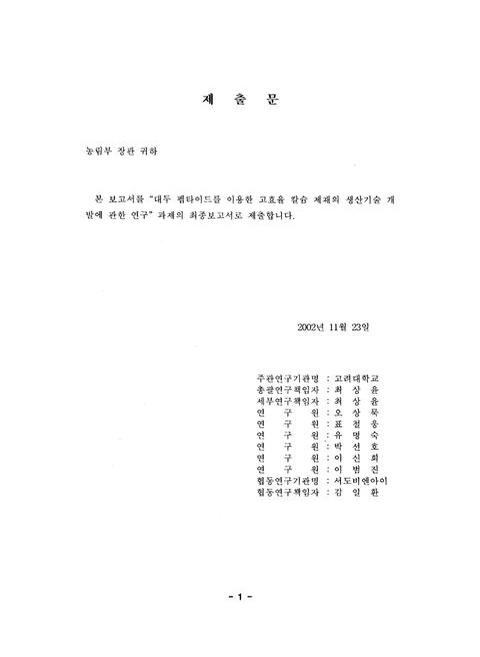
제출문=1,2,1
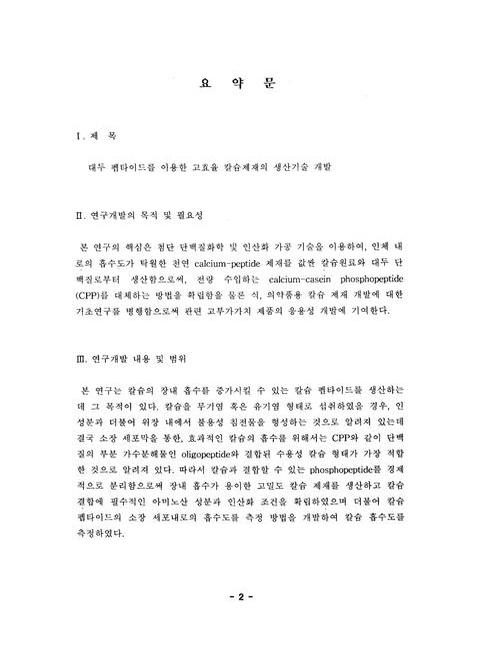
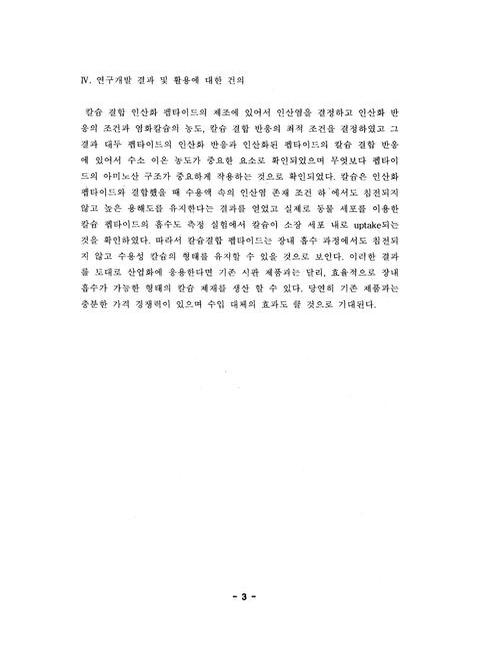
요약문=2,3,2
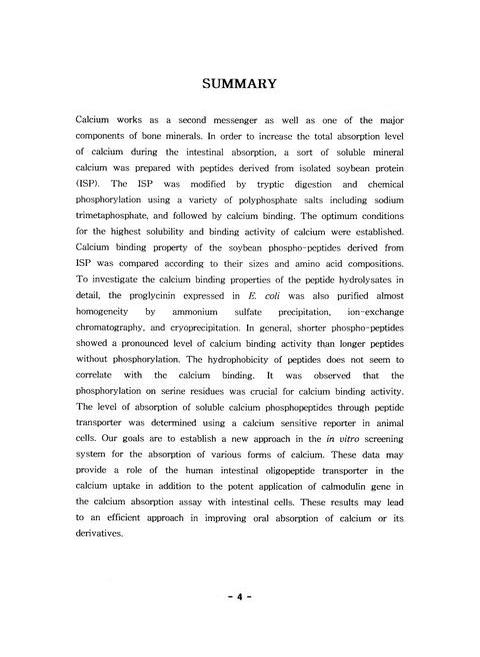
SUMMARY=4,5,1
CONTENTS=5,6,4
목차=9,10,4
List of Tables=13,14,2
List of Figures=15,16,3
제1장 연구개발과제의 개요=18,19,1
1절 연구개발의 목적 및 필요성=18,19,1
1. 기술적 측면=18,19,3
2. 경제 산업적 측면=20,21,1
3. 사회 문화적 측면=20,21,2
2절 연구 개발의 범위=21,22,2
제2장 국내외 기술개발 현황=23,24,1
1절 국내의 관련분야에 대한 기술 개발 현황=23,24,1
2절 연구 결과가 국내외 기술 개발 현황에서 차지하는 위치=24,25,3
제3장 연구 개발수행 내용 및 결과=27,28,1
1절 칼슘 결합 인산화 펩타이드의 제조=27,28,1
1. 실험적 접근 방법 및 연구내용=27,28,1
가. 원료 단백질의 분리 정제=27,28,2
나. 분리 대두 단백(ISP) 용액의 용해도를 높이기 위한 최적 조건 확립=28,29,5
다. 가수분해 효소를 이용한 인산화 대두 펩타이드(SPP) 생산=32,33,5
라. 대두 단백질의 인산화=36,37,5
마. 칼슘 결합 반응의 조건 확립=40,41,3
바. Affinity chromatography를 이용한 proglycinin 유래의 phosphopeptide의 분리=42,43,3
사. 우수칼슘결합성 대두 펩타이드의 대량 확보=44,45,2
2. 연구결과=45,46,1
가. 원료 단백질의 분리 정제=45,46,1
나. ISP 용액의 용해도를 높이기 위한 최적 조건 확립=45,46,4
다. 가수분해 효소를 이용한 인산화 대두 펩타이드(SPP)의 생산=48,49,24
라. 대두 단백질의 인산화=71,72,12
마. 칼슘 결합 반응의 조건 확립=83,84,13
바. IMAC를 이용한 proglycinin 유래의 phosphopeptide의 분리=95,96,1
1) phosphopeptide의 분리=95,96,4
2) proglycinin phosphopeptide의 칼슘 결합능 측정=98,99,8
2절 인산화 펩타이드의 인산칼슘 침전 저해=106,107,1
1. 실험적 접근 방법 및 연구내용=106,107,2
2. 연구 결과=107,108,1
가. 인산화 펩타이드의 인산칼슘 침전 저해:P-Ser and P-SerSerSer vs. Ser and SerSerSer=107,108,1
나. 인산화 펩타이드의 인산칼슘 침전 저해:P-13 amino acids vs. 13 amino acids=107,108,11
다. 인산화 펩타이드의 인산칼슘 침전 저해:P-ISP hydrolysates vs. ISP hydrolysates=117,118,11
3절 동물 및 조직 배양에 의한 칼슘 펩타이드의 흡수도=128,129,1
1. 실험적 접근 방법 및 연구 내용=128,129,2
가. 조직배양=129,130,1
나. Plasmids=129,130,1
다. Transient transfection=129,130,2
라. Stable transfection=130,131,1
마. Cell treatment=131,132,1
바. Luciferase assay=131,132,1
2. 연구 결과=131,132,1
가. EDTA의 농도 결정=132,133,1
나. Ca-P-SerSerSer의 흡수도 측정=132,133,7
다. Ca-P-Ser의 흡수도 측정=139,140,10
제4장 목표달성도 및 관련분야에의 기여도=149,150,1
1절 1차년도=149,150,1
1) 연구개발 목표=149,150,2
2) 연구 평가의 착안점=151,152,1
3) 연구 개발 목표의 달성도=151,152,3
4) 관련분야의 기술 발전에의 기여도=153,154,2
2절 2차년도=154,155,1
1) 연구개발 목표=154,155,2
2) 연구 평가의 착안점=156,157,1
3) 연구 개발 목표의 달성도=156,157,3
4) 관련분야의 기술 발전에의 기여도=158,159,2
3절 3차년도=159,160,1
1) 연구개발 목표=159,160,2
2) 연구 평가의 착안점=160,161,1
3) 연구 개발 목표의 달성도=160,161,4
4) 관련분야의 기술 발전에의 기여도=164,165,1
제5장 연구개발결과의 활용계획=165,166,1
1절 추가 연구의 필요성=165,166,2
2절 타 연구에의 응용=166,167,1
3절 기업화 추진 방안=166,167,3
제6장 연구개발과정에서 수집한 해외과학기술정보=169,170,2
제7장 참고문헌=171,172,8
영문목차
[title page etc.]=0,1,5
CONTENTS=5,6,13
Chapter 1. Outline of the report on development of research=18,19,1
I. Objects and necessities of the development of research=18,19,1
1. Technical aspects=18,19,3
2. Economic industrial aspects=20,21,1
3. Social cultural aspects=20,21,2
II. Scope of the studies=21,22,2
Chapter 2. Status of the development of techniques domestically and at overseas=23,24,1
I. Status of the development of related techniques within the country and at overseas=23,24,1
II. Position of the outcome of the research at the present status of progress=24,25,3
Chapter 3. Contents and products of the development of research=27,28,1
I. Production of calcium bound phosphopeptide=27,28,1
1. Approach of the experiment and contents of the research=27,28,1
a. Separation and purification of the protein=27,28,2
b. Establishment of the conditions for the higher solubility of isolated soybean protein(ISP)=28,29,5
c. Production of phospho-soybean peptide(SPP) using enzymatic hydrolysis=32,33,5
d. Phosphorylation of ISP=36,37,5
e. Establishment of the conditions for the calcium binding reactions=40,41,3
f. Separation of phosphopeptide from proglycinin using IMAC=42,43,3
g. Gene cloning of calcium binding peptide=44,45,2
2. Results of the studies=45,46,1
a. Separation and purification of the protein=45,46,1
b. Establishment of the conditions for the higher solubility of isolated soybean protein(ISP)=45,46,4
c. Production of soybean phospho-peptide(SPP) using enzymatic hydrolysis=48,49,24
d. Phosphorylation of ISP=71,72,12
e. Establishment of the conditions for the calcium binding reactions=83,84,13
f. Separation of phosphopeptide from proglycinin using IMAC=95,96,1
(i) separation of phosphopeptide=95,96,4
(ii) Measurement of calcium bindings to phosphopeptide from proglycinin=98,99,8
II. Inhibition of calcium phosphate precipitation by phosphopeptide=106,107,1
1. Approach of the experiment and contents of the research=106,107,2
2. Results of the research=107,108,1
a. Inhibition of calcium phosphate precipitation by phosphopeptide:P-Ser and P-SerSerSer vs. Ser and SerSerSer=107,108,1
b. Inhibition of calcium phosphate precipitation by phosphopeptide:P-13 amino acids vs. 13 amino acids=107,108,11
c. Inhibition of calcium phosphate precipitation by phosphopeptide:P-ISP hydrolysates vs. ISP hydrolysates=117,118,11
III. Absorption of the calcium peptide=128,129,1
1. Approach of the experiment and contents of the research=128,129,2
a. Tissue culture=129,130,1
b. Plasmids=129,130,1
c. Transient transfection=129,130,2
d. Stable transfection=130,131,1
e. Cell treatment=131,132,1
f. Luciferase assay=131,132,1
2. Result of the research=131,132,1
a. Determination for concentration of EDTA=132,133,1
b. Absorption of Ca-P-SerSerSer=132,133,7
c. Absorption of Ca-P-Ser=139,140,10
Chapter 4. Achievements and contributions of the studies to the related fields=149,150,1
I. The first year of the study=149,150,1
1. Goal of the study=149,150,2
2. Standpoints of evaluation=151,152,1
3. Accomplishment of the studies=151,152,3
4. Contributions to technical development in related areas=153,154,2
II. The second year of the study=154,155,1
1. Goal of the study=154,155,2
2. Standpoints of evaluation=156,157,1
3. Accomplishment of the studies=156,157,3
4. Contributions to technical development in related areas=158,159,2
III. The third year of the study=159,160,1
1. Goal of the study=159,160,2
2. Standpoints of evaluation=160,161,1
3. Accomplishment of the studies=160,161,4
4. Contributions to technical development in related areas=164,165,1
Chapter 5. Plans for the application of the research=165,166,1
I. Necessities for further studies=165,166,2
II. Applications to other studies=166,167,1
III. Plans for industrialization=166,167,3
Chapter 6. Informations on scientific techniques at overseas=169,170,2
Chapter 7. Reference=171,172,8
1. Simplified separation process of glycinin and β-conglycinin=29,30,1
2. Production process of soy protein isolate in pilot-plant scale=30,31,1
3. Modified separation process of glycinin and β-conglycinin in pilot-plant scale=31,32,1
4. STMP에 의한 인산화 과정=37,38,1
5. SDS-PAGE analysis of proglycinin samples at different stages of the purification=46,47,1
6. ISP 농도에 따른 단백질의 용해도=50,51,1
7. 용해도 시간에 따른 단백질의 용해도=52,53,1
8. pH에 따른 단백질의 용해도=54,55,1
9. Determination of isoelectric point of phosphorylated proglycinin=56,57,1
10. Calcium binding activity of phosphorylated tryptic hydrolysates=57,58,1
11. Calcium binding activity of non-phosphorylated and phosphorylated tryptic hydrolysates=58,59,1
12. 인산화후 효소 트립신의 잔여 활성도 측정=60,61,1
13. Calcium binding ability of phosphorylated ISP hydrolysates prepared by the reaction with a variety of phosphorylating agents=73,74,1
14. Effect of pH on phosphorylation level (A,B)=78,79,2
15. Effect of pH and STMP concentration on phosphorylation level (A,B)=81,82,2
16. Effect of phosphorylation on calcium binding=89,90,1
17. Calcium binding ability depending on level of phosphorylation (A,B)=91,92,2
18. Effect of pH on Calcium binding (A,B)=93,94,2
19. Calcium binding ability depending on various concentration of CaCl2=96,97,1
20. Fractionation of phosphorylated proglycinin on a HiTrap Chelating by FPLC system=97,98,1
21. Fractionation of phosphorylated proglycinin hydrolysates on a HiTrap Chelating by FPLC system=99,100,1
22. Calcium binding activity of IMAC fraction (E:S=1:1000)=100,101,1
23. Ion exchange chromatography of bound fraction on IMAC chromatography=101,102,1
24. Calcium binding activity of Mono Q fraction=102,103,1
25. 합성펩타이드의 칼슘결합도=105,106,1
26. The inhibition of calcium phosphate precipitation (Ser)=109,110,1
27. The inhibition of calcium phosphate precipitation (P-Ser)=111,112,1
28. The inhibition of calcium phosphate precipitation (SSS)=113,114,1
29. The inhibition of calcium phosphate precipitation (P-SSS)=115,116,1
30. Effect of phosphorylation on the inhibition of calcium phosphate precipitation in in vitro calcium binding assay=116,117,1
31. The inhibition of calcium phosphate precipitation (13 amino acids)=119,120,1
32. The inhibition of calcium phosphate precipitation (P-13 amino acids)=121,122,1
33. Inhibition of calcium phosphate precipitation by a moderate size of phosphopeptide in in vitro calcium binding assay=122,123,1
34. The inhibition of calcium phosphate precipitation (ISP hydrolysate)=124,125,1
35. The inhibition of calcium phosphate precipitation (P-ISP hydrolysate)=126,127,1
36. Inhibition of calcium phosphate precipitation by phosphopeptides with multiple sizes in in vitro Calcium binding assay=127,128,1
37. EDTA 농도(0mM-0.6mM)에 따른 칼슘의 Chelating=134,135,1
38. EDTA 농도(0mM-2mM)에 따른 칼슘의 Chelating=136,137,1
39. Expression of calcium dependent calmodulin-luciferase in response to extracellular concentration of P-Ser-Ser-Ser-Ca=138,139,1
40. Expression of calmodulin-luciferase in response to extracellular concentration of P-Ser-Ca=141,142,1
41. Expression of calmodulin-luciferase by the amount of P-Ser-Ca uptaken through cellular membrane (Caco-2 cells)=143,144,1
42. Expression of calmodulin-luciferase by the amount of P-Ser-Ca uptaken through cellular membrane (HEK 293T cells)=145,146,1
43. Expression of calmodulin-luciferase by the amount of P-Ser-Ca uptaken through cellular peptide transporter=147,148,1
44. Mechanism of phosphorylation and calcium binding of soybean peptide=148,149,1
*표시는 필수 입력사항입니다.
| 전화번호 |
|---|
| 기사명 | 저자명 | 페이지 | 원문 | 기사목차 |
|---|
| 번호 | 발행일자 | 권호명 | 제본정보 | 자료실 | 원문 | 신청 페이지 |
|---|
도서위치안내: / 서가번호:

우편복사 목록담기를 완료하였습니다.
*표시는 필수 입력사항입니다.
저장 되었습니다.
