
 대표어
대표어




권호기사보기
| 기사명 | 저자명 | 페이지 | 원문 | 기사목차 |
|---|
결과 내 검색
동의어 포함
목차
표제지=0,1,1
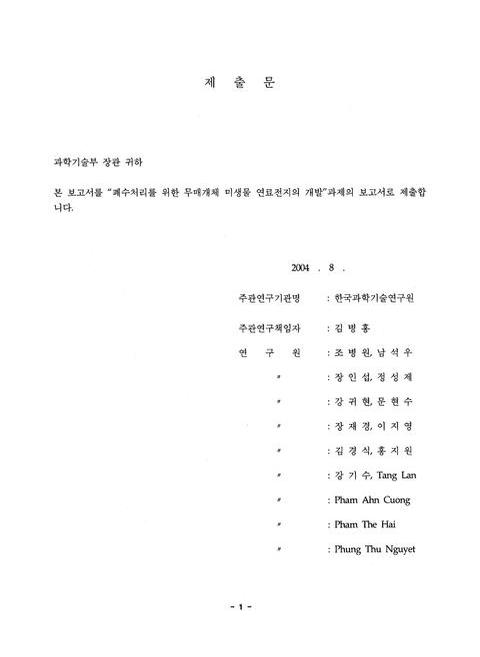
제출문=1,2,2
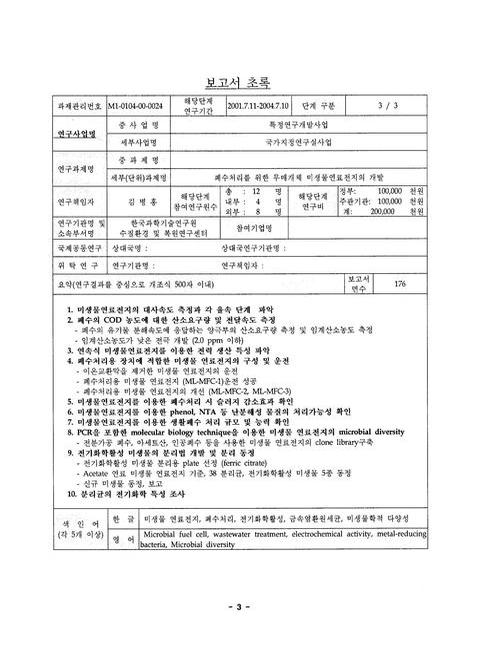
보고서 초록/김병홍=3,4,2
요약문=5,6,4
SUMMARY=9,10,4
CONTENTS=13,14,6
목차=19,20,6
제1장 연구개발과제의 개요=25,26,1
제1절 연구의 배경 및 필요성=25,26,2
제2절 연구의 추진 전략 및 체계=26,27,1
1. 폐수처리용 생물연료전지=26,27,2
2. 전기화학활성미생물=27,28,2
3. 전기화학활성미생물의 분리와 molecular microbial ecology=28,29,2
4. Confocal scanning laser microscopy와 생화학 실험=29,30,2
제2장 국내외 관련분야의 환경 변화=31,32,4
제3장 연구개발 수행 내용 및 결과=35,36,1
제1절 미생물 연료전지의 성능 최적화=35,36,1
1. 미생물연료전지의 양극반응=35,36,1
가. 서론=35,36,3
나. 실험 재료 및 방법=38,39,1
(1) 폐수=38,39,2
(2) 미생물 연료전지=39,40,2
(3) Chemicals=40,41,2
(4) 전극의 회수와 전자현미경=41,42,1
(5) Platinum coated graphite electrode=41,42,1
(6) Dissolved oxygen (DO) monitoring=41,42,1
(7) 기타 분석=42,43,1
다. 결과=42,43,1
(1) 미생물 연료전지=42,43,4
(2) 미생물연료전지에서 양극부 전극의 임계산소농도 측정=45,46,4
(3) Cathode mediator의 사용=48,49,5
라. 결론=52,53,2
2. 연속식 미생물연료전지를 이용한 전력 생산 특성=54,55,1
가. 서론=54,55,1
나. 실험 재료 및 방법=54,55,1
(1) 미생물연료전지와 운전=54,55,2
(2) 폐수=55,56,1
다. 실험 결과=55,56,1
(1) 전력 생산에 대한 백금 코팅의 영향=55,56,2
(2) 전력 생산에 대한 폐수 농도의 영향=56,57,2
(3) 전력 생산에 대한 폐수 공급 속도의 영향=57,58,3
(4) 전력 생산에 대한 온도의 영향=59,60,1
(5) Sensor-type과 C-type과의 성능 비교=59,60,3
(6) C-type 성능에 대한 온도 및 폐수 loading rate의 영향=61,62,1
(7) C-tyre performamce에 대한 catholyte의 영향=61,62,3
라. 고찰=63,64,1
(1) Cathode system 설계=63,64,1
(2) 연료전지의 flow channel 설계와 물질 전달=63,64,1
(3) 기존 미생물연료전지와의 비교=63,64,2
3. 공기호흡형 미생물 연료전지의 단위 셀 성능 시험=65,66,1
가. 서론=65,66,1
나. 실험 재료 및 방법=65,66,1
(1) 공기호흡형 미생물연료전지=65,66,2
(2) Membrane electrode assembly=66,67,2
(3) 접종=67,68,1
(4) 농화배양=67,68,1
다. 실험 결과=67,68,1
(1) 농화배양=67,68,2
(2) Aeration의 영향=68,69,2
(3) 공기호흡형 미생물 연료전지의 전력 밀도=69,70,2
(4) 나피온 막을 통한 양이온 이동=70,71,1
라. 고찰=70,71,1
(1) 공기호흡형 미생물연료전지의 전류밀도=70,71,1
(2) 공기호흡형 미생물연료전지의 flooding problem=71,72,1
제2절 폐수처리용 미생물 연료전지=72,73,1
1. 막없는 미생물연료전지의 개발 및 성능 최적화=72,73,1
가. 서론=72,73,1
나. 실험 재료 및 방법=72,73,1
(1) ML-MFC 의 구조 및 운전조건=72,73,2
(2) 폐수 및 시약=74,75,1
(3) Cyclic voltammetry (CV)=74,75,1
(4) 전류측정 및 coulomb 계산=74,75,1
(5) Platinum-coated electrode 제작(ML-MFC-2,3)=74,75,1
(6) Separator의 전류 발생에 미치는 영향(ML-MFC-2)=74,75,2
다. 결과 및 고찰=75,76,1
(1) 막 없는 미생물연료전지 운전=75,76,2
(2) Aeration의 영향=76,77,3
(3) 폐수의 공급 속도에 대한 영향=78,79,2
(4) 폐수의 공급 농도에 대한 영향=79,80,4
(5) 음극부와 양극부 사이의 거리에 대한 영향=82,83,2
(6) 폐수 처리용 미생물연료전지의 특성=83,84,2
(7) Cyclic voltamogram=84,85,2
(8) NaCl과 acidification의 영향=85,86,2
(9) 미생물연료전지의 구조개선 (ML-MFC-2)=87,88,2
(가) ML-MFC-2의 운전=88,89,2
(나) 폐수 loading rate에 따른 전류발생 및 쿨롬 수율=89,90,3
(다) Separator의 영향=91,92,2
(라) 백금 loading양의 영향=92,93,5
라. 결론=96,97,1
2. 막없는 미생물 연료전지의 유체 흐름 특성 및 전기 생산과 폐수처리에 대한 영향=97,98,1
가. 서론=97,98,1
나. 실험재료 및 방법=97,98,1
(1) Residence time distribution (RTD) test 용 cell=97,98,2
(2) Step respose test=98,99,1
(3) ML-MFC-3=98,99,2
(4) 농화배양=99,100,1
다. 실험 결과=100,101,1
(1) 동일 전극 높이에서의 RTD curve 특성=100,101,1
(2) 동일 전극 무게에서의 RTD curve 특성=100,101,2
(3) RTD에 대한 flow rate의 영향=101,102,2
(4) Flow model을 이용한 data fitting=102,103,3
(5) 농화배양=104,105,1
(6) 농화배양 후 RTD 특성=104,105,2
(7) ML-MFC-3에 대한 fuel loading rate의 영향=105,106,1
(8) Polarization curve 특성=105,106,2
(9) 동특성=106,107,2
라. 고찰=107,108,1
(1) Perforated와 Normal graphite felt의 성능 비교=107,108,1
(2) ML-MFC-2와의 성능 비교=107,108,2
(3) MFC간 성능 비교=108,109,2
(4) Actlvated sludge process와의 비교=109,110,1
3. 미생물연료전지에서의 슬러지 발생=110,111,1
가. 서론=110,111,2
나. 실험방법 및 재료=111,112,1
(1) 미생물연료전지=111,112,2
(2) 인공폐수=112,113,2
(3) 단백질 분석=113,114,1
(4) Suspended solid (SS)=113,114,1
(5) COD=113,114,1
다. 실험 결과=113,114,1
(1) ML-MFC-2의 SS와 단백질 생성량=113,114,3
(2) Graphite cloth 사용=115,116,2
라. 결론=116,117,2
제3절 미생물연료전지를 이용한 난분해성 물질의 분해=118,119,1
1. 서론=118,119,1
2. 실험 재료 및 방법=118,119,1
가. 폐수 및 슬러지=118,119,2
나. 미생물 연료 전지=119,120,1
다. 석유화학폐수 분석=119,120,1
라./다 페놀 및 nitrilotriacetate (NTA) 분석=119,120,1
3. 결과 및 고찰=119,120,1
가. 미생물연료전지에 의한 페놀 분해=119,120,3
나. 저영양성 미생물연료전지를 이용한 NTA 분해=121,122,2
다. 고영양성 미생물연료전지를 이용한 NTA 분해=122,123,2
라. 강물로 농화 배양한 미생물연료전지를 이용한 NTA 분해=123,124,1
마. 미생물연료전지를 이용한 석유화학폐수의 처리=123,124,5
제4절 미생물 연료전지의 microbial diversity=128,129,1
1. 연구 내용=128,129,2
2. 실험 재료 및 방법=130,131,1
가. 사용 연료 및 미생물 연료전지=130,131,1
나. Biodiversity and taxonomy of microbial populations in the MFC=130,131,1
(1) Genomic DNA extraction from microbial community=130,131,1
(2) Polymerase chain reaction(PCR) of 16S rDNA=130,131,2
(3) Cloning of 16S ribosomal DNA gene=131,132,1
(4) Transformation into competent cell,E.coli=131,132,1
(5) Purification of plasmid DNA=132,133,1
(6) Restriction fragment length polymorphism(RFLP) analysis=132,133,1
(7) Sequencing of plasmid DNA=132,133,1
(8) Construction of phylogenetic tree=132,133,2
다. Denaturing gradient gel electrophoresis (DGGE)=133,134,2
3. 실험 결과 및 고찰=135,136,1
가. 미생물의 형태학적 관찰=135,136,1
나. 165-rDNA 증폭과 RFLP analysis=135,136,2
다. DGGE(Denaturing gradient gel electrophoresis)=136,137,3
라. 미생물연료전지의 미생물 다양성의 분석=138,139,4
마. Construction of phylogenetic tree of MFCs=141,142,6
제5절 전기화학활성미생물의 분리,동정 및 전기화학활성 측정=147,148,1
1. 연구내용 및 결과=147,148,1
가. 미생물의 분리 및 전기화학활성=147,148,3
나. 미생물의 동정=149,150,8
다. 전기화학 활성 분리균을 이용한 생물연료전지의 운전=157,158,1
라. Electron transfer inhibitor의 영향=157,158,2
2. 고찰=159,160,2
제4장 목표 달성도 및 관련 분야에의 기여도=161,162,4
제5장 연구 개발 결과의 활용계획=165,166,2
제6장 연구개발 과정에서 수집한 해외과학기술정보=167,168,2
제7장 참고 문헌=169,170,6
특정연구개발사업 연구결과 활용계획서/김병홍=175,176,13
영문목차
[title page etc.]=0,1,13
CONTENTS=13,14,12
Chapter 1 Outline of research project=25,26,1
Section 1 Backgrounds & Necessity=25,26,2
Section 2 Research strategy=26,27,1
1. Microbial fuel cell for wastewater treatment=26,27,2
2. Electrochemically active bacteria=27,28,2
3. Isolation of electrochemically active bacteria and molecular microbial ecology=28,29,2
4. Confocal laser scanning microscopy and biochemical tests=29,30,2
Chapter 2 Current status of R&D activities=31,32,4
Chapter 3 Contents and results=35,36,1
Section 1 Optimization of microbial fuel cell performance=35,36,1
1. Microbial fuel cell and cathode reaction=35,36,1
A. Introduction=35,36,3
B. Materials and methods=38,39,1
(1) Wastewater=38,39,2
(2) Microbial fuel cell=39,40,2
(3) Chemicals=40,41,2
(4) Electrode recovery and microscopy=41,42,1
(5) Platinum coated graphite electrode=41,42,1
(6) Dissolved oxygen (DO) monitonng=41,42,1
(7) Other analyses=42,43,1
C. Results=42,43,1
(1) Microbial fuel cell=42,43,4
(2) Measurement of critical oxygen concentration of cathode=45,46,4
(3) Use of cathode mediator=48,49,5
D. Conclusion=52,53,2
2. Continuous electricity generation using microbial fuel cell=54,55,1
A. Introduction=54,55,1
B. Materials and methods=54,55,1
(1) Microbial fuel cell and its operation=54,55,2
(2) Wastewater=55,56,1
C. Results=55,56,1
(1) Effects of platinum coating on power generation=55,56,2
(2) Effects of wastewater strength on power generation=56,57,2
(3) Effects of wastewater loading rate on power generation=57,58,3
(4) Effects of temperature on power generation=59,60,1
(5) Comparison of peformances between Sensor-tyre and C-type=59,60,3
(6) Effects of temperature and wastewater loading rate on C-type performance=61,62,1
(7) Effects of catholyte on C-type performance=61,62,3
D. Discussion=63,64,1
(1) Cathode system design=63,64,1
(2) Flow channel design and mass transfer=63,64,1
(3) Comparison of performance with previous MFCs=63,64,2
3. Unit cell testinB of air-breathing microbial fuel cell=65,66,1
A. Introduction=65,66,1
B. Materials and methods=65,66,1
(1) Air-breathing microbial fuel cell=65,66,2
(2) Membrane electrode assembly=66,67,2
(3) Inoculation=67,68,1
(4) Enrichment=67,68,1
C. Results=67,68,1
(1) Enrichment=67,68,2
(2) Effects of aeration=68,69,2
(3) Power density of air-breathing microbial fuel cell=69,70,2
(4) Cation transfer through Nafion membrane=70,71,1
D. Discussion=70,71,1
(1) Current density of air-breathing microbial fuel cell=70,71,1
(2) Flooding problem of air-breathing microbial fuel cell=71,72,1
Section 2 Microbial fuel cell for wastewater treatment=72,73,1
1. Development and optimization of membrane-less microbial fuel=72,73,1
A. Introduction=72,73,1
B. Materials and methods=72,73,1
(1) Structure of ML-MFC and operating condition=72,73,2
(2) Wastewater and chemicals=74,75,1
(3) Cyclic voltammetry (CV)=74,75,1
(4) Measurement of current and coulomb calculation=74,75,1
(5) Platinum coated electrode=74,75,1
(6) Effect of separator on current Beneration=74,75,2
C. Results and discussion=75,76,1
(1) Operation of membrane-less microbial fuel cell=75,76,2
(2) Effects of aeration=76,77,3
(3) Effects of wastewater feeding rate=78,79,2
(4) Effects of wastewater water concentration=79,80,4
(5) Effects of distance between anode and cathode=82,83,2
(6) Characteristics of microbial fuel cell for wastewater treatment=83,84,2
(7) Cyclic voltamogram=84,85,2
(8) Effects of NaCl and acidification=85,86,2
(9) New design of ML-MFC (ML-MFC-2)=87,88,2
(A) Operation of ML-MFC-2=88,89,2
(B) Effects of wastewater loading rate on current generation and coulomb yield=89,90,3
(C) Effect of separator=91,92,2
(D) Effect of platinum loading=92,93,5
D. Conclusion=96,97,1
2. Flow property in membrane-less microbial fuel and its effect on electricity generation and wastewater treatment=97,98,1
A. Introduction=97,98,1
B. Naterials and methods=97,98,1
(1) Cell for residence time distribution (RTD) test=97,98,2
(2) Step change response test=98,99,1
(3) ML-MFC-3=98,99,2
(4) Enrichment=99,100,1
C. Results=100,101,1
(1) RTD curve property using same height of electrode=100,101,1
(2) RTD curve property using same weight of electrode=100,101,2
(3) Effect of flow rate on RTD=101,102,2
(4) Data fitting using flow model=102,103,3
(5) Enrichment=104,105,1
(6) RTD property after enrichment=104,105,2
(7) Effect of fuel loading rate on ML-MFC-3=105,106,1
(8) Polarization curve property=105,106,2
(9) Dynamic property=106,107,2
D. Discussion=107,108,1
(1) Performance comparison between perforated and normal graphite felt=107,108,1
(2) Comparison with ML-MFC-2=107,108,2
(3) Companson of MFC peformances=108,109,2
(4) Comparison with activated sludge process=109,110,1
3. Sludge generation in microbial fuel cell=110,111,1
A. Introduction=110,111,2
B. Materials and methods=111,112,1
(1) Microbial fuel cell=111,112,2
(2) Wastewater=112,113,2
(3) Protein assay=113,114,1
(4) Determination of suspended solid (SS)=113,114,1
(5) Determination of COD=113,114,1
C. Results and discussion=113,114,1
(1) SS and protein generation in ML-MFC-2=113,114,3
(2) Graphite cloth=115,116,2
D. Conclusion=116,117,2
Section 3 DeEradation of xenobiotics under microbial fuel cell conditions=118,119,1
1. Introduction=118,119,1
2. Materials and methods=118,119,1
A. Wastewater and sludge=118,119,2
B. Microbial fuel cell=119,120,1
C. Analysis of wastewater generated from petrochemical plant=119,120,1
D. Analysis of phenol and nitrilotriacetate (NTA)=119,120,1
3. Results and discussion=119,120,1
A. Phenol degradation using microbial fuel cell=119,120,3
B. NTA degradation using oligotrophic microbial fuel cell=121,122,2
C. NTA degradation using copiotrophic microbial fuel cell=122,123,2
D. NTA degradation using microbial fuel cell enriched with surface water=123,124,1
E. Treatment of wastewater generated from petrochemical plant using microbial fuel cell=123,124,5
Section 4 Microbial diversity of microbial fuel cell=128,129,1
1. Introduction=128,129,2
2. Materials and methods=130,131,1
A. Fuel and microbial fuel cell=130,131,1
B. Biodiversity and taxonomy of microbial populations in the MFC=130,131,1
(1) Genomic DNA extraction from microbial community=130,131,1
(2) Polymerase chain reaction (PCR) of 165 rDNA=130,131,2
(3) Cloning of 165 rDNA=131,132,1
(4) Transformation into competent cell,E.coli DH5a=131,132,1
(5) Purification of plasmid DNA=132,133,1
(6) Restriction fragment length polymorphism(RFLP) analysis=132,133,1
(7) Sequencing of plasmid DNA=132,133,1
(8) Construction of phylogenetic tree=132,133,2
C. Denaturing gradient gel electrophoresis(DGGE)=133,134,2
3. Results and discussion=135,136,1
A. Morphology observation=135,136,1
B. RFLP analysis=135,136,2
C. DGGE=136,137,3
D. Microbial diversity of microbial fuel cell=138,139,4
E. Construction of phylogenetlc tree of MFCs=141,142,6
Section 5 Isolation and characterization of electrochemically active bacteria=147,148,1
1. Introduction and results=147,148,1
A. Isolation and electrochemical activity=147,148,3
B. Identification of microorganism=149,150,8
C. Microbial fuel cell operation using electrochemically active bacteria=157,158,1
D. Effects of electron transfer inhibitor=157,158,2
2. Discussion=159,160,2
Chapter 4 Achievements goals and contribution to related field=161,162,4
Chapter 5 Application of results=165,166,2
Chapter 6 Technical information gathered from overseas sources during project=167,168,2
Chapter 7 References=169,170,19
*표시는 필수 입력사항입니다.
| 전화번호 |
|---|
| 기사명 | 저자명 | 페이지 | 원문 | 기사목차 |
|---|
| 번호 | 발행일자 | 권호명 | 제본정보 | 자료실 | 원문 | 신청 페이지 |
|---|
도서위치안내: / 서가번호:

우편복사 목록담기를 완료하였습니다.
*표시는 필수 입력사항입니다.
저장 되었습니다.
