
 대표어
권호기사보기
| 기사명 | 저자명 | 페이지 | 원문 | 기사목차 |
|---|
결과 내 검색
동의어 포함
목차
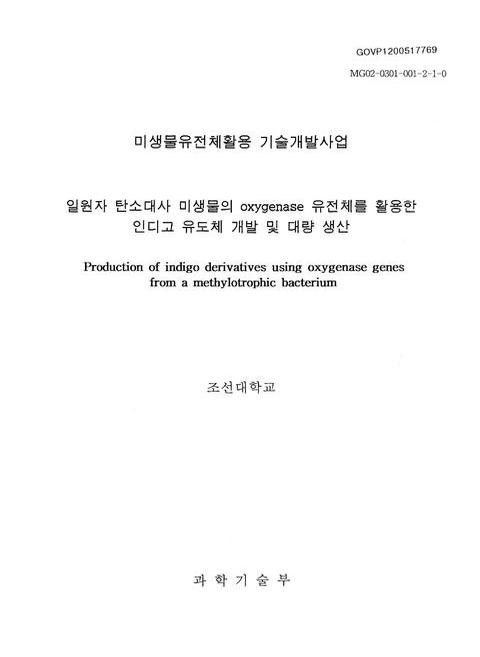
표제지=0,1,1
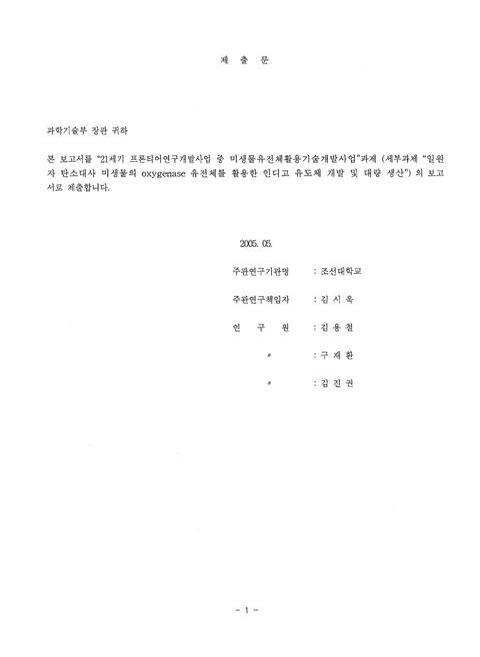
제출문=1,2,1
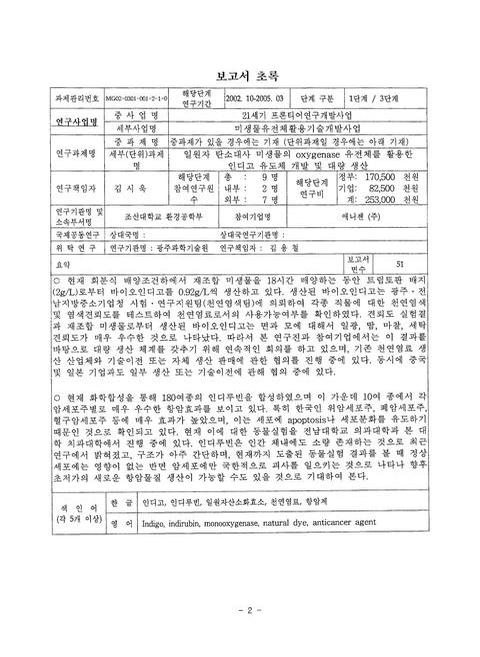
보고서 초록/김시욱=2,3,1
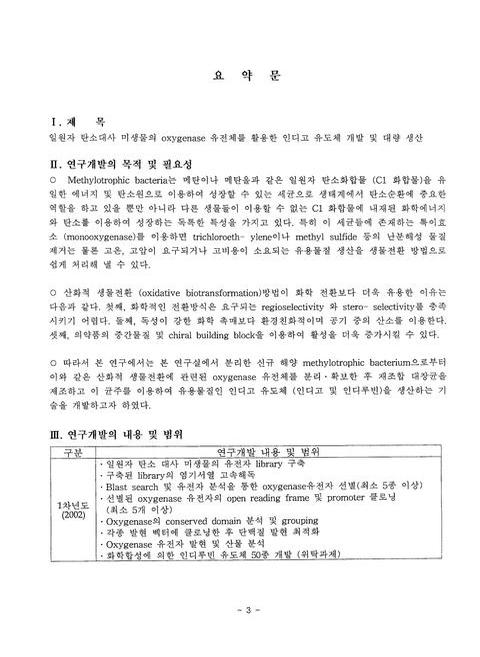
요약문=3,4,2
SUMMARY=5,6,2
CONTENTS=7,8,2
목차=9,10,2
제1장 연구개발과제의 개요=11,12,1
가. 연구개발의 필요성=11,12,1
(1) 기술적 측면=11,12,1
1) 미생물 유전체를 이용한 인디고 대량 생산=11,12,2
2) 미생물 유전체를 이용한 인디루빈 생산=13,14,1
(2) 경제ㆍ산업적 측면=13,14,1
1) 천연염료로서의 인디고 생산=13,14,2
2) 치료제로서의 인디루빈 생산=14,15,1
(3) 사회ㆍ문화적 측면=14,15,1
제2장 국내외 기술개발 현황=15,16,1
가. 외국의 경우=15,16,1
나. 국내의 경우=15,16,1
다. 조사연구개발사례에 대한 평가=15,16,1
제3장 연구개발수행 내용 및 결과=16,17,1
제1절. fmo 유전자의 클로닝=16,17,1
가. 청색소 생산 클론의 분석=16,17,2
나. 염기서열 결정=17,18,1
다. 발현단백질 아미노산 서열의 분석=17,18,6
라. 칭색소의 분자량 측정=22,23,2
제2절 재조합 대장균을 이용한 indigo와 indirubin 생산=23,24,1
가. Indigo 생산=23,24,1
(1) 배지조성=24,25,1
(2) pH=24,25,1
(3) 온도=24,25,1
(4) 숙주 대장균의 선택=24,25,1
(5) 용존산소의 영향=25,26,3
나. 인디고 분리 및 정제=28,29,1
다. 재조합 미생물로부터 생산된 Bio-indigo를 이용한 천연염색=29,30,2
제3절 Flavin-containing monooxygenase (FMO) 정제 및 특성 조사=30,31,1
가. FMO의 정제=30,31,1
나. FMO 단백질의 특성=30,31,1
(1) 분자량=30,31,1
(2) 온도와 pH의 영향=30,31,2
(3) 온도 안정성=31,32,4
(4) Km(이미지참조),Vmax(이미지참조) 결정=34,35,1
(5) 기질 특이성=34,35,1
다. 흡수스펙트럼=34,35,2
라. FMO의 활성 부위=35,36,2
제4절 인디루빈 유도체 화학합성=37,38,1
가. 인디루빈 Amine 유도체 합성=37,38,2
나. 인디루빈 Amide 유도체 합성=38,39,1
다. 인디루빈 amide 유도체를 이용한 indirubin oxime 합성=39,40,2
라. 인디루빈 유도체들의 suzuki coupling reaction=41,42,1
마. 화학합성 인디루빈 유도체의 항암활성 측정=42,43,1
(1) RK3E-Ras cells에서 인디루빈 유도체 처리 후 세포활성 측정=42,43,1
(2) RK3E-Ras cells에서 인디루빈 유도체 처리 후 DNA fragmentation 측정=42,43,2
(3) Apoptosis를 측정하기 위한 Annexin-V-FLUOS/Propidium iodide double staining assay[원본불량;p.44]=44,45,1
(4) 암세포 진행에 대한 인디루빈 유도체의 영향=44,45,2
(5) 인디루빈 유도체 처리 후 암세포 크기 측정=45,46,1
(6) 인디루빈 유도체 처리 후 Softex x-ray 분석=45,46,2
(7) 인디루빈 유도체 처리 후 암세포의 조직학적 분석=46,47,1
제4장 목표달성도 및 관련분야에의 기여도=47,48,1
제5장 연구개발결과의 활용계획=48,49,1
가. 타 연구에의 응용=48,49,1
나. 실용화=48,49,1
제6장 참고문헌=49,50,3
영문목차
[title page etc.]=0,1,7
CONTENTS=7,8,4
I. Introduction=11,12,1
1. Necessities of research and development=11,12,1
(1) Technical Aspect=11,12,1
1) Mass production of indigo using microbial genome=11,12,2
2) Mass production of indirubin using microbial genome=13,14,1
(2) Economical and Industrial Aspects=13,14,1
1) Indigo production as a natural dye=13,14,2
2) Indirubin production as a anticancer agent=14,15,1
(3) Social and Cultural Aspects=14,15,1
II. Present Status of Techniques Developed in Domestic and Foreign Countries=15,16,1
1. Foreign country=15,16,1
2. Domestic=15,16,1
3. Evaluation of developed techniques which have been studied=15,16,1
III. Research and Development Fields and Results=16,17,1
1. Cloning of fmo gene=16,17,1
(1) Analysis of clone producing blue dye=16,17,2
(2) Determination of nucleotide sequence=17,18,1
(3) Analysis of amino acids sequence of expressed protein=17,18,6
(4) Determination of molecular weight of blue dye=22,23,2
2. Production of indigo and indirubin using recombinant E. coli=23,24,1
(1) Indigo production=23,24,1
a. Medium composition=24,25,1
b. pH=24,25,1
c. Temperature=24,25,1
d. Selection of host E. coli=24,25,1
e. Dissolved oxygen=25,26,3
(2) Isolation and purification of indigo=28,29,1
(3) Dyeing of Bio-indigo produced from recombinant E. col=29,30,2
3. Purification and characterization of flavin-containing monooxygenase (FMO)=30,31,1
(1) Purification of FMO=30,31,1
(2) Characteristics of FMO=30,31,1
a. Molecular weight=30,31,1
b. Effect of temperature and pH=30,31,2
c. Thermal stability=31,32,4
d. Determination of Km(이미지참조) and Vmax(이미지참조)=34,35,1
e. Substrate specificity=34,35,1
(3) Absorbance spectrum=34,35,2
(4) Active site of FMO=35,36,2
4. Chemical synthesis of indirubin derivatives=37,38,1
(1) Synthesis of indirubin amine derivatives=37,38,2
(2) Synthesis of indirubin amide derivatives=38,39,1
(3) Synthesis of indirubin oxime from amide derivatives=39,40,2
(4) Suzuki coupling reaction of indirubin derivatives=41,42,1
(5) Anticancer activity of chemically synthesized indirubin derivatives=42,43,1
a. Measurements of cell viability after indirubin derivatives treatment in RK3E- Ras cells.=42,43,1
b. Measurements of DNA fragmentation after indirubin derivatives treatment in RK3E-Ras cells.=42,43,2
c. Annexin-V-FLUOS/Propidium iodide double staining assay for apoptosis=44,45,1
d. Effect of indirubin derivatives on tumor progression=44,45,2
e. Measurements of rat tumor volume after treatment of indirubin derivatives=45,46,1
f. Softex x-ray analysis after treatment of indirubin derivatives in vivo=45,46,2
g. Histological appearance of tumor lesion after indirubin derivatives treatment=46,47,1
IV. Achievements of Results vs. Research Objects and Contributions to Other Research Fields=47,48,1
V. Planning for Application of Results=48,49,1
1. Application to other research fields=48,49,1
2. Industrialization=48,49,1
VI. References=49,50,3
*표시는 필수 입력사항입니다.
| 전화번호 |
|---|
| 기사명 | 저자명 | 페이지 | 원문 | 기사목차 |
|---|
| 번호 | 발행일자 | 권호명 | 제본정보 | 자료실 | 원문 | 신청 페이지 |
|---|
도서위치안내: / 서가번호:

우편복사 목록담기를 완료하였습니다.
*표시는 필수 입력사항입니다.
저장 되었습니다.
