
 대표어
대표어


권호기사보기
| 기사명 | 저자명 | 페이지 | 원문 | 기사목차 |
|---|
결과 내 검색
동의어 포함
목차
[표제지]=0,1,1
제출문=1,2,2
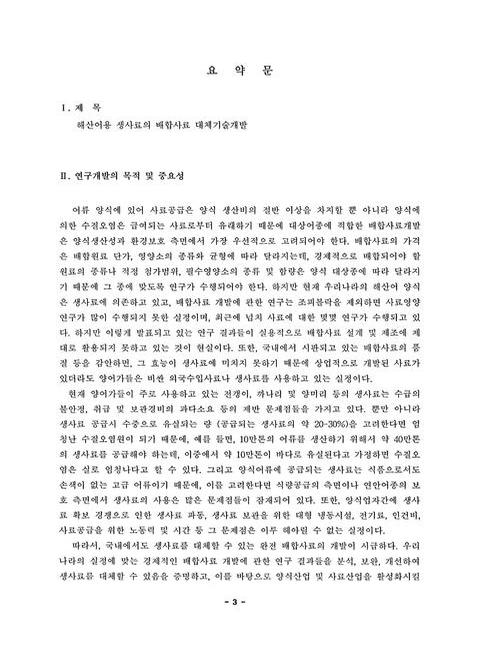
요약문=3,4,34
Summary=37,38,28
Contents=65,66,4
목차=69,70,4
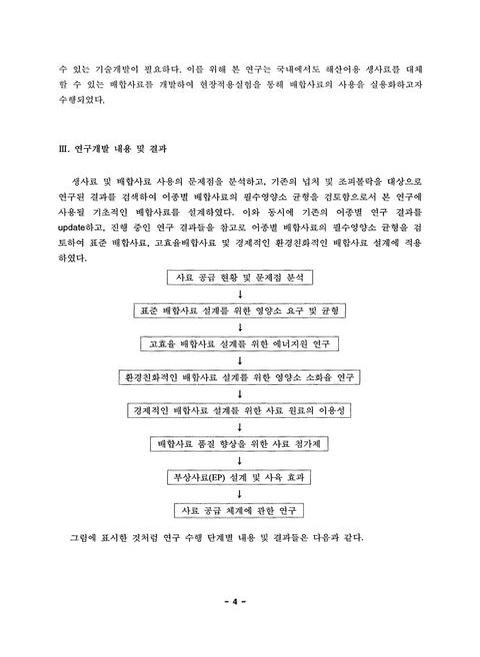
제1장 연구개발과제의 개요=73,74,1
제2장 국내외 기술개발 현황=74,75,2
제3장 우리나라의 사료 공급 현황 및 문제점=76,77,1
제1절 생사료 및 배합사료의 문제점=76,77,2
제2절 넙치 및 조피볼락의 사료 영양 연구 결과 검색=78,79,5
제4장 표준 배합사료 설계를 위한 영양소 요구 및 균형=83,84,1
제1절 사료 원료 및 생체의 영양화학성분 분석=83,84,1
제2절 넙치 사료 내 비타민 E 결핍 및 공급시 비타민 C 요구량=84,85,12
제3절 넙치 사료 내 지질 함량에 따른 비타민 E 요구량=96,97,8
제4절 조피볼락의 Choline 요구량=104,105,10
제5절 넙치(치어 및 육성용) 및 조피볼락 실용 배합사료 조성에 콜린 첨가 필요성=114,115,5
제6절 넙치의 Myo-Inositol 요구량=119,120,8
제7절 사료의 Vitamin E 함량에 따른 n-3HUFA 첨가가 조피볼락의 성장 및 체성분에 미치는 영향=127,128,11
제8절 넙치 치어 사료의 적정 n-3HUFA 함량=138,139,8
제5장 고효율 배합사료 설계를 위한 에너지원 연구=146,147,1
제1절 조피볼락 배합사료의 가소화 단백질과 지질 함량=146,147,11
제2절 넙치 치어 건조사료(EP)의 단백질과 지질 함량=157,158,6
제3절 조피볼락(치어 및 성장어) 배합사료의 지질 및 탄수화물 함량=163,164,13
제4절 넙치 치어 배합사료의 탄수화물원 및 α-Starch 함량=176,177,6
제5절 넙치 치어용 배합사료의 α-셀룰로오스 함량=182,183,6
제6장 환경친화적인 배합사료 설계를 위한 영양소 소화율 연구=188,189,1
제1절 넙치 배합사료 원료의 외견상 영양소 소화율=188,189,13
제2절 사료 탄수화물원과 사육 수온에 따른 조피볼락 치어 및 성어의 영양소 소화율=201,202,8
제3절 조피볼락 사료 단백질 및 에너지 함량과 사료 공급 횟수에 따른 영양소 소화율=209,210,5
제4절 부상 배합사료의 영양소 함량과 공급횟수에 따른 넙치의 영양소 소화율=214,215,8
제7장 경제적인 배합사료 설계를 위한 사료 원료의 이용성=222,223,1
제1절 넙치 배합사료의 어분 평가=222,223,7
제2절 치어 및 성장기 넙치 사료의 어분 대체 단백질원으로서 육분, 대두박 및 콘글루텐밀의 이용성=229,230,6
제3절 조피볼락 치어 배합사료의 어분 대체 단백질원으로서 육분 이용성=235,236,8
제4절 넙치 사료의 어분 대체 단백질원으로 육분 이용성=243,244,6
제5절 넙치 배합사료의 어분 대체 단백질원으로서 오징어간분 이용성=249,250,6
제6절 넙치 배합사료의 어분 대체 단백질원으로 발효 참치 내장 부산물 이용성=255,256,7
제7절 넙치 치어 배합사료의 어분 대체 단백질원으로서 탈지대두박과 면실박 이용성=262,263,8
제8절 넙치 사료 내 면실박과 대두박 첨가에 따른 철과 인의 보충 효과=270,271,9
제9절 넙치 치어용 배합사료에 깻묵 첨가 효과=279,280,5
제8장 배합사료 품질 향상을 위한 사료 첨가제=284,285,1
제1절 넙치 배합사료에 미역분말, 한약제 및 고추냉이 분말 첨가 효과=284,285,9
제2절 넙치 배합사료에 고추냉이 추출물, 키토산 및 김 분말 첨가 효과=293,294,6
제3절 넙치 EP 사료에 한약재, 김분말 및 파프리카 첨가 효과=299,300,5
제4절 조피볼락 배합사료에 생약제, 약쑥 및 삼지구엽 첨가 효과=304,305,8
제9장 부상사료(EP) 설계 및 사육 효과=312,313,2
제1절 넙치 배합사료로서 EP, SMP 및 생사료 비교 실험=313,314,1
(실험 1) FRP 사육수조를 이용한 넙치 성장실험=313,314,14
(실험 2) 콘크리트 사육수조를 이용한 넙치 성장실험(대형수조)=326,327,14
(실험 3) 넙치의 최대 성장을 위한 적정 사료 급여회수 설정 실험=339,340,13
제2절 넙치 육성용으로 부상건조사료(EP)와 생사료(MP) 비교 : 대형수조에서 10개월간 사육=352,353,7
제3절 넙치 육성용으로 부상건조사료(EP), 시판 부상사료 및 생사료(MP) 비교 : 소형수조에서 사육=359,360,8
제4절 넙치 육성용으로 부상건조사료(EP)와 생사료(MP) 비교 : 대형수조에서 12개월간 사육=367,368,10
제5절 넙치 육성용으로 부상건조사료(EP)와 생사료(MP) 비교 : 대형수조에서 11주간 사육=377,378,7
제6절 넙치 육성용으로 부상건조사료(EP)와 상품사료 비교 : 대형수조에서 11주간 사육=384,385,7
제7절 조피볼락 육성용으로 부상건조사료(EP)와 생사료(MP) 비교 : FRP 수조에서 35주간 사육=391,392,13
제8절 넙치 육성용으로 부상건조사료(EP)와 생사료(MP) 비교 : 대형수조에서 30주간 사육=404,405,6
제9절 넙치 및 조피볼락 육성용으로 부상건조사료(EP)와 생사료(MP) 비교 : 대형수조에서 8개월간 사육=410,411,1
(실험 1) 넙치 EP 비교평가 실험=410,411,4
(실험 2) 조피볼락 EP 비교평가 실험=413,414,8
제10장 사료 공급 체계에 관한 연구=421,422,1
제1절 넙치 배합사료의 사료물성 평가 및 물성에 따른 사료 공급 횟수=421,422,2
(실험 1) 사료물성 평가=422,423,2
(실험 2) 사료 물성에 따른 사료 공급 횟수=423,424,11
제2절 사료 물성과 넙치 크기에 따른 장 내용물 통과 시간=434,435,4
제3절 일일 및 격일 습사료 공급방법이 육성 넙치의 성장과 영양소 이용효율에 미치는 영향 : 대형수조 실험=438,439,7
제4절 넙치 치어용 부상 건조사료(EP)와 습사료(MP)의 만복 및 제한 공급 효과 : 대형수조 실험=445,446,7
제5절 넙치 치어의 부상사료 공급횟수 : 겨울철=452,453,8
제6절 넙치 부상사료의 사료조성, 공급율 및 공급횟수=460,461,11
제7절 조피볼락 배합사료 조성 및 사료 공급횟수=471,472,12
(어류 1㎏ 증육에 소요되는 사료 단가 비교)=483,484,4
(종합 요약 및 결론)=487,488,1
제11장 연구개발결과의 활용계획=488,489,12
제12장 참고문헌=500,501,67
영문목차
[title page etc.]=0,1,37
Summary=37,38,28
Contents=65,66,8
Chapter1. Introduction=73,74,1
Chapter2. Present Status Of Development Of Feed For Marine Fish Culture In The World=74,75,2
Chapter3. Present Status And Problems Of Feed Supply For Marine Fish Culture In Korea=76,77,1
Section1. Problems Of Raw Fish As Feed For Marine Fish Culture=76,77,2
Section2. Nutritional Studies For Flounder And Rockfish=78,79,5
Chapter4. Nutrients Requirement And Balance For Design Of Reference Feed Formulation=83,84,1
Section1. Chemical Analysis Of Dietary Ingredients And Fish=83,84,1
Section2. Effects Of Vitamin E Deficiency On Dietary Vitamin C Requirement In Flounder=84,85,12
Section3. Effects Of Dietary Lipid Levels On Vitamin E Requirements In Flounder=96,97,8
Section4. Dietary Choline Requirement Of Juvenile Rockfish=104,105,10
Section5. The Necessity Of Supplemental Choline In Practical Diets Contained Fish Meal For Flounder And Rockfish=114,115,5
Section6. Myo-Inositol Requirement In Diets For Juvenile Flounder=119,120,8
Section7. Influence Of Different Dietary n-3HUFA Level With Varying Additions Of α-Tocopherol On Growth And Body Composition Of Rockfish=127,128,11
Section8. Requirement Of Dietary n-3 HUFA For Juvenile Flounder=138,139,8
Chapter5. Optimum Energy Source And Level For Design Of High Quality Feed Formulation=146,147,1
Section1. Proper Levels Of Digestible Protein And Lipid In Practical Feed For Juvenile Rockfish=146,147,11
Section2. Proper Levels Of Protein And Lipid In Extruded Pellet Diet For Juvenile Flounder=157,158,6
Section3. Proper Levels Of Dietary Lipid And Starch For Juvenile And Growing Rockfish=163,164,13
Section4. Dietary Carbohydrate Kind And α-Starch Level For Juvenile Flounder=176,177,6
Section5. Dietary α-Cellulose Level For Juvenile Flounder=182,183,6
Chapter6. Apparent Digestibility Coefficients Of Various Feed Ingredients For Design Of Environment-Friendly Feed Formulation=188,189,1
Section1. Apparent Digestibility Coefficients Of Various Feed Ingredients For Grower Flounder=188,189,13
Section2. Effects Of Dietary Carbohydrate Source And Water Temperature On Nutrient Digestibilities In Juvenile And Adult Rockfish=201,202,8
Section3. Effects Of Dietary Protein And Energy Levels At Different Feeding Frequency On The Apparent Digestibility Coefficients Of Juvenile Rockfish=209,210,5
Section4. Effect Of Feeding Frequency Of Extruded Diets Containing Different Macro-Nutrient Level On Apparent Nutrient Digestibility In Grower Flounder=214,215,8
Chapter7. The Utilizations Of Feed Ingredients For Design Of Least Cost Feed Formulation=222,223,1
Section1. Evaluation Of Fish Meals As Dietary Protein Sources For Flounder=222,223,7
Section2. The Use Of Meat Meal, Soybean Meal Or Corn Gluten Meal As A Dietary Protein Source Replacing Fish Meal In Juvenile And Grower Flounder=229,230,6
Section3. The Use Of Meat Meal As A Dietary Protein Source Replacing Fish Meal Juvenile Rockfish=235,236,8
Section4. The Use Of Meat Meal As A Dietary Protein Source Replacing Fish Meal In Juvenile Flounder=243,244,6
Section5. The Use Of Squid Liver Meal As A Dietary Protein Source Replacing Fish Meal In Juvenile Flounder=249,250,6
Section6. Utilization Of Fermented Skipjack Tuna Viscera As A Dietary Protein Source Replacing Fish Meal For Juvenile Flounder=255,256,7
Section7. Fish Meal Replacement By Cottonseed And Soybean Meal In Diets For Juvenile Flounder=262,263,8
Section8. Supplemental Iron And Phosphorus Increase Dietary Inclusion Cottonseed And Soybean Meal In Flounder=270,271,9
Section9. Effect Of Sesame Seed Meal In The Formulated Diet On Growth And Body Composition Of Juvenile Flounder=279,280,5
Chapter8. The Utilizations Of Feed Additives For Improvement Of Feed Quality=284,285,1
Section1. Effects Of Supplemental Undaria, Obosan And Wasabi In The Diets On Growth, Body Composition, Blood Chemistry And Non-Specific Immune Response Of Flounder=284,285,9
Section2. Effects Of Supplemental Wasabi Extract, Chitosan And Pophyra In The Diets On Growth And Body Composition Of Juvenile Flounder=293,294,6
Section3. Effect Of Supplemental Medicinal Herb, Porphyra Powder And Paprika Powder In The Extruded Pellets On Growth, Body Composition And Blood Chemistry Of Juvenile Flounder=299,300,5
Section4. Effects Of Supplemental Herb Medicines, Artemisia Asiatica And Epimedium Koreanum In The Diets On Growth And Body Composition Of Juvenile And Grower Rockfish=304,305,8
Chapter9. Development And Evaluation Of Extruded Pellet(EP) Replacing Raw Fish-Based Moist Pellet For Aquaculture Of Marine Fish=312,313,2
Section1. Evaluation Of Extruded Pellet(EP), Soft-Moist Pellet(SMP) And Raw Fish-Based Moist Pellet(MP) For Growth Of Flounder=313,314,1
(Experiment 1) Growth And Feed Utilization Of Growing Flounder Fed Diets With Different Physio-Chemical Compositions(Laboratory Scale Experiment Using FRP Tank)=313,314,14
(Experiment 2) Growth And Feed Utilization Of Flounder Fed Different Physical Types Of Diet(Field Experiment Using Concrete Tank)=326,327,14
(Experiment 3) Effects Of Feeding Frequency On Growth Performance Of Flounder Fed The Extruded Pellet=339,340,13
Section2. Effects Of The Extruded Pellets And Raw Fish-Based Moist Pellet On Growth And Body Composition Of Flounder For 10 Months(Field Experiment Using Concrete Tank)=352,353,7
Section3. Evaluation Of Experimental Extruded Pellet, Commercial Pellet And Raw Fish-Based Moist Pellet For Growth Of Flounder=359,360,8
Section4. Evaluation Of Experimental Extruded Pellet And Raw Fish-Based Moist Pellet For Growth Of Flounder Rearing In The Field Scale Using Concrete Tank For Long Term=367,368,10
Section5. Evaluation Of Experimental Extruded Pellet And Raw Fish-Based Moist Pellet For Growth Of Flounder Rearing In The Field Scale Using Concrete Tank=377,378,7
Section6. Evaluation Of Experimental Extruded Pellet And Raw Fish-Based Moist Pellet For Growth Of Flounder Rearing In The Field Scale Using Concrete Tank=384,385,7
Section7. Evaluation Of Experimental Extruded Pellet And Raw Fish-Based Moist Pellet For Growth Of Rockfish For Long Term=391,392,13
Section8. Development Of An Alternative Extruded Pellet For Moisture Pellet In Flounder reared In Concrete Tank(Field Experiment Using Concrete Tank)=404,405,6
Section9. Evaluation Of Moist Pellet And Extruded Pellets For Growth Of Flounder And rockfish(Field Experiment Using Concrete Tank)=410,411,11
Chapter10. Optimum Feeding Frequency For Growth Of Flounder And Rockfish=421,422,1
Section1. Effect Of Feeding Frequency With Different Feed Types On Growth And Body Composition Of Flounder=421,422,13
Section2. The Effects Of Feed Types On The Rate Of Gastric Evacuation In Juvenile And Growing Rockfish=434,435,4
Section3. Effects Of Everyday And Every Other Day Feeding Methods Of Moist Pellet On Growth And Nutrient Utilization Of Growing Flounder(Field Experiment Using Concrete Tank)=438,439,7
Section4. Effect Of Extruded And Moist Pellets At Different Feeding Rate On Growth And Body Composition Of Juvenile Flounder(Field Experiment Using Concrete Tank)=445,446,7
Section5. Effect Of Feeding Frequency Of Extruded Pellet On Growth And Body Composition Of Juvenile Flounder During The Winter Season=452,453,8
Section6. Effects Of Dietary Composition, Feeding Satiation Rate And Feeding Frequency Of Extruded Pellets On Growth And Body Composition Of Flounder=460,461,11
Section7. Effects Of Dietary Composition And Feeding Frequency On Growth And Body Composition Of Juvenile Rockfish=471,472,12
(Feed Cost For ㎏ Fish Production)=483,484,4
(Conclusion)=487,488,1
Chapter11. Application Plan Of Results=488,489,12
Chapter12. References=500,501,67
jpg
Table 3. Apparent Nutrients Digestibilities (%, Mean±se Of Three Replicates) Adult (300 g/fish) And Juvenile (30 g/fish) Rockfish Fed The Reference Diet At Different Water Temperature=205,206,1
Table 4. Apparent Dry Matter Digestibility (%, Mean±se Of Three Replicates) Of Juvenile And Adult Rockfish Fed Different Dietary Carbohydrate Soures At Different Water Temperature=206,207,1
Table 5. Apparent Energy Digestibility (%, Mean±se Of Three Replicates) Of Juvenile And Adult Rockfish Fed Different Dietary Carbohydrate Soures At Different Water Temperature=207,208,1
Table 6. Apparent Nitrogen-free Extract Digestibility (%, Mean±se Of Three Replicates) Of Juvenile And Adult Rockfish Fed Different Dietary Carbohydrate Soures At Different Water Temperature=208,209,1
Table 5. Growth And Feed Efficiency Of Flounder Fed Different Diet Type With Different Feeding Frequency For 7 Weeks. Values (Mean±SE Of Three Replications) In Each Column With Different Letters Are Significantly Different(P<0.05)=429,430,1
Table 6. Feed Intake And Protein Efficiency Ratio Of Flounder Fed Different Diet Type With Different Feeding Frequency For 7 Weeks. Values (Mean±SE Of Three Replications) In Each Column With Different Letters Are Significantly Different(P<0.05)=430,431,1
Table 7. Proximate Analysis Of Flounder Fed Different Diet Type With Different Feeding Frequency 7 Weeks. Values (Mean±SE Of Three Replications) In Each Column With Different Letters Are Significantly Different(P<0.05)=431,432,2
*표시는 필수 입력사항입니다.
| 전화번호 |
|---|
| 기사명 | 저자명 | 페이지 | 원문 | 기사목차 |
|---|
| 번호 | 발행일자 | 권호명 | 제본정보 | 자료실 | 원문 | 신청 페이지 |
|---|
도서위치안내: / 서가번호:

우편복사 목록담기를 완료하였습니다.
*표시는 필수 입력사항입니다.
저장 되었습니다.
