
 대표어
대표어


권호기사보기
| 기사명 | 저자명 | 페이지 | 원문 | 기사목차 |
|---|
결과 내 검색
동의어 포함
목차
[표제지]=0,1,1
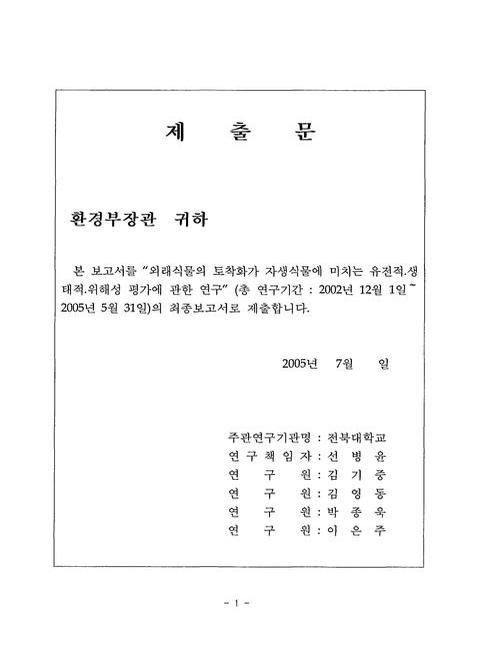
제출문=1,2,2
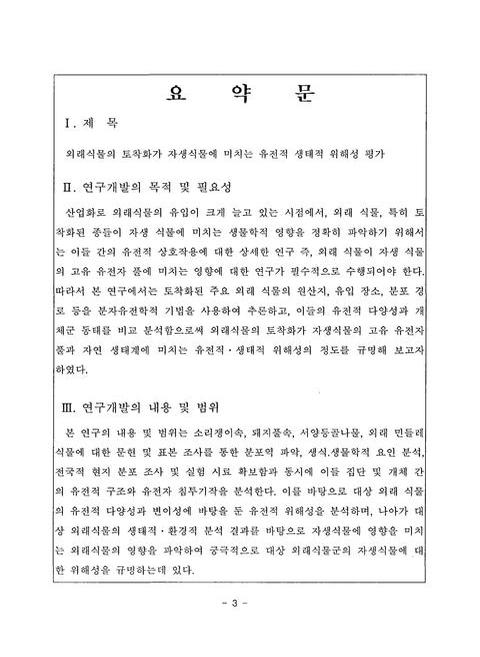
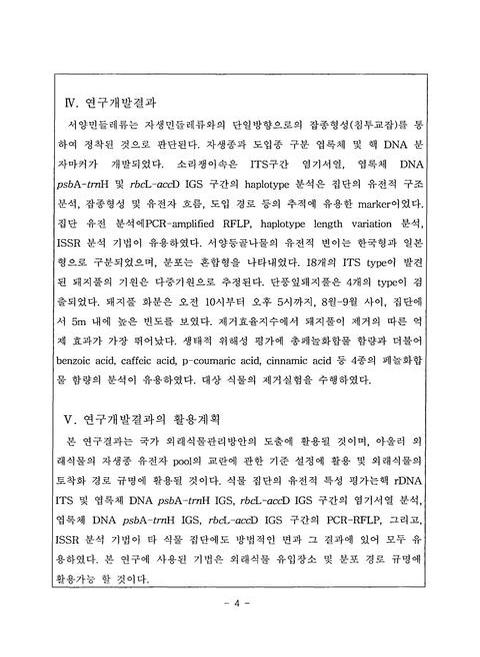
요약문=3,4,2
Summary=5,6,2
Contents=7,8,1
목차=8,9,1
List Of Tables=9,10,4
List Of Figures=13,14,4
제1장 서론=17,18,2
제1절 연구 개발의 필요성=19,20,5
제2절 연구 개발의 목적=23,24,4
제3절 연구 범위=26,27,5
제2장 국내외 기술개발 현황=31,32,2
제1절 국내 기술개발 현황=33,34,4
제2절 국외 기술개발 현황=37,38,4
제3장 연구개발수행 내용 및 결과=41,42,2
제1절 대상식물의 유전적 위해성 분석=43,44,1
1. 민들레속=43,44,40
2. 소리쟁이속(Rumex)=83,84,121
3. 서양등골나물(Eupatorium Rugosum)=204,205,27
4. 돼지풀속(Genus Ambrosia)=231,232,25
제2절 대상식물에 대한 생태적 위해성 평가=256,257,49
제4장 연구개발목표 달성도 및 대외 기여도=305,306,2
제1절 연구개발목표 달성도=307,308,3
제2절 대외 기여도=310,311,1
1. 대상식물의 유전적 위해성 분석=310,311,1
가. 민들레속=310,311,7
나. 소리쟁이속=316,317,5
다. 서양등골나물=320,321,5
라. 돼지풀속=324,325,7
2. 대상식물의 생태적 위해성 분석=331,332,6
3. 활용실적=337,338,4
제5장 연구개발결과의 활용계획=341,342,11
제6장 참고문헌=352,353,18
제7장 부록=370,371,2
제1절 연구 성과에 대한 공개 세미나=372,373,5
Fig.1-1. Location Of Collection Site Of Taraxacum Numerals In Circle Indicates Number Of Individuals Or Populations Collected. Asterisk Indicates Populations Containing Presumable Hybrids=62,63,1
Fig.1-2. Phylogeny Of 500 Individuals Of Dandelions Based On ITS Sequences=69,70,1
Fig.1-3. Phylogeny Of 500 Individuals Of Dandelions Based On trn T-L-F Sequences=71,72,1
Fig.2-1. Rhizome Of R. Acetosella In Jeju Populations=92,93,1
Fig.2-2. Representative Lower Cauline Leaves Of The Genus Rumex In Korea. A.R. Acetosa;B. R. Acetosella;C. R. Longifolius;D. R. Patientia;E. R. Crispus;F. R. Japonicus;G. R. Obtusifolius;H. R. Nipponicus;I. R. Maritimus;J. Ulleung Island Population=95,96,1
Fig.2-3. Inflorescence And Flower Fascicles Found In The Genus Rumex A. Diagram Of An Imflorescence;B. Scanning Electron Micrograph Of A Flower Fascicle Of R. Crispus;C. Diagram Of A Flower Fascicle Of R. Crispus=99,100,1
Fig.2-4. Representative Flower Of The Genus Rumex. A. Flower Of R. Crispus;B. Floral Diagram=102,103,1
Fig.2-5. Scanning Electron Micrographs Of Achene (A) And Achene Surface (B) Of The Genus Rumex=102,103,1
Fig.2-6. Representative Valves Of The Genus Rumex In Korea. A. R. Acetosa;B. R. Acetosella;C. R. Longifolius;D. R. Patientia;E. R. Crispus;F. R. Japonicus;G. R. Obtusifolius;H. R. Nipponicus;I. R. Maritimus;J. Ulleung Island Population=103,104,1
Fig.2-7. Distribution Of R. Acetosella In Korea=107,108,1
Fig.2-8. Distribution Of R. Crispus In Korea=115,116,1
Fig.2-9. Distribution Of R. Obtusifolius In Korea=121,122,1
Fig.2-10. Distribution Of R. Nipponicus In Korea=123,124,1
Fig.2-11. Distribution Of R. Acetosa In Korea=126,127,1
Fig.2-12. Distribution Of R. Longifolius In Korea=131,132,1
Fig.2-13. Distribution Of R. Patientia In Korea=134,135,1
Fig.2-14. Distribution Of R. Japonicus In Korea=135,136,1
Fig.2-15. Distribution Of R. Maritimus In Korea=143,144,1
Fig.2-16. Organization Of The ITS Regions Of Nuclear Ribosomal DNA. Arrows Indicate Orientation And Approximate Position Of Primer Sites=156,157,1
Fig.2-17. psbA-trnH IGS Region Of Chloroplast DNA And Primers Used For PCR And Sequencing Reaction=157,158,1
Fig.2-18. rbcL-accD IGS Region Of Chloroplast DNA And Primers Used For PCR And Sequencing Reaction=157,158,1
Fig.2-19. Aligned Sequences Of ITS Regions Of Seven Taxa Of The Genus Rumex. See Tables 2-5 And 2-8 For Taxon Acronyms. Dashes(-) Indicate Gaps And Dots(.) Indicate Matched Sequences To The First Taxon=167,168,2
Fig.2-20. Aligned Sequences Of psbA-trnH IGS Region From Nine Korean Taxa Of The Genus Rumex. See Table 2-6 And 2-10 For Taxon Acronyms. Dashes(-) Indicates Gaps And Dots(.) Indicate Matched Sequences To The First Taxon=173,174,1
Fig.2-21. Aligned Sequences Of rbcL-accD IGS Region From Nine Korean Taxa Of The Genus Rumex. See Tables 2-6 And 2-12 For Taxon Acronyms. Dashes(-) Indicates Gaps And Dots(.) Indicate Matched Sequences To The First Taxon=178,179,2
Fig.2-22. Neighbor-Joining Tree From The Combined psbA-trnH And rbcL-accD IGS Sequence Data From Korean Rumex Species. See Table 2-6 For Taxon Acronyms. OFF Indicates Rhmex Officinale;ALE R. Alexandrea=185,186,1
Fig.2-23. Two Hypotheses Proposed For The Pollen Capture In R. Crispus, A. Pollen Of R. Crispus Fertilized A Unknown Taxa With Haplotype 7. B. Pollen Of R. Crispus With Haplotype 7 Fertilized R. Patientia, R. Japonicus, And R. Longifolius=186,187,1
Fig.2-24. Agarose Gel Electrophoretic Patterns Of 10 Haplotypes Founded In Korean Rumex Taxa=190,191,1
Fig.2-25. Distribution Of cpDNA rbcL-accD IGS Haplotypes Of R. Acetosella In 2% Agarose Gel Electrophoresis. Stars(*) Indicate Haplotype 4(562 bp PCR Fragment). The Rest Are Haplotype 5(552 bp PCR Fragment)=192,193,2
Fig.2-26. Locations Of 24 R. Acetosella Populations Collected From Korea. Frequency Of Haplotype 4 Is Followed By That Of Haplotype. 5 After A Slash In Each Population=194,195,1
Fig.2-27. UPGMA Phenogram Based On ISSR Analysis Of 200 Rumex Acetosella Samples. Star(*) Indicates The Location Where The Tree Was Broken. Sample Numbers, Population Names, And Chloroplast Haplotype Numbers Are Given=199,200,1
Fig.3-1. Distribution Of Eupatorium Rugosum In Korea=207,208,1
Fig.3-2. External Morphology Of Eupatorium Rugosum=210,211,1
Fig.3-3. Rhizome Type Of Eupatorium Rogosum. Short Rhizomes With Two Aerial Stems, Short Rhizomes With 3 Aerial Stems, And Long Rhizomes=212,213,1
Fig.4-1. Leaf Shape Of Ambrosia Artemisiifolia(A) And A. Trifida(B)=233,234,1
Fig.4-2. Male Head(A) And Flower(B), Female Head Of Ambrosia Artemisiifolia(Right Side)=234,235,1
Fig.4-3. Achene Of A. Artemisiifolia Enclosed By Involucere(A). 5-6 Spines Are Developed As The Schene Matures. Lenth Of Achene Is Ca. 4㎜. About 40-200 Achenes Are Produced From Single Individual=235,236,1
Fig.4-4. Development Of Achene In Ambrosia Tifida. 1-3 Female Flowers Are Enclosed By Involucre. 5-6 Spines Begin To Grow After Fertilization. Note Long Stigma In The Female Flower(Center). Achenes Grow Upto 8 ㎜ And 100-500 Achenes Are Produced From Sing=235,236,1
Fig.4-5. Result Of PCR-RFLP(AluI, HaeIII) For 10 Representative Individuals(Left->Right : Aa25, Aa35, Aa38, Aa40, Aa47, Aa54, Aa58, Aa60, Aa64, Aa69) Of Ambrosia Artemisiifolia In Korea. Monomorphic Patterns Are Evident In Two Different Restriction Enzyme=241,242,1
Fig.4-6. SSR Sequence Data Of Representative Individuals Of Ragweed. Mono-Allelic Pattern Is Evident=242,243,1
Fig.4-7. Aligned ITS Sequences From A. Artemisiifolia And A. Trifida. ITS 1 : 1-263;5.8S : 265-425;ITS 2 : 426-652=246,247,2
Fig.4-8. Types Of ITS Sequences Detected From A. Artemisiifolia(Left) And A. Trifida(Right). Refer Table 4-2 For Detailed Information On The ITS Types=248,249,1
Fig.4-9. Phylogenetic Relationship Of ITS Types Detected From A. Artemisiifolia(A-a) And A. Trifida(A-t). Type 1, 9, 11 Appeared As Most Ancient Types Among The 18 Types Included For The Analyses=249,250,1
Fig.4-10. Distribution Of A. Artemisiifolia ITS Types In Korea=252,253,1
Fig.4-11. UPGMA Tree Of A. Artemisiifolia And A. Trifida Based Of ISSR Data=254,255,1
Fig.5-1. Chemical Structure Of Toxic Tremetone=259,260,1
Fig.5-2. Pollen Picture Of Ambrosia Artemisiaefolia(×100)=261,262,1
Fig.5-3. Diurnal Pollen Deposition Of Ambrosia Artemisiaefolia(grains/㎠/hour)=263,264,1
Fig.5-4. Pollen Deposition Of Ambrosia Artemisiaefolia With Distance(grains/㎠/day)=264,265,1
Fig.5-5. Pollen Deposition Of Ambrosia Artemisiaefolia With Direction(grains/㎠/day)=265,266,1
Fig.5-6. Removal Experiment Sites Of Rumex Acetocella a) Before Removal, b) After Removal=269,270,1
Fig.5-7. Mean Numbers Of Taraxacum Officinale In Fixed Study Sites(Plot Size=50×50㎝;Con.=Control Plots, Exp.=Experimental Plots, n=10)=272,273,1
Fig.5-8. Relative Cover Of Taraxacum Officinale In Fixed Study Sites(Plot Size=50×50㎝;Con.=Control Plots, Exp.=Experimental Plots, n=10)=273,274,1
Fig.5-9. Relative Cover Of Rumex Acetocella In Fixed Study Sites(Plot size=50×50㎝;Con.=Control Plots, Exp.=Experimental Plots, n=10)=274,275,1
Fig.5-10. Numbers Of Eupatorium Rugosum In Fixed Study Sites(Plot size=1×1m;Con.=Control Plots, Exp.=Experimental Plots, n=10)=276,277,1
Fig.5-11. Relative Cover Of Eupatorium Rugosum In Fixed Study Sites(Plot Size=1×1m;Con.=Control Plots, Exp.=Experimental Plots, n=10)=276,277,1
Fig.5-12. Numbers of Ambrosia Artemisiaefolia In Fixed Study Sites(Plot Size=1×1 m;Con.=Control Plots, Exp.=Experimental Plots, n=10)=277,278,1
Fig.5-13. Relative Cover Of Ambrosia Artemisiaefolia In Fixed Study Sites(Plot Size=1×1m;Con.=Control Plots, Exp.=Experimental Plots, n=10)=278,279,1
Fig.5-14. Species Diversity Index In Control And Removal Sites. a) : Taraxacum Officinale b) : Rumex Acetocella c) : Eupatorium Rugosum d) : Ambrosia Artemisiaefolia=280,281,2
Fig.5-15. Relative Cover Presented By Life Forms. a) : Taraxacum Officinale b) : Rumex Acetocella c) : Eupatorium Rugosum d) : Ambrosia Artemisiaefolia(TO : Taraxacum Officinale, RA : Rumex Acetocella, ER : Eupatorium Rugosum, AA : Ambrosia Artemisiaefoli=283,284,2
Fig.5-16. Allelopathic Experiments With Phenolic Compounds=289,290,1
Fig.5-17. Phenolic Compount Contents In Several Alien Plants(Unit=㎎/g, Mean±S.E., n=3) (ER : Eupatorium Rugosum, OO : Oenothera Odorata, EC : Erigeron Canadensis, AA : Ambrosia Aremisiaefolia, EH : Erechtites Hieracifolia, BF : Bidens Frondosa, AP : A=290,291,1
Fig.5-18. Germination Rates Of Tested Plants With Several Phenolic Compound Treatments(Zoysia Sp., Lactuca Sativa, Raphanus Sativus)=294,295,2
Fig.5-19. Root Growth Of Tested Plants With Several Phenolic Compound Treatments=296,297,2
영문목차
[title page etc.]=0,1,5
Summary=5,6,2
Contents=7,8,2
List Of Tables=9,10,4
List Of Figures=13,14,4
I. Introduction=17,18,2
1. Necessity=19,20,5
2. Aims=23,24,4
3. Scope=26,27,5
II. Current Status Of Development=31,32,2
1. Domestic Status=33,34,4
2. Foreign Countries=37,38,4
III. Results=41,42,2
1. Analysis Of Genetic Harmful Effects=43,44,1
1) Taraxacum=43,44,40
2) Rumex=83,84,121
3) Eupatorium=204,205,27
4) Ambrosia=231,232,25
2. Analysis Of Ecological Harmful Effects=256,257,49
IV. Achievements And Contributions To The Public=305,306,2
1. Achievements=307,308,3
2. Contributions To The Public=310,311,1
1) Analysis Of Genetic Harmful Effects=310,311,1
(1) Taraxacum=310,311,7
(2) Rumex=316,317,5
(3) Eupatorium=320,321,5
(4) Ambrosia=324,325,7
2) Analysis Of Ecological Harmful Effects=331,332,6
3) Publication And Presentation=337,338,4
V. Application Plan=341,342,11
VI. Literature Cited=352,353,18
VII. Appendix=370,371,2
1. Open Seminar=372,373,5
jpg
Fig. 5-15. Relative Cover Presented By Life Forms=283,284,2
*표시는 필수 입력사항입니다.
| 전화번호 |
|---|
| 기사명 | 저자명 | 페이지 | 원문 | 기사목차 |
|---|
| 번호 | 발행일자 | 권호명 | 제본정보 | 자료실 | 원문 | 신청 페이지 |
|---|
도서위치안내: / 서가번호:

우편복사 목록담기를 완료하였습니다.
*표시는 필수 입력사항입니다.
저장 되었습니다.
