
 대표어
권호기사보기
| 기사명 | 저자명 | 페이지 | 원문 | 기사목차 |
|---|
결과 내 검색
동의어 포함
표제지
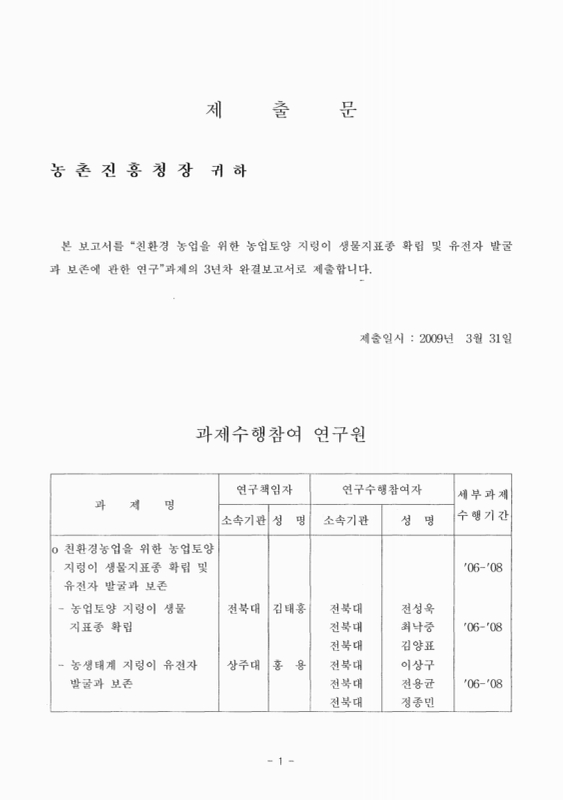
제출문
과제수행참여 연구원
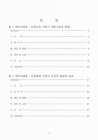
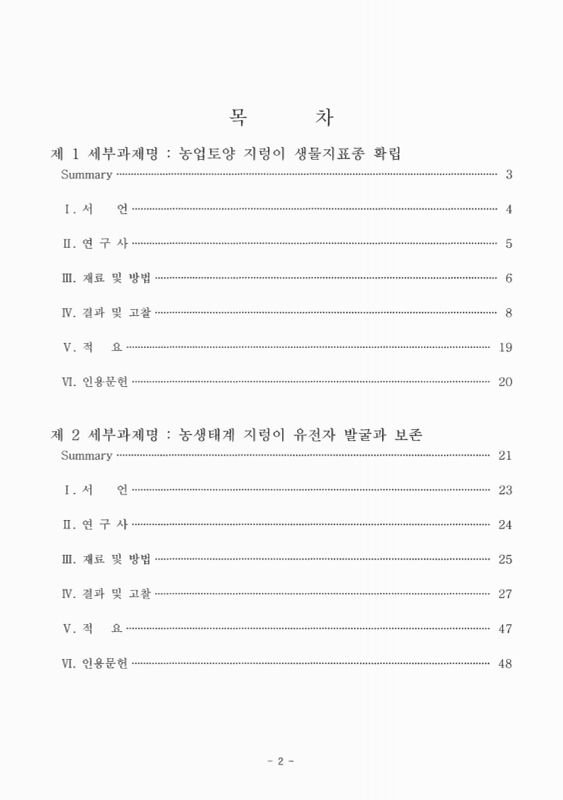
목차
제1세부과제명 : 농업토양 지렁이 생물지표종 확립 4
영문요약 (Summary) 4
I. 서언 5
II. 연구사 6
III. 재료 및 방법 7
IV. 결과 및 고찰 9
V. 적요 20
VI. 인용문헌 21
제2세부과제명 : 농생태계 지렁이 유전자 발굴과 보존 22
영문요약 (Summary) 22
I. 서언 24
II. 연구사 25
III. 재료 및 방법 26
IV. 결과 및 고찰 28
V. 적요 48
VI. 인용문헌 49
Appendix 1. Earthworm collcetion point from 2006 to 2008, Korea. 52
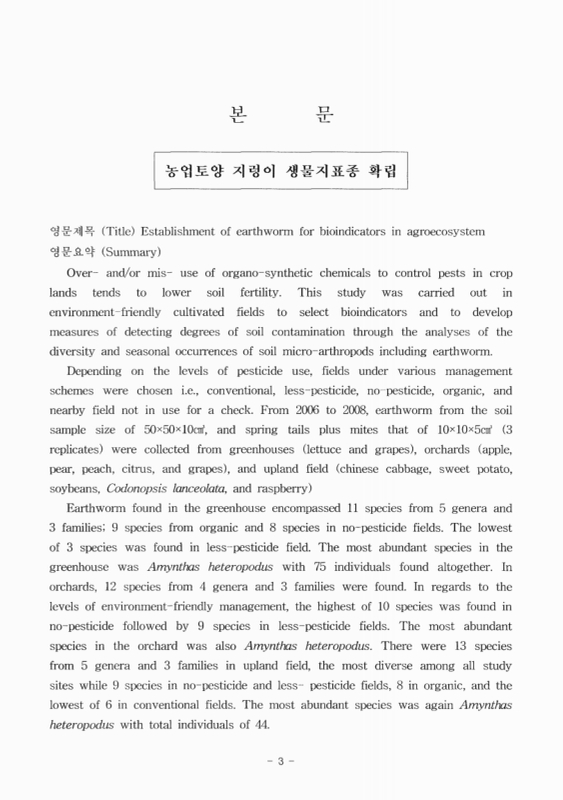
농업토양 지렁이 생물지표종 확립
Over- and/or mis- use of organo-synthetic chemicals to control pests in crop lands tends to lower soil fertility. This study was carried out in environment-friendly cultivated fields to select bioindicators and to develop measures of detecting degrees of soil contamination through the analyses of the diversity and seasonal occurrences of soil micro-arthropods including earthworm.
Depending on the levels of pesticide use, fields under various management schemes were chosen i.e., conventional, less-pesticide, no-pesticide, organic, and nearby field not in use for a check. From 2006 to 2008, earthworm from the soil sample size of 50×50×10㎤, and spring tails plus mites that of 10×10×5㎤ (3 replicates) were collected from greenhouses (lettuce and grapes), orchards (apple, pear, peach, citrus, and grapes), and upland field (chinese cabbage, sweet potato, soybeans, Codonopsis lanceolata, and raspberry)
Earthworm found in the greenhouse encompassed 11 species from 5 genera and 3 families; 9 species from organic and 8 species in no-pesticide fields. The lowest of 3 species was found in less-pesticide field. The most abundant species in the greenhouse was Amynthas heteropodus with 75 individuals found altogether. In orchards, 12 species from 4 genera and 3 families were found. In regards to the levels of environment-friendly management, the highest of 10 species was found in no-pesticide followed by 9 species in less-pesticide fields. The most abundant species in the orchard was also Amynthas heteropodus. There were 13 species from 5 genera and 3 families in upland field, the most diverse among all study sites while 9 species in no-pesticide and less- pesticide fields, 8 in organic, and the lowest of 6 in conventional fields. The most abundant species was again Amynthas heteropodus with total individuals of 44.
농생태계 지렁이 유전자 발굴과 보존
The abundance of earthworm in the agroecosystem was assessed on the basis of 6,052 individuals collected from 2006 to 2008. Material was found from litter layers in soils by hand sorting and digging and encompassed 4 families, 9 genera, and 24 species. Species composition and abundance were as follows: Amynthas koreanus 18.6%, Amynthas heteropodus 15.6%, Amynthas agrestis 12.4%, Amynthas sp. 11.2%, Drawida japonica 7.6%, Eisenia fetida 7.5%, Aporrectodea tuberculata 6.7%, Aporrectodea caliginosa 4.9%, Amynthas hilgendorfi 4.1%, Bimastos parvus 3.6%, Amynthas hupeiensis 2.3%, Amynthas corticis 2.0%, Drawida nemora 1.9%, Eisenia andrei 1.3%, Amynthas sp. nov. B 0.2% and Amynthas sp. nov. A 0.1%. Of 2,250 individuals, the A. koreanus, A. heteropodus, and A. agrestis were the most numerous members with abundance of 46.6%. Two new species of earthworms were found in a survey of lettuce cultivation fields, created by slash and burn, Amynthas sp. nov. A and Amynthas sp. nov. B. The clitellate vs. aclitellate ratio of the earthworm was approximately 1 : 1.1.
Five new species of family Enchytraeidae were found, including Hemifridericia sp. nov., Hemienchytraeus sp. nov A, Hemienchytraeus sp. nov. B, Fridericia sp. nov. A and Fridericia sp. nov. B. and also, three species of the Korean Enchytraeidae unrecorded specis, Enchytraeus irregularis, Enchytraeus varithecatus, and Henlea ventriculosa.
The study was carried out to investigate the species composition in the plastic greenhouse bed for cultivation of cucumber in June 2006 and led to find four genera and seven species found. The abundance of earthworm in the agro-ecosystem of Sunyu Island was estimated on the basis of 1,025 individuals collected in August and October, 2007. It encompassed 3 families, 4 genera, and 12 species.
Phylogeny of the species mainly from the agroecosystem in the family Megascolecidae was inferred at the molecular level using CO1 regions in mtDNA. With 31 species of earthworms from 11 genera in 1 family. Phylogenetic analyses of nucleotide sequences with a help of MP, NJ, and QP yielded 3 groups similarly.| 등록번호 | 청구기호 | 권별정보 | 자료실 | 이용여부 |
|---|---|---|---|---|
| T000028594 | 전자형태로만 열람가능함 | 전자자료 | 이용불가 |
*표시는 필수 입력사항입니다.
| 전화번호 |
|---|
| 기사명 | 저자명 | 페이지 | 원문 | 기사목차 |
|---|
| 번호 | 발행일자 | 권호명 | 제본정보 | 자료실 | 원문 | 신청 페이지 |
|---|
도서위치안내: / 서가번호:

우편복사 목록담기를 완료하였습니다.
*표시는 필수 입력사항입니다.
저장 되었습니다.
