
 대표어
권호기사보기
| 기사명 | 저자명 | 페이지 | 원문 | 기사목차 |
|---|
결과 내 검색
동의어 포함
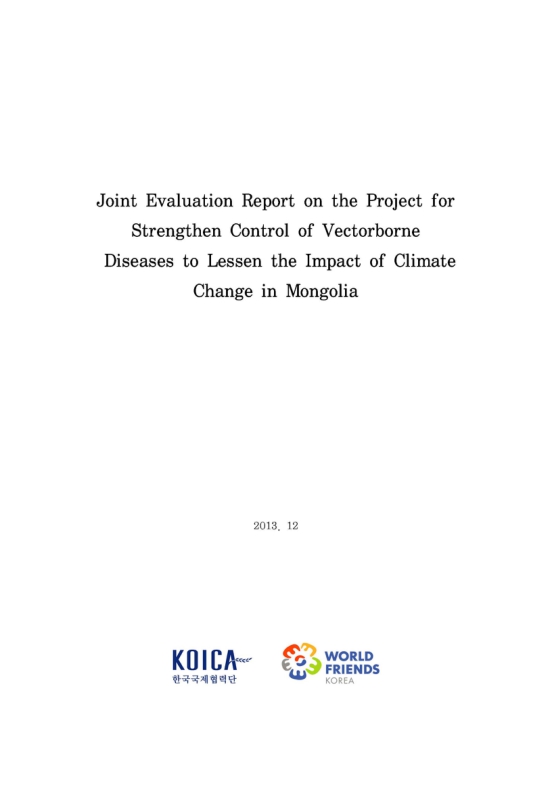
Title Page
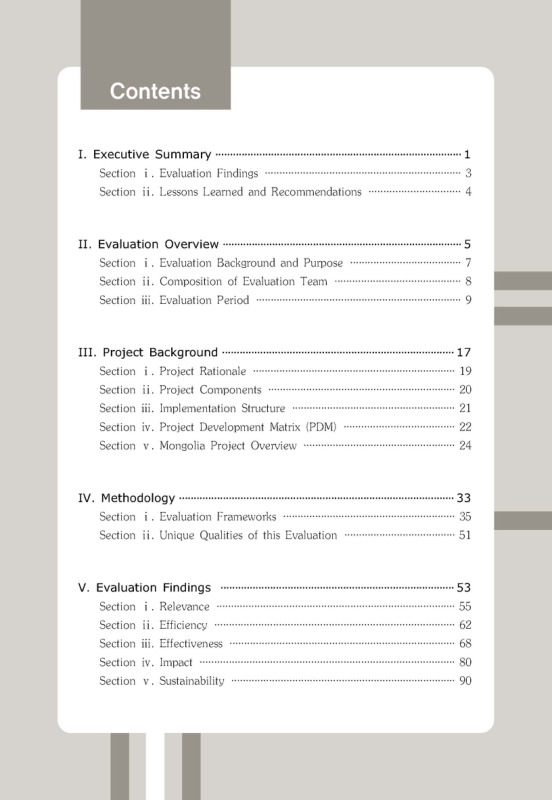
Contents
I. Executive Summary 6
Section i. Evaluation Findings 8
Section ii. Lessons Leanwd and Recommendations 9
II. Evaluation Overview 10
Section i. Evaluation Background and Purpose 12
1. Evaluation Background 12
2. Evaluation Purpose 13
Section ii. Composition of Evaluation Team 13
Section iii. Evaluation Period 14
1. Implementation Period 14
2. Evaluation Standards and Methods 16
3. Domestic and Field Assessment 16
4. Community AlMlreness Survey 20
III. Project Background 22
Section i. Project Rationale 24
Section ii. Project Components 25
Section iii. Implementation Structure 26
Section iv. Project Development Matrix (PDM) 27
Section v. Mongolia Project Overview 29
1. Project Objective and Outputs 29
2. Analysis of Project Outputs 30
IV. Methodology 38
Section i. Evaluation Frameworks 40
1. Evaluation Standards 40
2. Assessment Methods 51
Section ii. Unique Qualities of this Evaluation 56
1. Clear and Comparable Indicators 56
2. Standardized Evaluation Tools 56
3. Outcome-specific Evaluation 57
4. Qualitative Methods and Triangulation 57
5. Other Qualities 57
V. Evaluation Findings 58
Section i. Relevance 60
1. Compatibility of the Project with the Target Country's Policies and Capacity 60
2. Selection of Target Area/Population 61
3. Appropriateness of Project Planning and Organization 62
4. Project's Relevance to Cross-cultural Issues 63
Section ii. Efficiency 67
1. Establishment of a Technical Working Group 67
2. Appropriate allocation of resources and budget 68
3. Project Expenditure 72
Section iii. Effectiveness 73
1. Achievements of desired objectives and outputs 73
2. Strengthened Surveillance and Response Capacity 75
3. Diagnosis and Treatment 77
4. Strategic Information and Research 79
5. Country Programs and Project Management 80
6. Overall Attainment of Project Objectives 80
7. Cross-cutting Issues - Gender 81
8. Cross-cutting Issues - Environment 82
Section iv. Impact 85
1. Increased Community Awareness 85
2. Establishment of VBD Surveillance System 88
3. Increased Capacity for VBD Diagnosis and Treatment 89
4. Increased Research Capacity 90
5. Mongolian National Public Health System 91
6. Overall Impact of the Project 92
7. Cross-cutting Issues 93
Section v. Sustainability 95
1. Vector Surveys 95
2. Diagnostic Testing Kits 96
3. VBD Management Training for Medical Workers 97
4. Community Education 98
5. Establishment of VBD Management Guidelines and Policies 98
6. Project Length and Exit Strategy 99
7. Overall Sustainability of the Project 101
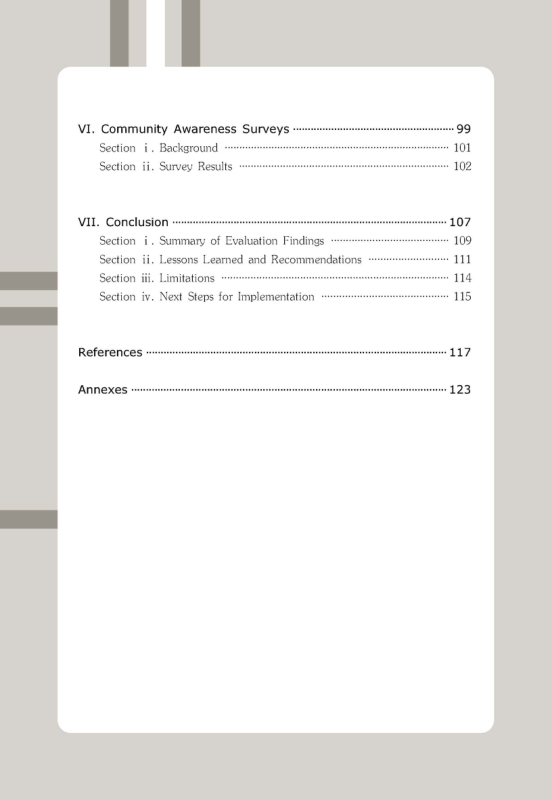
VI. Community Awareness Surveys 104
Section i. Background 106
Section ii. Survey Results 107
VII. Conclusion 112
Section i. Summary of Evaluation Findings 114
Section ii. Lessons Learned and Recommendations 116
1. Immediate Follow-up Support for the Project 116
2. Medium and Long-tenn Plans 116
Section iii. Limitations 119
1. Evaluation Period 119
2. Collaboration with International Organizations 119
Section iv. Next Steps for Implementation 120
1. Advancement of Evaluation Tools 120
2. Strengthening the Project in Mongolia 120
3. Strengthening Multilateral Collaboration 120
References 122
Annexes 128
Annex 1. Project Budget for Mongolia 130
Annex 2. Stakeholder Survey-Korean 132
Annex 3. Stakeholder Survey-English 138
Annex 4. Analysis of Stakeholder Surveys 143
Annex 5. Community Awareness Survey 147
Annex 6. Field Assessment Pictures 151
Copyright 155
| 등록번호 | 청구기호 | 권별정보 | 자료실 | 이용여부 |
|---|---|---|---|---|
| EM0000054444 | ER 전자형태로만 열람 가능함 | 이용가능 |
*표시는 필수 입력사항입니다.
| 전화번호 |
|---|
| 기사명 | 저자명 | 페이지 | 원문 | 기사목차 |
|---|
| 번호 | 발행일자 | 권호명 | 제본정보 | 자료실 | 원문 | 신청 페이지 |
|---|
도서위치안내: / 서가번호:

우편복사 목록담기를 완료하였습니다.
*표시는 필수 입력사항입니다.
저장 되었습니다.
