본문 바로가기 주메뉴 바로가기

전체메뉴

국회도서관 홈으로 정보검색 소장정보 검색

결과 내 검색

동의어 포함

목차보기

Title Page

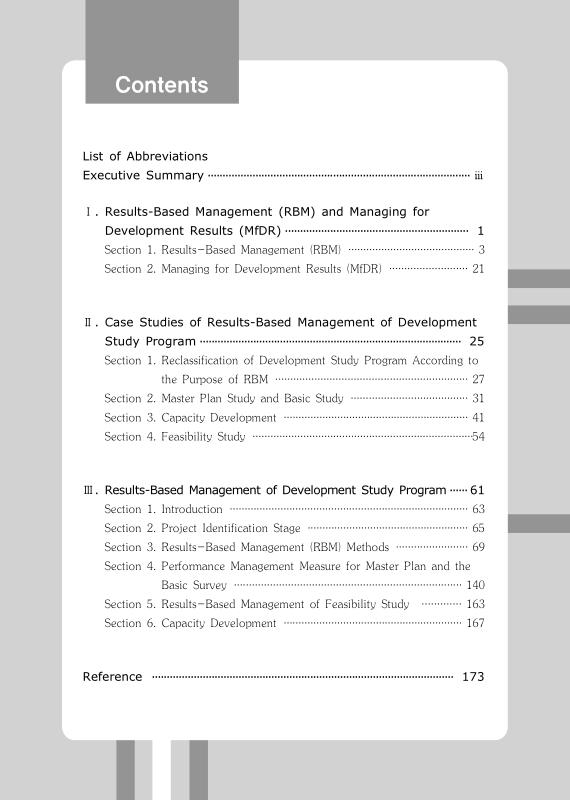
Contents

List of Abbreviations 10

Executive Summary 12

I. Results-Based Management (RBM) and Managing for Development Results (MfDR) 27

Section 1. Results-Based Management (RBM) 29

1. Public Sector Reforms and Results-Based Management 29

2. Development Cooperation and Results-Based Management 31

3. RBM at Three Different Levels 33

Section 2. Managing for Development Results (MfDR) 47

II. Case Studies of Results-Based Management of Development Study Program 51

Section 1. Reclassification of Development Study Program According to the Purpose of RBM 53

1. Concept and Character of Development Study Program 53

2. Types and Purpose of Development Study Program 54

3. Reclassification of Development Study Program 56

Section 2. Master Plan Study and Basic Study 57

1. JICA Case 57

2. ADB Case 61

Section 3. Capacity Development 67

1. JICA 67

2. ADB 69

3. World Bank (WB) 74

Section 4. Feasibility Study 80

1. Overview 80

2. ADB 80

3. Other Development Agencies 84

III. Results-Based Management of Development Study Program 87

Section 1. Introduction 89

1. Classification of Development Study Program 89

2. Strengthening Strategic Linkage with Upper Level plan 89

3. Integration of Project Identification, Formulation, Monitoring and Evaluation 90

4. Strengthening the Role of Project Formulation 90

5. Active Utilization of Operational Manuals and Quality Standards 90

6. Active Participatory Approach 91

Section 2. Project Identification Stage 91

1. Checking Alignment of Target Project with CPS and Sectoral Results Framework 91

Section 3. Results-Based Management (RBM) Methods 95

1. RBM Framework and Participatory Approach 95

2. Analysis Process 99

3. Tips for Making PDM 120

4. Monitoring 157

5. Evaluation 163

6. Report and Use of Evaluation Results 164

Section 4. Performance Management Measure for Master Plan and the Basic Survey 166

1. Project Assessment Phase 166

2. Performance Management Phase 169

3. Follow-up Study (JICA Case) 180

4. Post Evaluation 188

Section 5. Results-Based Management of Feasibility Study 189

1. Project Formulation Phase 189

Section 6. Capacity Development 193

Reference 199

Copyright 204

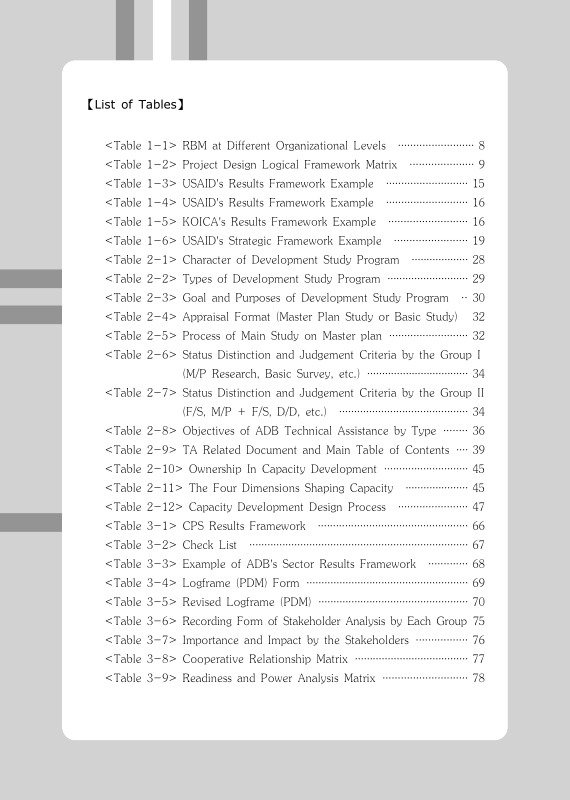
List of Tables

〈Table 1-1〉 RBM at Different Organizational Levels 34

〈Table 1-2〉 Project Design Logical Framework Matrix 35

〈Table 1-3〉 USAID's Results Framework Example 41

〈Table 1-4〉 USAID's Results Framework Example 42

〈Table 1-5〉 KOICA's Results Framework Example 42

〈Table 1-6〉 USAID's Strategic Framework Example 45

〈Table 2-1〉 Character of Development Study Program 54

〈Table 2-2〉 Types of Development Study Program 55

〈Table 2-3〉 Goal and Purposes of Development Study Program 56

〈Table 2-4〉 Appraisal Format (Master Plan Study or Basic Study) 58

〈Table 2-5〉 Process of Main Study on Master plan 58

〈Table 2-6〉 Status Distinction and Judgement Criteria by the Group I (M/P Research, Basic Survey, etc.) 60

〈Table 2-7〉 Status Distinction and Judgement Criteria by the Group II (F/S, M/P + F/S, D/D, etc.) 60

〈Table 2-8〉 Objectives of ADB Technical Assistance by Type 62

〈Table 2-9〉 TA Related Document and Main Table of Contents 65

〈Table 2-10〉 Ownership In Capacity Development 71

〈Table 2-11〉 The Four Dimensions Shaping Capacity 71

〈Table 2-12〉 Capacity Development Design Process 73

〈Table 3-1〉 CPS Results Framework 92

〈Table 3-2〉 Check List 93

〈Table 3-3〉 Example of ADB's Sector Results Framework 94

〈Table 3-4〉 Logframe (PDM) Form 95

〈Table 3-5〉 Revised Logframe (PDM) 96

〈Table 3-6〉 Recording Form of Stakeholder Analysis by Each Group 101

〈Table 3-7〉 Importance and Impact by the Stakeholders 102

〈Table 3-8〉 Cooperative Relationship Matrix 103

〈Table 3-9〉 Readiness and Power Analysis Matrix 104

〈Table 3-10〉 Supportive/Antagonistic/Constructive/Destructive Relationship Matrix 104

〈Table 3-11〉 Readiness Analysis 106

〈Table 3-12〉 Demand Analysis 106

〈Table 3-13〉 Detailed Analysis Form of Target Group 108

〈Table 3-14〉 Alternative Analysis Matrix 118

〈Table 3-15〉 Major Factors of PDM 120

〈Table 3-16〉 PDM Form 121

〈Table 3-17〉 A case of Project Summary 129

〈Table 3-18〉 Selection Criteria for the Good Indicators 143

〈Table 3-19〉 Major Performance Indicators by the Sector 144

〈Table 3-20〉 The Correlation Between the Types of Change, Baselines, and the Targets 146

〈Table 3-21〉 Baselines of the Education Sector and Their Target Level Case 148

〈Table 3-22〉 Research Methods 152

〈Table 3-23〉 Qualitative Sufficing Conditions of the Material 154

〈Table 3-24〉 Qualitative Sufficing Conditions of the Material 158

〈Table 3-25〉 Qualitative Sufficing Conditions of the Material 158

〈Table 3-26〉 Main Contents of Monitoring 160

〈Table 3-27〉 PDM for Monitoring Implementation and Performance Achievement 161

〈Table 3-28〉 PDM for Risk Monitoring 162

〈Table 3-29〉 Risk Management Chart 162

〈Table 3-30〉 Requirements of the Use of Evaluation Results and the Qualitative Evaluation 163

〈Table 3-31〉 Information Suggested by the Evaluation 164

〈Table 3-32〉 Three Elements of Evaluation Results Report 164

〈Table 3-33〉 Main Contents Related with the Use of Evaluation Results 165

〈Table 3-34〉 List of the Project Pre-assessment Table 166

〈Table 3-35〉 Case of "The Philippines: Master Plan for the Agusan River Basin" by ADB 169

〈Table 3-36〉 Case of the Standard Model of the JICA's Report 173

〈Table 3-37〉 Board of Supervisors 176

〈Table 3-38〉 PDM for Risk Monitoring 177

〈Table 3-39〉 Risk Management Chart 178

〈Table 3-40〉 Sample Table of Contents of Evaluation Report 179

〈Table 3-41〉 Criteria of the Development Objective Attainment Grade by the ADB 180

〈Table 3-42〉 Status Distinction and Judgement Criteria by the Group I (M/P Research, Basic Study, etc.) 181

〈Table 3-43〉 Status Distinction and Judgement Criteria by the Group II (F/S, M/P + F/S, D/D, etc.) 181

〈Table 3-44〉 Follow-up Study Questionnaire 182

〈Table 3-45〉 Questionnaire for The Status of The Completed Project 185

〈Table 3-46〉 Feasibility Study Activities 189

〈Table 3-47〉 Feasibility Study TOR Form 190

〈Table 3-48〉 Project Document Form 190

〈Table 3-49〉 Project Appraisal Check List 191

〈Table 3-50〉 Kirkpatrick's Foul Level Evaluation Model 194

〈Table 3-51〉 Type I: Individual Capacity Development 195

〈Table 3-52〉 Type II: Organizational Capacity Development 195

〈Table 3-53〉 Type III: End Users (Beneficiary) Capacity Development 196

〈Table 3-54〉 Type IV: Community Capacity Development 196

〈Table 3-55〉 Capacity Development PDM for Master Plan for Haiphong New Town Development 197

List of Figures

〈Figure 1-1〉 Seven Phases of Results-Based Management 31

〈Figure 1-2〉 Purposes of RBM 33

〈Figure 1-3〉 RBM at Different Organizational Levels 33

〈Figure 1-4〉 Analysis Stage and Planning Stage 36

〈Figure 1-5〉 General Structure of Country Program Results Framework 37

〈Figure 1-6〉 Relationship Between Results Framework and Project Logframe 38

〈Figure 1-7〉 Hypothetical Illustration of A Country Program Results Framework 39

〈Figure 1-8〉 Agency Strategic Framework Hierarchy Levels 45

〈Figure 1-9〉 UNDP's Agency Strategic Framework Example 46

〈Figure 2-1〉 Design and Monitoring Framework(DMF) Format 64

〈Figure 2-2〉 Preconditions of Change and Tools for Capacity Development 72

〈Figure 2-3〉 Capacity Development as a Part of the Development Process 75

〈Figure 2-4〉 Logic Model for a Capacity Development Program 77

〈Figure 2-5〉 Capacity Development Results Framework (CDRF) Cycle 79

〈Figure 2-6〉 ADB Project Cycle 81

〈Figure 2-7〉 USAID Program Cycle 84

〈Figure 3-1〉 Design and Monitoring Framework (DMF) Form 96

〈Figure 3-2〉 Importance and Impact Matrix 103

〈Figure 3-3〉 Participant Analysis 109

〈Figure 3-4〉 Detailed Analysis of Target Group 109

〈Figure 3-5〉 A Case of Problem Tree 113

〈Figure 3-6〉 A Case of Objective Tree 116

〈Figure 3-7〉 Vertical Logic and Causal Relationship 123

〈Figure 3-8〉 Relationship Between Impact and Outcomes 125

〈Figure 3-9〉 Killer Assumption Testing 131

〈Figure 3-10〉 Probability of Fulfilling Assumptions 132

〈Figure 3-11〉 Causal Relationships In The Project Summary 133

〈Figure 3-12〉 Concept of Target Level 147

〈Figure 3-13〉 Implementation Monitoring and Performance Monitoring 159

〈Figure 3-14〉 The Correlation between Implementation Monitoring and Performance Monitoring 159

이용현황보기

Research on means of results-based management (RBM) for the development consulting project "DEEP" [electronic resource] 이용현황 표 - 등록번호, 청구기호, 권별정보, 자료실, 이용여부로 구성 되어있습니다.
등록번호 청구기호 권별정보 자료실 이용여부
EM0000054454 ER 전자형태로만 열람 가능함 이용가능

