
 대표어
대표어
권호기사보기
| 기사명 | 저자명 | 페이지 | 원문 | 기사목차 |
|---|
결과 내 검색
동의어 포함
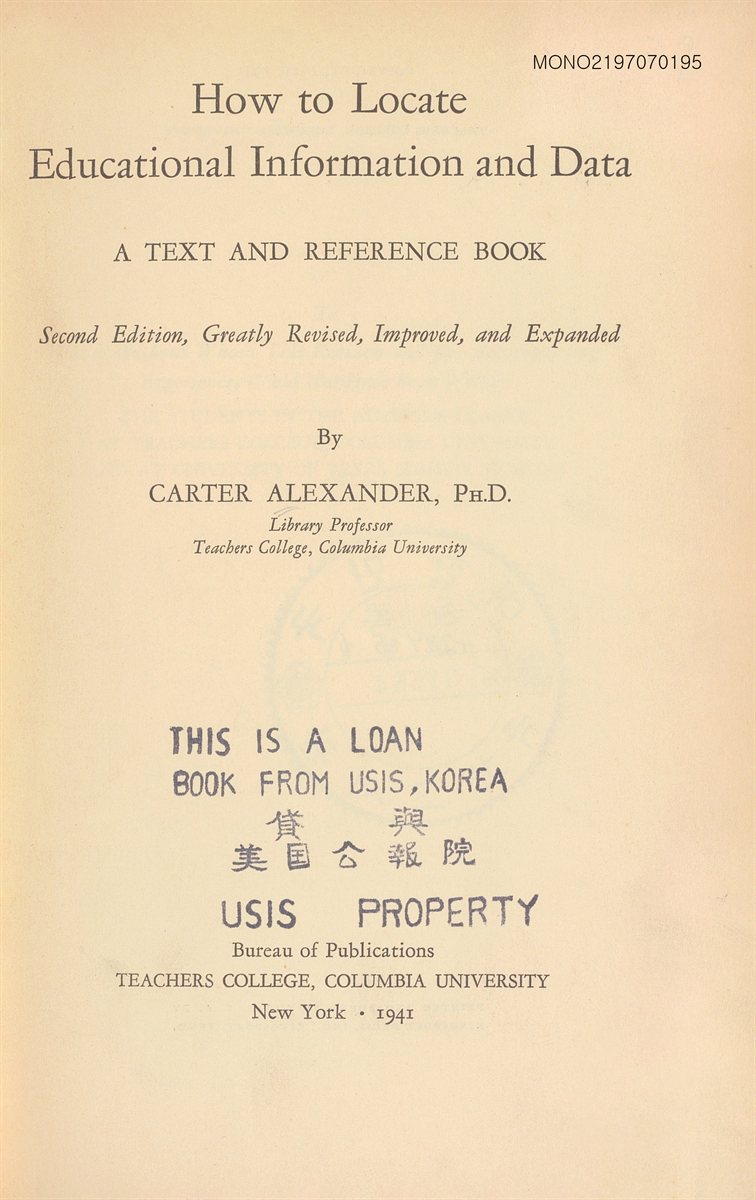
Title Page
Preface / C. A.
Contents
Directions for Using Key for Locating References in This Book 17
INTRODUCTION : The Educator's Needs for Library Materials 18
I. THE POWER AGE OF LIBRARIES 18
II. PRESENT PREDICAMENT AND ITS CAUSES 19
1. Failure of previous instruction 20
2. Rapid improvement in library searching techniques 21
3. Inaccessibility or non-existence of suitable helps 21
4. Number of printed resources 22
III. WHEN WILL YOU NEED TO LOOK UP LIBRARY MATERIALS? 22
1. Just what is your problem? 23
2. Is your problem likely to have been solved before? 24
3. Which methods will give you the best attack on your problem? 24
4. Where can you secure data and information essential for solving your problem? 25
5. How will you obtain help in interpreting your results? 25
6. Are you hunting a problem on which to work? 26
IV. REFERENCES FOR FURTHER READING 26
CHAPTER I. Library Knowledge and Skills Needed by the Educator 27
I. MINIMUM ESSENTIALS 27
1. Saving time and energy on the mechanics 27
2. Securing a satisfactory bibliography 28
3. Doing efficiently the different kinds of reading required 29
4. Efficient note-taking 30
II. SELF-SURVEY OF LIBRARY KNOWLEDGES AND SKILLS NEEDED BY PROFESSIONALLY ALERT SCHOOL WORKERS IN THE FIELD 30
A. To facilitate professional contacts or advancement 31
B. To further growth in a major interest 31
C. To increase efficiency in the classroom and supervision 32
D. Miscellaneous knowledges and skills of importance 34
III. SELF-SURVEY OF LIBRARY KNOWLEDGES AND SKILLS NEEDED BY EDUCATIONAL RESEARCH WORKERS 35
A. To improve planning procedures 35
B. To expedite finding library materials 36
C. To facilitate writing up a research 38
CHAPTER II. Intelligent Planning in Searching for Library Materials 39
I. IMPORTANCE OF INTELLIGENT PLANNING 39
II. GETTING ACQUAINTED WITH YOUR LIBRARY 40
III. TYPICAL DECISIONS ADVISABLE AT THE START OF YOUR SEARCH 43
1. What sort of library work is needed? 43
2. What kinds of library materials are required? 44
3. Where will the materials be found? 44
4. How can time and energy be saved? 46
IV. MOST PROFITABLE ORDER OF PROCEDURES IN A STUDY WITH LIBRARY MATERIALS 50
CHAPTER III. Keeping a Perspective 52
I. MAKE A WORKING OUTLINE OF THE PROJECT 53
1. What is the exact title of my problem or topic? 54
2. What are the best questions I can now ask about my problem? 54
3. Just what things do I need to do to answer the questions in 2 and thus solve my problem? 55
4. Just how do I propose to carry out the things I need to do in 3? 55
5. What specific kinds of library materials do I need if I am to carry out the things to be done in 3 in the ways specified in 4? 55
6. What difference would it make if I should solve the problem? 56
II. LIST THE SPECIFIC KINDS OF LIBRARY MATERIALS NEEDED 57
III. ITEMIZE THE PUBLICATIONS AND LIBRARY TOOLS LIKELY TO LIST REFERENCES OF THE NEEDED KINDS 58
IV. LIST HEADINGS FROM WHICH TO WORK 58
V. FIND AND COLLECT LIKELY REFERENCES 59
VI. KEEP REFERENCES FILED AS ACCUMULATED, UNDER HEADINGS OF WORKING OUTLINE 60
VII. READ LITTLE WHILE COLLECTING REFERENCES 61
VIII. REFERENCES FOR ILLUSTRATION 62
CHAPTER IV. Library Card Catalog 63
I. GENERAL NATURE OF THE LIBRARY CATALOG 63
II. DETAILED WORKINGS OF THE CARD CATALOG 66
1. Kinds of cards 66
2. Alphabetical arrangements 68
3. Call number 69
4. Items of information on a catalog card 70
5. Special local devices in the library card catalog 73
III. PRACTICAL QUESTIONS ANSWERABLE BY THE CARD CATALOG 73
A. Does the library have a certain book by this author? Any book? What books? 73
B. Does the library have a certain book about this author? Any books? What books? 74
C. Does the library have a book with a certain title? 74
D. What books does the library have on a certain subject? 74
E. What can be done to supply missing bibliographic data on a certain book, such as author, date of publication, or number of pages? 75
F. What is the call number for a certain book? 75
G. What are the call numbers for books on a certain subject or subjects? 75
H. How old is a certain person who has written a book? 76
I. What is the full name of any person who has written a book? 76
J. When was a certain book published? 76
K. Who published a certain book? 76
L. What is the title of a book you have forgotten but for which you remember the author? 76
IV. DEWEY SYSTEM OF LIBRARY CLASSIFICATION 77
V. LIBRARY OF CONGRESS SYSTEM OF LIBRARY CLASSIFICATION 78
CHAPTER V. Library Reading 79
I. KINDS OF LIBRARY READING AND WHEN TO USE THEM 81
II. SUGGESTIONS APPLICABLE TO ALL TYPES OF READING 82
1. Read only when you have a definite and clear purpose 82
2. Before starting to read a whole book, make a preliminary survey of it for pertinency to your purpose 84
3. Read first in order to get an overview, then read for details 84
4. Save your memory efforts for the higher levels of your work 85
5. Adjust your speed of reading to your purpose and kind of material 86
6. Increase your speed for eαch type of reading as much as possible without loss of results and undue strain 87
7. Don't read when you are excessively fatigued mentally 88
8. Use assistants only for the work they can profitably do 89
III. SPECIFIC SUGGESTIONS FOR THE FIVE KINDS OF READING NEEDED IN LIBRARY WORK 89
1. Scouting 89
2. Finding specific materials within a reference, particularly a book 91
3. Skimming 93
4. Thoughtful or critical reading 94
5. Interpretation and application 96
IV. REFERENCES FOR FURTHER READING 97
CHAPTER VI. Note-Taking in Work with Library Materials 98
I. KINDS OF NOTES 98
1. Notes carried by each reference card in your bibliography 98
2. All other notes 99
II. ESSENTIALS OF A GOOD NOTE IN LIBRARY READING 100
1. A good note is more than a mere topic or outline of topics 100
2. A good note is so definite that there can be no doubt about its meaning 100
3. A good note has all the data necessary to locate it readily, so that there is no doubt about who said it or wrote it, or where the original, if any, can be found 100
4. A good note has a definite topic or heading 101
5. A good note is made with the idea that it is to pass through a human head before being incorporated into the final product 102
III. MECHNICAL ESSENTIALS OF A GOOD NOTE SYSTEM 102
1. Possibility of easy transfer 102
2. Possibilities of expansion anywhere 106
3. Minimum copying or other mechanical work 106
4. Relative advantages of different filing systems 108
IV. READING FOR NOTE-TAKING 108
V. TAKING NOTES ON STATISTICAL DATA 110
VI. REFERENCES CONTAINING EXAMPLES AND SIMILAR HELPS 111
CHAPTER VII. Headings for Searching 112
I. NEED FOR A LIST OF HEADING BEFORE SEARCHING FOR REFERENCES 112
1. Such a list greatly reduces the grave danger of overlooking good references 112
2. A preliminary list of headings will save much time and energy 113
II. HOW TO MAKE A LIST OF HEADINGS 113
III. REFERENCES TO USE IN LISTING HEADINGS 117
CHAPTER VIII. Reference Books 118
I. VALUE OF REFERENCE BOOKS TO EDUCATORS 118
II. VALUE OF KNOWING HOW TO USE REFERENCE BOOKS 118
III. TYPES OF REFERENCE BOOKS IMPORTANT TO EDUCATORS 120
IV. HOW TO USE A REFERENCE BOOK 125
V. HOW TO SELECT REFERENCE BOOKS TO USE ON AN EDUCATIONAL PROBLEM 126
VI. REFERENCES FOR FURTHER READING OR ILLUSTRATION 133
CHAPTER IX. Books 136
I. SELECTED BOOK REFERENCES ON A TOPIC 136
II. ALL BOOKS ON A TOPIC 136
III. PRACTICAL QUESTIONS ABOUT BOOKS NOT LISTED BY YOUR LIBRARY CARD CATALOG 138
A. What are all the books by a given author? 138
B. What are complete bibliographic data for a given book? 139
C. What is the price of a certain book? 139
D. Has a given title ever been used for a book? 139
CHAPTER X. Periodicals and Other Serials 140
I. SPECIAL SERVICES OBTAINABLE FROM PERIODICALS 140
II. PERIODICAL INDEXES 141
III. HOW TO SELECT AND USE A PERIODICAL INDEX 143
IV. CLASSIFIED LIST SELECTED ABSTRACTS AND PERIODICAL INDEXES 145
V. YEARS COVERED BY VARIOUS INDEXES 145
VI. ANNOTATED REFERENCES FOR ABSTRACTS AND INDEXES LISTED IN SECTIONS IV AND V 147
VII. INDIVIDUAL PERIODICALS AND LISTS OF PERIODICALS 152
VIII. LOCATING OLD PERIODICALS 153
IX. PAMPHLETS 154
X. SOCIETY AND INSTITUTIONAL PUBLICATIONS 155
XI. PRACTICAL QUESTIONS ANSWERABLE BY PERIODICAL ABSTRACTS AND INDEXES 156
A. Where can one find lists of selected periodical references on a certain topic or question? 156
B. What articles are available on a certain subject? 157
C. Where can a certain article by a given author be found? 157
D. What are all the articles by a given author during a certain period of time? 157
E. What is the full name of a certain author whose field of writing you know, although you have only vague information about the name? 157
F. What is the trend of public interest in a certain subject? 158
G. What are the names of writers of articles in a certain field or for a special subject of current interest? 158
H. Are there periodical articles about a certain author? 158
CHAPTER XI. Education Index 159
I. VALUES OF THE INDEX FOR EDUCATORS 159
II. TYPES OF MATERIALS INDEXED 161
III. NOTES ON SPECIAL FEATRUES 162
CHAPTER XII. Guide to the Professional Literature of Your Educational Field 169
I. VALUE OF SUCH A GUIDE 169
II. HOW TO LOCATE A GUIDE IN YOUR FIELD 170
III. HOW TO MAKE A GUIDE FOR YOUR FIELD 171
IV. KEEPING A GUIDE UP TO DATE 174
CHAPTER XIII. National Education Association Publications 175
I. GENERAL SUGGESTIONS FOR LOCATING PUBLICATIONS OF THE ASSOCIATION 176
II. GENERAL PUBLICATIONS OF THE ASSOCIATION 178
1. Proceedings, 1857- 178
2. Journal of the National Education Association, monthly, 1913- 178
3. Research Bulletin, five times a year, 1922- 178
4. Other Publications 181
III. DEPARTMENTS AND THEIR PUBLICATIONS 182
CHAPTER XIV. United States Office of Education Publications 190
I. PLACE OF EDUCATION OFFICE IN THE FEDERAL GOVERNMENT 191
II. BIRD'S-EYE VIEW OF CURRENT OFFICE PUBLICATIONS 193
III. INDEXES OF OFFICE PUBLICATIONS 193
1. Indexes Covering All Office Publications 193
2. Specialized Indexes and Lists 195
IV. OFFICE PUBLICATIONS BY SERIES AND IMPORTANT TOPICS 195
V. LOCATING OFFICE PUBLICATIONS 202
CHAPTER XV. Government Documents 205
I. KINDS OF GOVERNMENT DOCUMENTS 206
II. SUGGESTIONS FOR LOCATING ALL KINDS OF GOVERNMENT DOCUMENTS 208
III. LOCATING FEDERAL DOCUMENTS 210
1. Scouting 210
2. Exhaustive searching 213
3. Access to the documents 215
IV. LOCATING STATE DOCUMENTS 215
V. LOCAL DOCUMENTS 217
VI. REFERENCES FOR FURTHER STUDY 218
CHAPTER XVI. Educational Researches 220
I. NEED OF KNOWING HOW TO LOCATE EDUCATIONAL RESEARCHES 220
II. HANDICAPS IN LOCATING EDUCATIONAL RESEARCHES 220
III. SUMMARIES OF EDUCATIONAL RESEARCHES 221
IV. LISTS OF EDUCATIONAL RESEARCHES 222
V. AVOIDING DUPLICATION OF PREVIOUS RESEARCH 226
CHAPTER XVII. History of an Educational Topic or Problem 228
I. WHEN THE HISTORY OF A PROBLEM IS NEEDED 228
II. HOW TO LOCATE A HISTORY OF AN EDUCATIONAL PROBLEM 230
1. Brief historical treatment 230
2. Extensive historical treatment 231
3. Bringing a history up to date 232
III. WORKING UP THE HISTORY OF A PROBLEM 232
IV. REFERENCES FOR FURTHER READING 233
CHAPTER XVIII. Making a Bibliography 234
I. PLANNING THE BIBLIOGRAPHY 234
II. CLEAN-CUT AIM OR AIMS, AS CLEARLY REALIZED 235
III. HOW TO FIND BIBLIOGRAPHIES AND BRING THEM UP TO DATE 238
IV. FULL BIBLIOGRAPHIC DATA AND FLEXIBILITY 242
V. CLASSIFICATION OF REFERENCES WITHIN THE BIBLIOGRAPHY 249
VI. UNIFORM ENTRIES IN FINAL BIBLIOGRAPHY 251
VII. TYPICAL ENTRY FORMS FOR A PUBLISHED BIBLIOGRAPHY 252
VIII. ANNOTATIONS 257
IX. REFERENCES CONTAINING ACCEPTABLE BIBLIOGRAPHIC FORM 258
CHAPTER XIX. Evaluations of Books and Other References 259
I. NEED OF EVALUATIONS 259
II. ESTIMATING THE RELATIVE WORTH OF BOOKS AND OTHER SEPARATE PUBLICATIONS 259
1. Book lists 260
2. Abstracts 260
3. Characteristics of a good book review 260
4. Ways of evaluating a book review 262
5. Writing book review 264
6. Editorial comment and discussion in periodicals 264
III. HOW TO LOCATE EVALUATIONS OF BOOKS AND OF SEPARATE PUBLICATIONS 264
1. Book reviews 265
2. Editorial comment and discussions 273
3. Periodical articles 273
IV. ESTIMATING THE VALUE OF PERIODICAL ARTICLES 273
V. HOW TO LOCATE EVALUATIONS OF PERIODICAL ARTICLES 274
CHAPTER XX. Book Lists 275
I. VALUE OF BOOK LISTS FOR THE EDUCATOR 275
II. TO LOCATE BOOK LISTS ON EDUCATIONAL TOPICS OR PROBLEMS 276
III. TO FIND BOOK LISTS ON NON-EDUCATIONAL TOPICS OR PROBLEMS 284
IV. TO LOCATE BOOK LISTS FOR A PARTICULAR CLASS OF READERS 285
V. TO BRING A PUBLISHED BOOK LIST UP TO DATE 285
CHAPTER XXI. Textbooks, Courses of Study, and Other Teaching Aids 287
I. TEXTBOOKS 287
1. Worth of knowing how to locate and evaluate textbooks 287
2. Locating recent textbooks 288
3. How to secure full bibliographic data on a textbook 289
4. Locating old textbooks 290
5. Evaluating textbooks 290
II. COURSES OF STUDY 293
1. Distinction between curriculum and courses of study 294
2. Curriculum 294
3. Best courses of study 295
4. Recent courses of study 295
5. Getting access to the courses themselves 295
III. TEACHING AIDS 296
CHAPTER XXII. Legal Aspects of Education 298
I. FIRST INFORMATION LEVEL 298
1. Meaning and importance of law for educators 298
2. Difficulties in finding the law on an educational problem 299
3. Kinds of law 300
4. Formulations of principles of law 302
5. News notes 303
6. Legal periodical articles 303
7. Legal dictionaries 304
8. How to find the school law : basic suggestions for the novice 304
II. SECOND INFORMATION LEVEL 307
III. THIRD INFORMATION LEVEL 307
CHAPTER XXIII. Statistics Needed by Educators 309
I. IMPORTANCE OF STATISTICS FOR SCHOOL WORKERS 309
II. NECESSARY PRELIMINARY CAUTIONS IN LOCATING STATISTICS 312
1. Collect statistics only for problems lending themselves to statistical treatment 312
2. Keep in mind that statistics are frequently not labeled as such 312
3. Be sure you know just what the statistics are 312
4. Be sure the statistics are accurate 313
III. HOW TO LOCATE STATISTICS 314
1. Procedure 314
2. Government statistics 314
3. Non-governmental statistics 319
4. Current statistics 319
5. Old statistics 319
6. Primary and derived statistics 320
7. Unpublished statistics 321
IV. STATISTICS ON SPECIAL TOPICS Of INTEREST TO EDUCATORS 322
CHAPTER XXIV. Biographical Information 325
I. NEEDS FOR BIOGRAPHICAL INFORMATION 325
1. Information on a person no longer living 325
2. Information about a living person 325
3. Interpretation of a publication of any kind 327
4. Evaluation of any kind of publication 328
II. SOURCES AND REFERENCES 328
1. Biographical information on the non-living 328
2. Biographical information on contemporaries 330
3. Biographies for different school levels 331
4. Autobiographies 332
5. Who's who type of books 332
III. LOCATING BIOGRAPHICAL INFORMATION 334
IV. NOTES ON IMPORTANT REFERENCES CITED IN THIS CHAPTER 336
1. Bibliographies 336
2. General, including educators 336
3. Educational only 337
4. Genealogies 339
5. Government 339
CHAPTER XXV. Names and Addresses 341
I. PROPER NAMES IN GENERAL 341
1. Alphabetizing in library tools 341
2. Christian names 342
3. Geographical names 342
4. Nicknames 344
5. Pronunciation of names of persons 344
6. Pseudonyms 345
7. Spelling of proper names 345
II. NAMES AND ADDRESSES OF INDIVIDUALS 346
1. Advantages of knowing how to locate names and addresses of individuals 346
2. Essential skill needed 347
3. Directories and other sources 347
III. DIRECTORIES USEFUL TO EDUCATORS 348
IV. HOW TO LOOK UP PROPER NAMES 354
V. LOCATING ADDRESSES 354
CHAPTER XXVI. News Items 356
I. WHEN AN EDUCATOR NEEDS NEWS ITEMS 356
II. LIBRARY SOURCES FOR NEWS ITEMS 357
III. HOW TO LOCATE NEWS ITEMS 359
1. To locate the event or topic of interest in time and place as accurately as possible 359
2. To look up The event or item in likely news digests 361
3. To look up the event or topic in likely newspapers 362
4. To look up the event or item in likely periodicals with news departments 364
IV. INTERPRETING NEWS ITEMS 364
V. BRINGING THE HISTORY OF A MATTER UP TO DATE BY USING NEWS ITEMS 364
VI. PICTURES OF NEWS EVENTS 365
CHAPTER XXVII. Quotations and Proverbs 366
I. EFFECTIVE USE OF QUOTATIONS 366
II. TYPICAL PROBLEMS IN LOCATING QUOTATIONS 367
1. To complete a quotation when the author is known 367
2. To find the author of a given quotation and where the complete writing appeared 368
3. To secure accurately the words of a garbled quotation and then identify it completely as in the two previous cases 368
4. To find a telling quotation on a given topic 369
5. To secure a quotation expressing a humorous attitude 369
6. To build up your own collection of pithy quotations for various educational situations 370
III. PROVERBS 370
IV. REFERENCES FOR LOCATING QUOTATIONS 371
V. REFERENCES FOR LOCATING PROVERBS 373
CHAPTER XXVIII. Audio-Visual Aids 374
I. KINDS OF INFORMATION NEEDED 375
II. SOURCES FOR LOCATING AUDIO-VISUAL AIDS 376
Graphs and pictorial charts 377
Illustrations and photographs 377
Maps 382
Motion pictures, silent and sound 382
Museums 388
Phonograph records 389
Portraits 390
Radio 392
Slides, glass and film 394
Stereographs 395
Television 395
CHAPTER XXIX. Maps and Graphs 397
I. MAPS IN GENERAL 399
1. Elementary planning for successful map use 399
2. References and sources for maps in general 403
II. SPECIFIC KINDS OF MAPS ESPECIALLY USEFUL FOR SCHOOL PURPOSES 407
III. GRAPHS AND CHARTS 408
1. Types of graphs most useful to educators 409
2. How to read a graph 411
3. How to make graphs 413
CHAPTER XXX. Technique of Library Searching 416
STEP I. FIND OUT PRECISELY WHAT THE QUESTION IS 417
1. Fact type : "Where can I find a certain fact?" 418
2. How-to-do type : "Where can I find out how to do a certain thing?" 421
3. Trends type : "What are the trends in such and such an activity?" 422
4. Supporting-evidence type : "What evidence or argument can I find to support something I wish supported?" 422
5. All-about type : "Where can I find out "all about" so-and-so?" 422
6. Evaluation of reference type 423
7. Duplication of previous-work type : "Has this ever been worked out and written up before?" 423
STEP II. DECIDE WHICH KIND OF LIBRARY MATERIALS IS MOST LIKELY TO HAVE THE ANSWER 424
STEP III. DECIDE WHICH ITEMS IN A GIVEN KIND OF LIBRARY MATERIALS ARE MOST LIKELY TO HAVE THE ANSWER AND RATE THE ITEMS IN ORDER OF TIME AND EFFORT REQUIRED TO OBTAIN THE ANSWER 424
STEP IV. LOCATE THE CHOSEN ITEMS 425
STEP V. SEARCH IN THE CHOSEN ITEMS IN ORDER OF LIKELIHOOD AND ECONOMY OF EFFORT UNTIL THE ANSWER IS FOUND OR YOU ARE SURE IT CANNOT BE FOUND THERE 426
STEP VI. IF THE ANSWER IS NOT FOUND BY THE FOREGOING METHOD, GO BACK OVER THE PREVIOUS STEPS AND TAKE THE NEXT MOST LIKELY SOURCES 426
APPLICATION OF THE LIBRARY SEARCHING TECHNIQUE TO SIX SAMPLE QUESTIONS 427
Question 1. What is the proper form for preparing an article or book manuscript for publication? 427
Question 2. How valuable is the book America's Young Men? 428
Question 3. What is the origin of the pupil report card? 429
Question 4. Where can I find a brief inclusive treatment of hygiene? 430
Question 5. How does a teacher get a position in Alaska, what qualifications must she have, and what salary can she expect? 430
Question 6. Where can I find the wording used in presenting Dr. X. Y. Blank for an honorary degree at Siwash College about seven years ago? 431
APPENDIX : Borrowing from Other Libraries 434
I. GENERAL CONDITIONS COVERING INTERLIBRARY LOANS 435
II. WHAT THE INDIVIDUAL BORROWER SHOULD DO 436
III. SUPPLEMENTING INTERLIBRARY LOANS 438
IV. REFERENCES FOR FURTHER DETAILS 439
Index 440
KEY FOR LOCATING REFERENCES 456
[Back Cover] 458
| 등록번호 | 청구기호 | 권별정보 | 자료실 | 이용여부 |
|---|---|---|---|---|
| 0000001564 | US 028.7 A375h | 이용불가 |
*표시는 필수 입력사항입니다.
| 전화번호 |
|---|
| 기사명 | 저자명 | 페이지 | 원문 | 기사목차 |
|---|
| 번호 | 발행일자 | 권호명 | 제본정보 | 자료실 | 원문 | 신청 페이지 |
|---|
도서위치안내: / 서가번호:

우편복사 목록담기를 완료하였습니다.
*표시는 필수 입력사항입니다.
저장 되었습니다.
