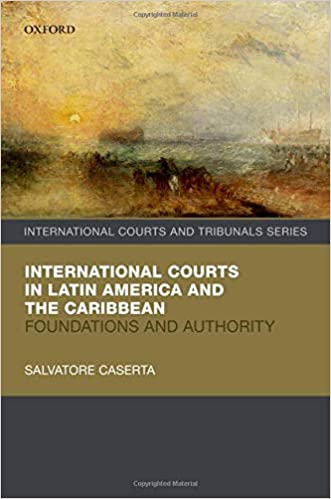
International courts in Latin America and the Caribbean : foundations and authority 이용현황 표 - 등록번호, 청구기호, 권별정보, 자료실, 이용여부로 구성 되어있습니다.
등록번호
청구기호
권별정보
자료실
이용여부
0002743523
LM 341.55 -A21-1
서울관 서고(열람신청 후 1층 대출대)
이용가능
출판사 책소개
This book explores the foundations and evolution of the four Latin American and Caribbean regional economic courts. It argues that local socio-political factors are often the decisive factor in influencing the direction of these Courts, rather than the formally delegated functions they were assigned when established.
This book provides the first in-depth and empirically grounded analysis of the foundations and evolution of the four Latin American and Caribbean regional economic courts: the Central American Court of Justice (CACJ), the Caribbean Court of Justice (CCJ), the Andean Tribunal of Justice (ATJ), and the Mercosur Permanent Review Court (MPRC). While these Courts were established to build common markets and to enforce trade liberalisation, they have often developed bodiesof jurisprudence in domains not directly associated with regional economic integration. The CCJ has been most successful in the area of human and fundamental rights; the CACJ has addressed issues related to the enforcement of the rule of law in national legal arenas and longstanding border disputesbetween the countries of the region; and the ATJ is an island of effective adjudication on intellectual property issues. The particular trajectories of these four Courts suggest that there is no universal formula for success. Challenging the mainstream account, this book argues that the Courts' operational path is not necessarily a function of their formally delegated competences or the will of the Member States. Rather, local socio-political contextual factors play a far more decisive role in influencing the direction of regional economic courts during and after their establishment.

 대표어
대표어