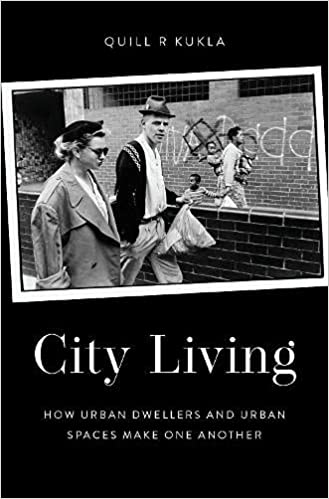
xvii, 319 pages, 8 unnumbered pages of plates : illustrations (some color) ; 25 cm
표준번호/부호
ISBN: 9780190855369 ISBN: 9780190855383
제어번호
MONO22022000007603
주기사항
Includes bibliographical references and index.
연계정보
외부기관 원문
목차보기
Preface Guide for Readers Chapter 1: Inhabiting Space Chapter 2: Urban Space and City Living Chapter 3: Living with Gentrification Chapter 4: Introduction to Repurposed Cities Chapter 5: The Repurposed City of Berlin Chapter 6: The Repurposed City of Johannesburg
이용현황보기
City living : how urban dwellers and urban spaces make one another 이용현황 표 - 등록번호, 청구기호, 권별정보, 자료실, 이용여부로 구성 되어있습니다.
등록번호
청구기호
권별정보
자료실
이용여부
0002889016
307.76 -A22-25
서울관 서고(열람신청 후 1층 대출대)
이용가능
출판사 책소개
Cities shape the people who live in them, while in turn, people shape the cities in which they live. In this book, Quill R. Kukla explores how city living is distinctive, and how people build territories for themselves and make themselves at home in cities. Through a philosophical exploration of what it means to be a city dweller, and rich and detailed explorations of particular cities such as Berlin, Johannesburg, and Washington, D.C., City Living shows howthe cities we live in penetrate every dimension of our lives, from how we move to how we see, and conversely, how city dwellers creatively bend their cities to their needs.
City Living is about urban spaces, urban dwellers, and how these spaces and people make, shape, and change one another. More people live in cities than ever before: more than 50% of the earth's people are urban dwellers. As downtown cores gentrify and globalize, they are becoming more diverse than ever, along lines of race, ethnicity, socioeconomic class, sexuality, and age. Meanwhile, we are in the early stages of what seems sure to be a period of intensecivil unrest. During such periods, cities generally become the primary sites where tensions and resistance are concentrated, negotiated, and performed. For all of these reasons, understanding cities and contemporary city living is pressing and exciting from almost any disciplinary and political perspective.Quill R. Kukla offers the first systematic philosophical investigation of the nature of city life and city dwellers. The book draws on empirical and ethnographic work in geography, anthropology, urban planning, and several other disciplines in order to explore the impact that cities have on their dwellers and that dwellers have on their cities. It begins with a philosophical exploration of spatially embodied agency and of the specific forms of agency and spatiality that are distinctive of urbanlife. It explores how gentrification is enacted and experienced at the level of embodied agency, arguing that gentrifying spaces are contested territories that shape and are shaped by their dwellers. The book then moves to an exploration of repurposed cities, which are cities materially designed tosupport one sociopolitical order, but in which that order collapsed, leaving new dwellers to use the space in new ways. Through detailed original ethnography of the repurposed cities of Berlin and Johannesburg, Kukla makes the case that in repurposed cities, we can see vividly how material spaces shape and constrain the agency and experience of dwellers, while dwellers creatively shape the spaces they inhabit in accordance with their needs. The book concludes with a reconsideration of the rightto the city, asking what would be involved in creating a city that enabled the agency and flourishing of all its diverse inhabitants.


 대표어