
 대표어
대표어
권호기사보기
| 기사명 | 저자명 | 페이지 | 원문 | 기사목차 |
|---|
결과 내 검색
동의어 포함
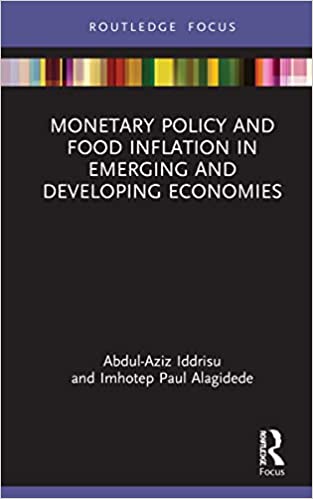
This book focuses on the impact of monetary policy and food price volatility and inflation in emerging and developing economies.
The tendency for food price volatility to blot inflation forecasting accuracy, engender tail dynamics in the overall inflation trajectory and derail economic welfare is well known in the literature. The ability of monetary policy to exact stability in food prices, theoretically, has also been well espoused. The empirical evidence, however, is not only in short supply, but also the studies available have dwelt on approaches that underplay the volatile behaviour of food prices. This book focuses on inflation targeting in emerging economies such as Chile, Mexico, Turkey, Brazil, Hungary, Russia, Colombia, South Africa, Indonesia and Ghana, as these are economies with considerable proportion of the consumption basket occupied by food. The book provides the means to understand at first hand the correct way to model food inflation, account for the related policy responses to deviations either in the short or medium to long term, and in market conditions that are subject to excessive variability. Strong evidence is presented that captures deviations of food prices from their trend and the accompanying monetary policy effect in stabilizing such variabilities across distinct frequencies. The novel approach in this book addresses the burgeoning puzzles of asymmetry in monetary policy effect on food prices at high, medium and low episodes of food inflation. In doing so, this book presents a powerful tool for researchers interested in understanding not just the transmission mechanism, but also the magnitudes involved, and to policymakers whose existing tools have failed them. Future studies will do well to deepen the evidence and seek new grounds to which the phenomenon manifests beyond and below emerging markets.
This book will be of great interest to students, scholars and policymakers involved in agricultural economics, financial economics, food security and sustainable development.
| 등록번호 | 청구기호 | 권별정보 | 자료실 | 이용여부 |
|---|---|---|---|---|
| 0002908210 | 332.41 -A22-12 | 서울관 서고(열람신청 후 1층 대출대) | 이용가능 |

This book focuses on the impact of monetary policy and food price volatility and inflation in emerging and developing economies.
The tendency for food price volatility to blot inflation forecasting accuracy, engender tail dynamics in the overall inflation trajectory and derail economic welfare is well known in the literature. The ability of monetary policy to exact stability in food prices, theoretically, has also been well espoused. The empirical evidence, however, is not only in short supply, but also the studies available have dwelt on approaches that underplay the volatile behaviour of food prices. This book focuses on inflation targeting in emerging economies such as Chile, Mexico, Turkey, Brazil, Hungary, Russia, Colombia, South Africa, Indonesia and Ghana, as these are economies with considerable proportion of the consumption basket occupied by food. The book provides the means to understand at first hand the correct way to model food inflation, account for the related policy responses to deviations either in the short or medium to long term, and in market conditions that are subject to excessive variability. Strong evidence is presented that captures deviations of food prices from their trend and the accompanying monetary policy effect in stabilizing such variabilities across distinct frequencies. The novel approach in this book addresses the burgeoning puzzles of asymmetry in monetary policy effect on food prices at high, medium and low episodes of food inflation. In doing so, this book presents a powerful tool for researchers interested in understanding not just the transmission mechanism, but also the magnitudes involved, and to policymakers whose existing tools have failed them. Future studies will do well to deepen the evidence and seek new grounds to which the phenomenon manifests beyond and below emerging markets.
This book will be of great interest to students, scholars and policymakers involved in agricultural economics, financial economics, food security and sustainable development.
This book focuses on the impact of monetary policy and food price volatility and inflation in emerging and developing economies.
*표시는 필수 입력사항입니다.
| 전화번호 |
|---|
| 기사명 | 저자명 | 페이지 | 원문 | 기사목차 |
|---|
| 번호 | 발행일자 | 권호명 | 제본정보 | 자료실 | 원문 | 신청 페이지 |
|---|
도서위치안내: / 서가번호:

우편복사 목록담기를 완료하였습니다.
*표시는 필수 입력사항입니다.
저장 되었습니다.
