Includes bibliographical references (pages 295-336) and index.
연계정보
외부기관 원문
목차보기
List of Figures and Tables Acknowledgments Introduction 1. Understanding Judicial Partisanship 2. Courts, Parties, and the Voting Rights Act 3. Courts, Parties, and Voter Identification 4. Courts, Parties, and Redistricting 5. Courts, Parties, and Campaign Finance Conclusion Notes Bibliography Index
이용현황보기
Partisan supremacy : how the GOP enlisted courts to rig America's election rules 이용현황 표 - 등록번호, 청구기호, 권별정보, 자료실, 이용여부로 구성 되어있습니다.
등록번호
청구기호
권별정보
자료실
이용여부
0003059565
LM 342.7307 -A24-1
서울관 서고(열람신청 후 1층 대출대)
이용가능
출판사 책소개
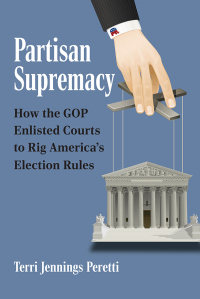
&;I have no agenda,&; US Supreme Court Chief Justice John Roberts proclaimed at his Senate confirmation hearing: &;My job is to call balls and strikes and not to pitch or bat.&; This declaration was in keeping with the avowed independence of the judiciary. It also, when viewed through the lens of Roberts&;s election law decisions, appears to be false. With a scrupulous reading of judicial decisions and a careful assessment of partisan causes and consequences, Terri Jennings Peretti tells the story of the GOP&;s largely successful campaign to enlist judicial aid for its self-interested election reform agenda.
Partisan Supremacy explores four contemporary election law issues&;voter identification, gerrymandering, campaign finance, and the preclearance regime of the Voting Rights Act&;to uncover whether Republican politicians and Republican judges have collaborated to tilt America&;s election rules in the GOP&;s favor. Considering cases from Shelby County v. Holder, which enfeebled the Voting Rights Act, to Crawford v. Marion County Election Board, which upheld restrictive voter identification laws, to Citizens United and McCutcheon, which loosened campaign finance restrictions, Peretti lays bare the reality of &;friendly&; judicial review and partisan supremacy when it comes to election law. She nonetheless finds a mixed verdict in the redistricting area that reveals the limits of partisan control over judicial decisions. Peretti&;s book helpfully places the current GOP&;s voter suppression campaign in historical context by acknowledging similar efforts by the postCivil War Democratic Party. While the modern Democratic Party seeks electoral advantage by expanding voting by America&;s minorities and youth, arguably hewing closer to democratic principles, neither party is immune to the powerful incentive to bend election rules in its favor.
In view of the evidence that Partisan Supremacy brings to light, we are left with a critical and pressing question: Can democracy survive in the face of partisan collaboration across the branches of government on critical election issues?

 대표어
대표어