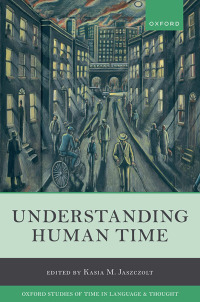
Oxford studies of time in language and thought ; 5
표준번호/부호
ISBN: 9780192896445
제어번호
MONO22024000002981
주기사항
Includes bibliographical references (pages [319]-347) and index.
연계정보
외부기관 원문
목차보기
General preface Preface The contributors 1. Introduction: Metaphysical time, human time, and time in language 2. Tense and emotion 3. An exploration into construals of subjective time in poetry 4. The 2D past 5. Counterfactuality as pragmatic inference in perspectival readings of Past Conditional utterances with modal verbs: Evidence from French 6. Avertive/frustrative markers in Australian languages: Blurring the boundaries between aspectuo-temporal and modal meanings 7. On modelling the future 8. Perceiving direction in directionless time 9. Temporal transparency and the flow of time 10. Does human time really flow? Metaindexicality, metarepresentation, and basic concepts 11. Underspecified temporal semantics in Pirahã: Compositional transparency and semiotic inference References Index
이용현황보기
Understanding human time 이용현황 표 - 등록번호, 청구기호, 권별정보, 자료실, 이용여부로 구성 되어있습니다.
등록번호
청구기호
권별정보
자료실
이용여부
0003075465
153.753 -A24-1
서울관 서고(열람신청 후 1층 대출대)
이용가능
출판사 책소개
This book explores the time that we (think we) experience and the concept of time in our beliefs, our knowledge, and our fears. The chapters bring together insights from linguists and philosophers to examine questions about time on the micro-level of physical reality, as well as time in language and discourse on the macro-level of social reality.
This book explores the time that we (think we) experience and the concept of time in our beliefs, our knowledge, and our fears. We believe that time passes, we know that death is inevitable, we fear that we are going to be late. How do these human feelings and sensations of time relate to metaphysical time of tenseless reality? What do different languages tell us about the nature of human time? And what exactly is the flow of time? The chapters in this volume bringtogether insights from linguists and philosophers to examine questions about time on the micro-level of physical reality, as well as time in language and discourse on the macro-level of social reality. The unifying theme is that in order to understand human time we have to discover not only how wethink and speak about time, but also what it is that makes us think and speak about it in a certain way.

 대표어