
 대표어
 https://documents.worldbank.org/en/publication/documents-reports/documentdetail/099146012112331629/IDU0e959f3f60973404af0088210e669e5f07689
권호기사보기
| 기사명 | 저자명 | 페이지 | 원문 | 기사목차 |
|---|
결과 내 검색
동의어 포함
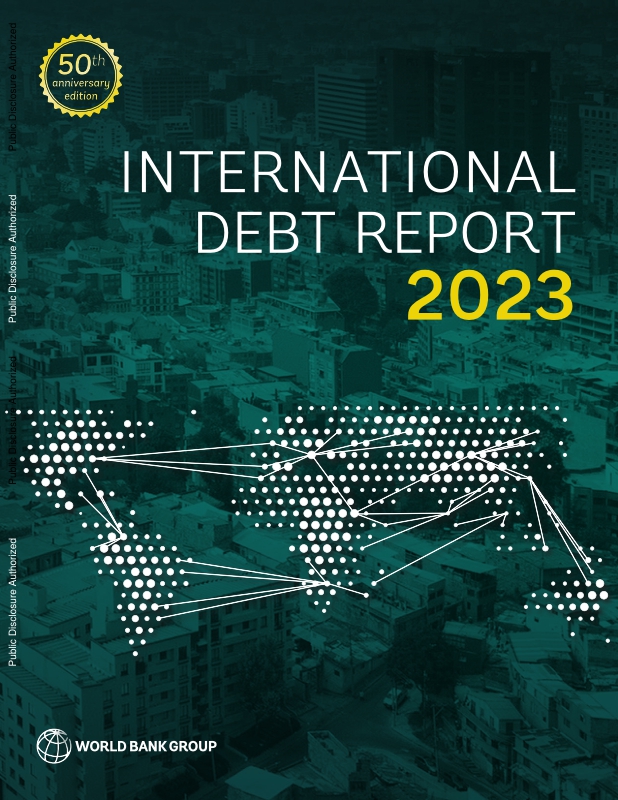
Title page
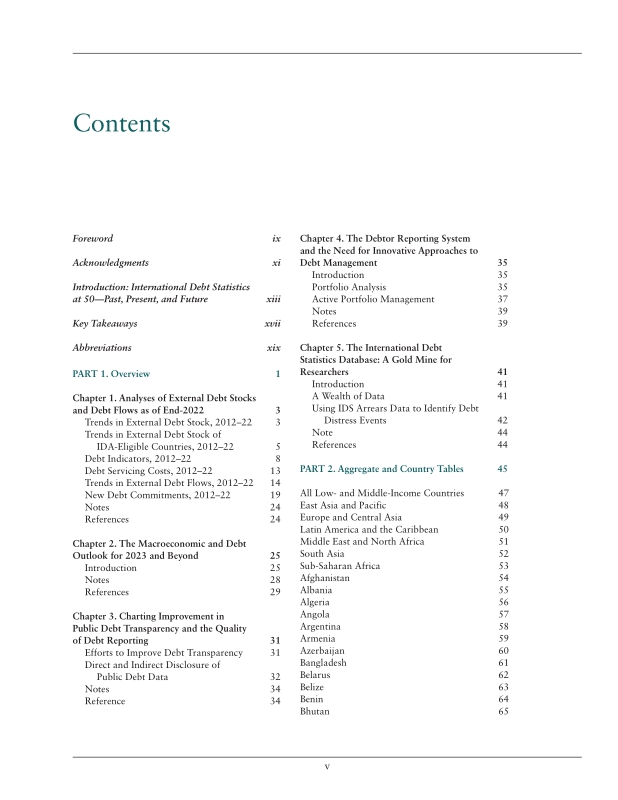
Contents
Foreword 9
Acknowledgments 11
Introduction: International Debt Statistics at 50-Past, Present, and Future 12
Key Takeaways 16
Abbreviations 18
PART 1. Overview 19
1. Analyses of External Debt Stocks and Debt Flows as of End-2022 20
Trends in External Debt Stock, 2012-22 20
Trends in External Debt Stock of IDA-Eligible Countries, 2012-22 22
Debt Indicators, 2012-22 25
Debt Servicing Costs, 2012-22 30
Trends in External Debt Flows, 2012-22 31
New Debt Commitments, 2012-22 36
Notes 41
References 41
2. The Macroeconomic and Debt Outlook for 2023 and Beyond 42
Introduction 42
Notes 45
References 46
3. Charting Improvement in Public Debt Transparency and the Quality of Debt Reporting 47
Efforts to Improve Debt Transparency 47
Direct and Indirect Disclosure of Public Debt Data 48
Notes 50
Reference 50
4. The Debtor Reporting System and the Need for Innovative Approaches to Debt Management 51
Introduction 51
Portfolio Analysis 51
Active Portfolio Management 53
Notes 55
References 55
5. The International Debt Statistics Database: A Gold Mine for Researchers 56
Introduction 56
A Wealth of Data 56
Using IDS Arrears Data to Identify Debt Distress Events 57
Note 59
References 59
PART 2. Aggregate and Country Tables 60
ALL LOW- AND MIDDLE-INCOME COUNTRIES 61
EAST ASIA AND PACIFIC 62
EUROPE AND CENTRAL ASIA 63
LATIN AMERICA AND THE CARIBBEAN 64
MIDDLE EAST AND NORTH AFRICA 65
SOUTH ASIA 66
SUB-SAHARAN AFRICA 67
AFGHANISTAN 68
ALBANIA 69
ALGERIA 70
ANGOLA 71
ARGENTINA 72
ARMENIA 73
AZERBAIJAN 74
BANGLADESH 75
BELARUS 76
BELIZE 77
BENIN 78
BHUTAN 79
BOLIVIA 80
BOSNIA AND HERZEGOVINA 81
BOTSWANA 82
BRAZIL 83
BULGARIA 84
BURKINA FASO 85
BURUNDI 86
CABO VERDE 87
CAMBODIA 88
CAMEROON 89
CENTRAL AFRICAN REPUBLIC 90
CHAD 91
CHINA 92
COLOMBIA 93
COMOROS 94
CONGO, DEMOCRATIC REPUBLIC OF 95
CONGO, REPUBLIC OF 96
COSTA RICA 97
CÔTE D'IVOIRE 98
DJIBOUTI 99
DOMINICA 100
DOMINICAN REPUBLIC 101
ECUADOR 102
EGYPT, ARAB REPUBLIC OF 103
EL SALVADOR 104
ERITREA 105
ESWATINI 106
ETHIOPIA 107
FIJI 108
GABON 109
GAMBIA, THE 110
GEORGIA 111
GHANA 112
GRENADA 113
GUATEMALA 114
GUINEA 115
GUINEA-BISSAU 116
GUYANA 117
HAITI 118
HONDURAS 119
INDIA 120
INDONESIA 121
IRAN, ISLAMIC REPUBLIC OF 122
IRAQ 123
JAMAICA 124
JORDAN 125
KAZAKHSTAN 126
KENYA 127
KOSOVO 128
KYRGYZ REPUBLIC 129
LAO PEOPLE'S DEMOCRATIC REPUBLIC 130
LEBANON 131
LESOTHO 132
LIBERIA 133
MADAGASCAR 134
MALAWI 135
MALDIVES 136
MALI 137
MAURITANIA 138
MAURITIUS 139
MEXICO 140
MOLDOVA 141
MONGOLIA 142
MONTENEGRO 143
MOROCCO 144
MOZAMBIQUE 145
MYANMAR 146
NEPAL 147
NICARAGUA 148
NIGER 149
NIGERIA 150
NORTH MACEDONIA 151
PAKISTAN 152
PAPUA NEW GUINEA 153
PARAGUAY 154
PERU 155
PHILIPPINES 156
RUSSIAN FEDERATION 157
RWANDA 158
SAMOA 159
SÃO TOMÉ AND PRÍNCIPE 160
SENEGAL 161
SERBIA 162
SIERRA LEONE 163
SOLOMON ISLANDS 164
SOMALIA 165
SOUTH AFRICA 166
SRI LANKA 167
ST. LUCIA 168
ST. VINCENT AND THE GRENADINES 169
SUDAN 170
SURINAME 171
SYRIAN ARAB REPUBLIC 172
TAJIKISTAN 173
TANZANIA 174
THAILAND 175
TIMOR-LESTE 176
TOGO 177
TONGA 178
TUNISIA 179
TÜRKIYE 180
TURKMENISTAN 181
UGANDA 182
UKRAINE 183
UZBEKISTAN 184
VANUATU 185
VIET NAM 186
YEMEN, REPUBLIC OF 187
ZAMBIA 188
ZIMBABWE 189
Appendix 190
Data Sources 191
Country Groups 193
Regional Groups 193
Income Groups 194
Glossary 195
Figure 1.1. Percent Change in External Debt Stocks of Low- and Middle-Income Countries, 2012-22 20
Figure 1.2. Share of External Debt Stocks of Low- and Middle-Income Countries, 2012-22 21
Figure 1.3. Composition of Debt Stock in Low- and Middle-Income Countries, 2012-22 22
Figure 1.4. Creditor Composition of Long-Term Public and Publicly Guaranteed External Debt for IDA-Eligible Countries, 2012-22 23
Figure 1.5. External Debt-to-GNI Ratios for Low- and Middle-Income Countries and IDA-Eligible Countries, 2012-22 26
Figure 1.6. Change in External Debt Stock and GNI, by Income and Lending Group, 2012-22 28
Figure 1.7. Change in External Debt Stock and GNI, by Region, 2012-22 28
Figure 1.8. Change in External Debt Stock and Exports, by Income and Lending Group, 2012-22 29
Figure 1.9. Total Debt Service and Interest Payments on External Debt for IDA-Eligible Countries, 2012-22 30
Figure 1.10. Net Debt Inflows to Low- and Middle-Income Countries, by Maturity, 2012-22 31
Figure 1.11. Bond Flows to Low- and Middle-Income Countries (excluding China), by Borrower Type, 2021 vs. 2022 34
Figure 1.12. Net Flows to IDA-Eligible Countries, by Region and Creditor Type, 2022 35
Figure 1.13. Net Equity Inflows and External Debt Flows to Low- and Middle-Income Countries, 2012-22 35
Figure 1.14. Loan Commitments to IDA-Eligible and IBRD-Only Countries, 2012-22 36
Figure 1.15. New Commitments from Multilateral Creditors to IDA-Eligible and IBRD-Only Countries, 2012-22 38
Figure 1.16. New Commitments from Bilateral Creditors to IDA-Eligible and IBRD-Only Countries, 2012-22 38
Figure 1.17. Percent Share of Loan Commitments to IDA-Eligible Countries, by Creditor Type, 2012-22 39
Figure 2.1. Percent Change in Gross Domestic Product Growth, 2018-24 42
Figure 2.2. Changes in External Debt-to-GNI Ratios, 1970-2022 44
Figure 2.3. Composition of Government Expenditures in Low- and Middle-Income Countries, 2010s vs. 2020s 45
Figure 3.1. Performance and Policy Actions, July 1, 2020, to June 30, 2023 48
Figure 4.1. Distribution of Interest Rates on Outstanding External Public Debt across IDA-Only Countries 52
Figure 4.2. Histogram of Commitment Fees across the Debt Portfolio of Official Loans 53
Figure 5.1. Risk of External Debt Distress among IDA-Eligible Countries, 2006-23 57
Figure 5.2. Projected Debt Service Payments and External Default Episodes, Selected Countries, 1970-2021 58
Boxes
Box 1.1. Allocation of the IMF's Special Drawing Rights in 2022 21
Box 1.2. External Debt Data: Concepts, Sources, and Coverage 24
Box 1.3. Debt-to-GDP versus Debt-to-GNI Ratios 26
Box 1.4. World Bank Income and Lending Classifications Used in International Debt Report 2023 27
Box 1.5. China: The Largest Borrower among Low- and Middle-Income Countries 32
Box 1.6. IDA Grants: Contributing to Reducing Debt Vulnerabilities 37
Box 1.7. China: Low- and Middle-Income Countries' Largest Bilateral Creditor 39
Box Figures
Figure B1.1.1. SDR Allocations as a Share of General Government External Debt and International Reserves, by Region, 2022 22
Figure B1.4.1. Number of Low- and Middle-Income Countries and Guyana Covered in International Debt Report 2023, by FY2024 Income and Lending Groups 27
Figure B1.5.1. Net Financial Flows to China, 2012-22 32
Figure B1.6.1. IDA Gross and Net Inflows of Credits and Grants to IDA-Eligible Countries, 2012-22 37
Figure B1.7.1. Low- and Middle-Income Countries' Debt to China, by Region, 2012-22 39
Figure B1.7.2. Commitments from China to Low- and Middle-Income Countries, by Region 2012-22 40

*표시는 필수 입력사항입니다.
| 전화번호 |
|---|
| 기사명 | 저자명 | 페이지 | 원문 | 기사목차 |
|---|
| 번호 | 발행일자 | 권호명 | 제본정보 | 자료실 | 원문 | 신청 페이지 |
|---|
도서위치안내: / 서가번호:

우편복사 목록담기를 완료하였습니다.
*표시는 필수 입력사항입니다.
저장 되었습니다.
