
 대표어
대표어
 https://library.wmo.int/records/item/69130-guide-to-the-wmo-information-system-volume-ii?offset=1
권호기사보기
| 기사명 | 저자명 | 페이지 | 원문 | 기사목차 |
|---|
결과 내 검색
동의어 포함
Title page 1
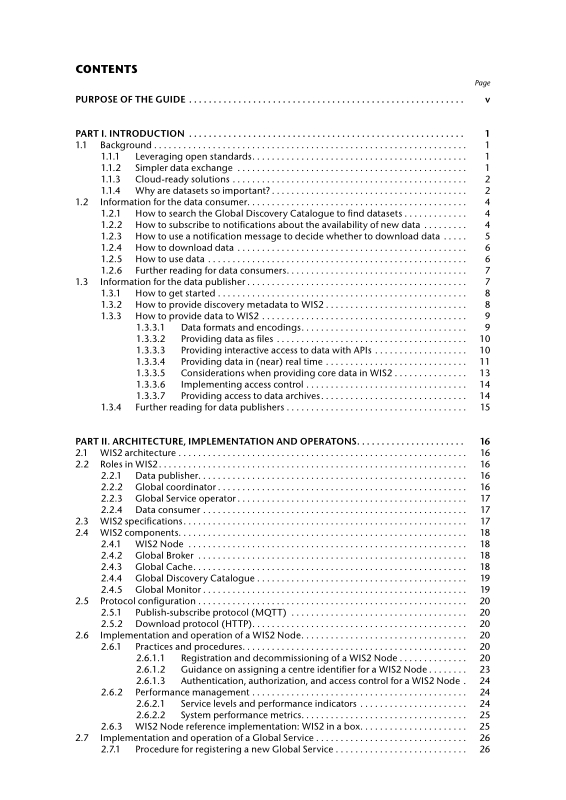
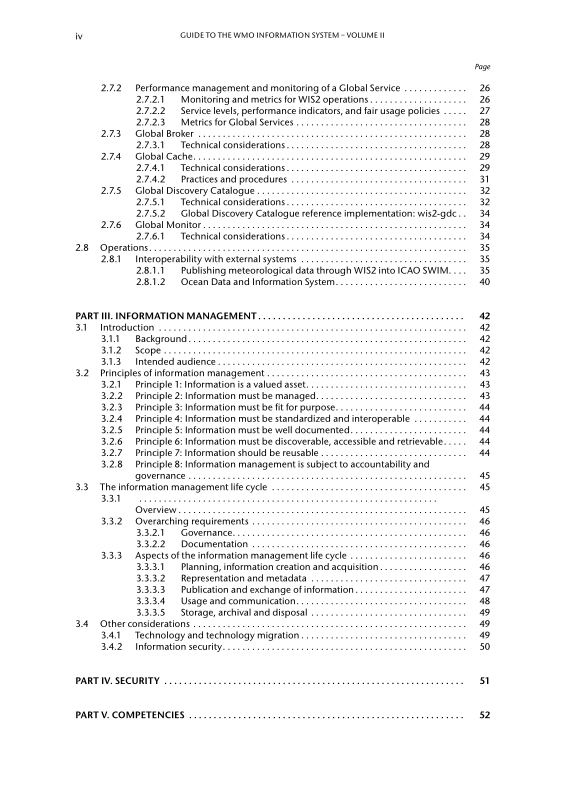
Contents 4
PURPOSE OF THE GUIDE 6
PART I. INTRODUCTION 7
1.1. BACKGROUND 7
1.1.1. Leveraging open standards 7
1.1.2. Simpler data exchange 7
1.1.3. Cloud-ready solutions 8
1.1.4. Why are datasets so important? 8
1.2. INFORMATION FOR THE DATA CONSUMER 10
1.2.1. How to search the Global Discovery Catalogue to find datasets 10
1.2.2. How to subscribe to notifications about the availability of new data 10
1.2.3. How to use a notification message to decide whether to download data 11
1.2.4. How to download data 12
1.2.5. How to use data 12
1.2.6. Further reading for data consumers 13
1.3. INFORMATION FOR THE DATA PUBLISHER 13
1.3.1. How to get started 14
1.3.2. How to provide discovery metadata to WIS2 14
1.3.3. How to provide data to WIS2 15
1.3.3.1. Data formats and encodings 15
1.3.3.2. Providing data as files 16
1.3.3.3. Providing interactive access to data with APIs 16
1.3.3.4. Providing data in (near) real time 17
1.3.3.5. Considerations when providing core data in WIS2 19
1.3.3.6. Implementing access control 20
1.3.3.7. Providing access to data archives 20
1.3.4. Further reading for data publishers 21
PART II. ARCHITECTURE, IMPLEMENTATION AND OPERATONS 22
2.1. WIS2 ARCHITECTURE 22
2.2. ROLES IN WIS2 22
2.2.1. Data publisher 22
2.2.2. Global coordinator 22
2.2.3. Global Service operator 23
2.2.4. Data consumer 23
2.3. WIS2 SPECIFICATIONS 23
2.4. WIS2 COMPONENTS 24
2.4.1. WIS2 Node 24
2.4.2. Global Broker 24
2.4.3. Global Cache 24
2.4.4. Global Discovery Catalogue 25
2.4.5. Global Monitor 25
2.5. PROTOCOL CONFIGURATION 26
2.5.1. Publish-subscribe protocol (MQTT) 26
2.5.2. Download protocol (HTTP) 26
2.6. IMPLEMENTATION AND OPERATION OF A WIS2 NODE 26
2.6.1. Practices and procedures 26
2.6.1.1. Registration and decommissioning of a WIS2 Node 26
2.6.1.2. Guidance on assigning a centre identifier for a WIS2 Node 29
2.6.1.3. Authentication, authorization, and access control for a WIS2 Node 30
2.6.2. Performance management 30
2.6.2.1. Service levels and performance indicators 30
2.6.2.2. System performance metrics 31
2.6.3. WIS2 Node reference implementation: WIS2 in a box 31
2.7. IMPLEMENTATION AND OPERATION OF A GLOBAL SERVICE 32
2.7.1. Procedure for registering a new Global Service 32
2.7.2. Performance management and monitoring of a Global Service 32
2.7.2.1. Monitoring and metrics for WIS2 operations 32
2.7.2.2. Service levels, performance indicators, and fair usage policies 33
2.7.2.3. Metrics for Global Services 34
2.7.3. Global Broker 34
2.7.3.1. Technical considerations 34
2.7.4. Global Cache 35
2.7.4.1. Technical considerations 35
2.7.4.2. Practices and procedures 37
2.7.5. Global Discovery Catalogue 38
2.7.5.1. Technical considerations 38
2.7.5.2. Global Discovery Catalogue reference implementation: wis2-gdc 40
2.7.6. Global Monitor 40
2.7.6.1. Technical considerations 40
2.8. OPERATIONS 41
2.8.1. Interoperability with external systems 41
2.8.1.1. Publishing meteorological data through WIS2 into ICAO SWIM 41
2.8.1.2. Ocean Data and Information System 46
PART III. INFORMATION MANAGEMENT 48
3.1. INTRODUCTION 48
3.1.1. Background 48
3.1.2. Scope 48
3.1.3. Intended audience 48
3.2. PRINCIPLES OF INFORMATION MANAGEMENT 49
3.2.1. Principle 1: Information is a valued asset 49
3.2.2. Principle 2: Information must be managed 49
3.2.3. Principle 3: Information must be fit for purpose 50
3.2.4. Principle 4: Information must be standardized and interoperable 50
3.2.5. Principle 5: Information must be well documented 50
3.2.6. Principle 6: Information must be discoverable, accessible and retrievable 50
3.2.7. Principle 7: Information should be reusable 50
3.2.8. Principle 8: Information management is subject to accountability and governance 51
3.3. THE INFORMATION MANAGEMENT LIFE CYCLE 51
3.3.1. Overview 51
3.3.2. Overarching requirements 52
3.3.2.1. Governance 52
3.3.2.2. Documentation 52
3.3.3. Aspects of the information management life cycle 52
3.3.3.1. Planning, information creation and acquisition 52
3.3.3.2. Representation and metadata 53
3.3.3.3. Publication and exchange of information 53
3.3.3.4. Usage and communication 54
3.3.3.5. Storage, archival and disposal 55
3.4. OTHER CONSIDERATIONS 55
3.4.1. Technology and technology migration 55
3.4.2. Information security 56
PART IV. SECURITY 57
PART V. COMPETENCIES 58
Figures 28
Figure 1. Diagram of the process for registering a WIS2 Node 28
Figure 2. Schematic of an interoperability approach 42
Figure 3. Interactions between the gateway component and the WIS2 and SWIM components 45
Figure 4. WIS2 and ODIS metadata and catalogue interoperability 47
*표시는 필수 입력사항입니다.
| 전화번호 |
|---|
| 기사명 | 저자명 | 페이지 | 원문 | 기사목차 |
|---|
| 번호 | 발행일자 | 권호명 | 제본정보 | 자료실 | 원문 | 신청 페이지 |
|---|
도서위치안내: / 서가번호:

우편복사 목록담기를 완료하였습니다.
*표시는 필수 입력사항입니다.
저장 되었습니다.
