본문 바로가기 주메뉴 바로가기
국회도서관 홈으로 정보검색 소장정보 검색

결과 내 검색

동의어 포함

목차보기


Acknowledgements
List of Abbreviations
1 Introduction
Introduction
The Global Regulation of Medical Products
The Role of Regulatory Regimes for Medical Products
Regulatory Harmonisation
An Unwavering Spotlight on Medical Products Regulation: The COVID-19 Pandemic
Australia’s Regulatory Regime for ‘Therapeutic Goods’ in the Global Context
Political Legitimacy as a Tool of Investigation
Failings in Political Legitimacy and Addressing the Challenges
Outline of the Book
2 The Foundations of the Regulation of Medical Products
Introduction
Scientism and Technocracy: The Ideas That Shaped the Regulation of Medical Products
The History of the Regulation of Medical Products
An Overview of the United States and European Union
Australia in Focus
Conclusion
3 A Constant Dialogic Approach to Political Legitimacy
Introduction
The Diverse Meanings of Political Legitimacy
Normative Approaches to Political Legitimacy
Descriptive Approaches to Political Legitimacy
Combined Normative and Descriptive Approaches to Political Legitimacy
A Foundation for Legitimacy: David Beetham’s Framework of Legitimacy
Beetham’s Three Elements of Legitimacy
The Limitations of Beetham’s Framework
Building on Beetham: A Constant Dialogic Approach to Political Legitimacy
Key Characteristics of a Dialogic Approach to Political Legitimacy
Analysing the Therapeutic Goods Regulatory Regime: The Constant Dialogic Approach to Political Legitimacy
Conclusion
4 Voices of Change: Regulatory Reform of Medicinal Cannabis in Australia
Introduction
The Contemporary Regulation of Medicinal Cannabis
Commonwealth Regulation
Restricted Access to Medicinal Cannabis in Australia
The Regulatory Reform Period of 2014 to 2018
The Different Voices of Medicinal Cannabis Regulatory Change
The Dominant Voice
The Moderate Voice
The Radical Voice
What Does This Case Study Indicate about the Political Legitimacy of Therapeutic Goods Regulation?
The Challenge of the ‘Moderate’ and ‘Radical’ Voices to the Political Legitimacy of Therapeutic Goods Regulation
The Failure of Therapeutic Goods Regulation to Embrace the Constant Dialogic Approach to Political Legitimacy
Developments since 2018
Conclusion
5 A Normative Void: The Regulation of Medical Abortion in Australia
Introduction
Medical Abortion and RU486
The Regulatory History of RU486
The Law of Abortion in Australia
RU486 and the Therapeutic Goods Regulatory Regime
The Harradine Amendments
The Repeal of the Harradine Amendments
The Approval of RU486 in Australia
The Social and Ethical Issues Surrounding RU486
The Social and Ethical Co-production of Abortion
The Traditional Conceptualisation of Abortion
The Subversive Conceptualisation of Abortion
RU486 and the Harradine Amendments: A Challenge to the Political Legitimacy of the Therapeutic Goods Regulatory Regime
A Failure to Engage with the Social and Ethical Issues Surrounding RU486
A Failure to Engage in a Constant Dialogue with All Relevant Parties
Recent Developments
Conclusion
6 Shouting to Be Heard: The Regulation of Urogynaecological Mesh Devices in Australia
Introduction
Urogynaecological Mesh and its Regulation
What Is Urogynaecological Mesh?
The Polycentric Regulation of Urogynaecological Mesh Devices in Australia
Polycentric Regulation of Urogynaecological Mesh Devices and the Regulatory Information Loop
The Events of 2006 to 2021
Patient and Media Response
Regulatory Response
Political Response
Judicial Response
Factors Contributing to the Urogynaecological Mesh Device Controversy
The Conduct and Training of Clinicians
The Risk and Efficacy Profile of Urogynaecological Mesh Devices
The Inadequacy of ‘Informed Consent’ for Use of Urogynaecological Mesh Devices
The Underreporting of Adverse Events
What Does This Case Study Indicate about the Political Legitimacy of the Regulation of Therapeutic Goods?
The Challenge to Political Legitimacy
The Absence of the Constant Dialogic Approach to Political Legitimacy
Conclusion
7 Regulatory Challenges, Courage and Evolution
Introduction
Regulatory Challenge 1: The Regulatory Regime as Expert
A Directive and Unilateral Approach to Expertise
Regulatory Challenge 2: The Regulatory Regime as Scientist
Epistemic Arrogance
Epistemic Scarcity
The Regulatory Challenges and Political Legitimacy in Conflict
Confronting the Regulatory Paradox: Regulatory Courage and Evolution
Regulatory Courage
Regulatory Evolution 1 – Normative Pluralism
Regulatory Evolution 2 – Facilitative Expertise
Conclusion
8 Conclusion
Introduction
Findings
The ‘Post-Pandemic’ Regulation of Medical Products
Expectations
Challenges and Opportunities
Appendix 1: Chronology of Key Events Relating to Urogynaecological Mesh Devices (‘UMDs’)
Bibliography
Index

이용현황보기

The regulation of medical products : dope, drugs and devices 이용현황 표 - 등록번호, 청구기호, 권별정보, 자료실, 이용여부로 구성 되어있습니다.
등록번호 청구기호 권별정보 자료실 이용여부
0003187435 LM 344.94042 -A25-1 서울관 법률정보센터(206호) 북큐레이션
(자료실내 이용)

출판사 책소개

알라딘제공

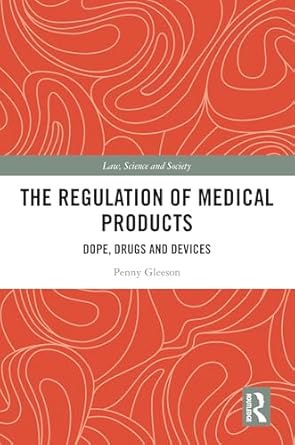
This book develops a theoretical framework for examining and assessing the regulatory arrangements for medical products.

Since the first half of the 20th century, the regulation of pharmaceuticals, medical devices and, more recently, biologicals have been controlled in many jurisdictions by specific regulatory regimes and agencies. Their regulatory mandates are similar ? to ensure the quality, safety and efficacy of medical products. This book provides a timely and relevant assessment of the complexities of medical regulatory regimes, by drawing on a particular theory of political legitimacy. In this respect, the book adopts a ‘dialogic’ approach ? according to which a shared set of normative beliefs and values are formulated ? as a theoretical ‘tool’ to identify deficiencies in the regulatory arrangements for medical products. Drawing on several Australian cases studies, characterised by divergent normative perspectives, the book develops its dialogic approach in order to challenge the usual legitimation of regulatory regimes from the perspective of science alone. Specifically, it maintains that such regimes need to embrace a normative pluralism that admits a diversity of types and sources of knowledge.

This evaluation of the increasingly influential domain of medical regulation will appeal to a range of scholars and practitioners working in law, public health, politics and science and technology studies.


This book develops a theoretical framework for examining and assessing the regulatory arrangements for medical products.


