본문 바로가기 주메뉴 바로가기
국회도서관 홈으로 정보검색 소장정보 검색

결과 내 검색

동의어 포함

목차보기


1 Introduction 1
Bibliography 10
Part I Conceptual Framework
2 Economic Analysis of Law 17
1 Introduction 18
2 On the Nature of Economic Reasoning 20
3 Methodology and Concepts Used in the Economic
Analysis of Law 22
Traditional Methodological Concepts: Wealth
Maximization, Risks and Transaction Costs 22
Transaction Costs 23
Uncertainty and Risks 25
4 Comparative Law and Economics 26
Positive and Normative Economic Analysis 27
5 Behavioural Law and Economics 30
General Implications and Evidences of Non-rational
Behaviour 32
6 Obstacles to an Economic Approach 35
7 Conclusions 36
Bibliography 36
3 The Case for Regulatory Intervention and Its Limits 43
1 Introduction 43
2 A Nirvana World: Perfect Competition 45
3 Market Failures 47
Information Asymmetries 47
Negative Externalities 50
4 Nature, Scope and Form of Regulation 51
5 Conclusion 53
Bibliography 53
4 Introduction to the Generative Artificial Intelligence
Systems 59
1 Introduction 59
2 A General Background and Key Concepts 61
3 Setting the Scene: Definitions, Concepts
and Research Trends 64
Intelligent and Logical Agents 67
Problem-Solving and Reasoning 68
4 Learning and Communicating 70
5 Robotics 71
6 Generative Artificial Intelligence 73
7 Conclusions 75
Bibliography 76
Part II Generative Artificial Intelligence and Key
Regulatory Questions
5 What Can Get Wrong? 85
1 Introduction 85
2 Can Generative AI Think and Act Intelligently? 87
3 Risks of Developing Artificial Intelligence 90
4 AI Making Moral Choices and Independent
Development 94
5 Conclusion 95
Bibliography 96
6 Key Regulatory Principles and Current Regulatory
Approaches 99
1 Introduction 100
2 Generative AI and Regulatory Problems 103
3 Five Criteria for Good Regulation 108
4 Regulatory Strategies: Self-regulation,
Meta-regulation and Regulatory Networks 112
5 Low of Torts: Responsibility and Liability 120
6 Tort Law and Economics 126
7 Causation and Generative Artificial Intelligence 128
8 Conclusion 132
Bibliography 133
7 Towards an Optimal Regulator: Assessment of the EU
Artificial Intelligence Act 145
1 Introduction 146
2 Current Trends in Legislative Activity 147
3 General Remarks and Economic Assessment 155
4 Hybrid Regulatory Approach and Co-regulatory
Initiative 159
5 Causality, Manufacturer Residual Liability
and Generative AI Agents 167
6 Global Regulatory Markets, Markets for Rules
and Private Regulators 179
7 Regulatory Golden Rule of Thumb and Optimal
Regulatory Timing 184
8 Liability for Harm Versus Safety Regulation 187
9 Regulatory Sandboxes and Innovation 188
10 Liability for Harm and Incentives to Innovate 195
11 Public Databases, Uncertainty and Transaction
Costs Problems of the EU AI Act 197
12 Conclusions 204
Bibliography 205
Epilogue 215
Index 219

이용현황보기

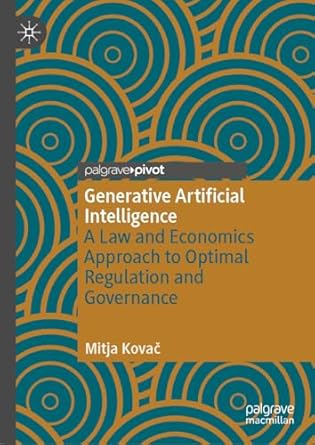
Generative artificial intelligence : a law and economics approach to optimal regulation and governance 이용현황 표 - 등록번호, 청구기호, 권별정보, 자료실, 이용여부로 구성 되어있습니다.
등록번호 청구기호 권별정보 자료실 이용여부
0003191705 LM 343.0999 -A25-12 서울관 법률정보센터(206호) 이용가능

출판사 책소개

알라딘제공

This book takes a comparative law and economics approach to explore the role of public and private actors in regulating generative artificial intelligence. The book provides an introduction and context for the creation of new generative AI technologies, now understood to be the chief goal of the leading AI companies. As autonomous 'super-intelligences', these technologies are still an unknown entity which nevertheless have profound implications for liberal democracy, consumer choice mechanisms, mutual trust, and political legitimacy.

This book explores the deep challenges posed for lawmakers and how we can achieve an optimal form of regulation and governance of such unreliable technologies. Chapters investigate possible hybrid modes of regulation, such as a co-regulatory approach between private AI companies and public actors in addressing the issue of misinformation spread. It also explores mixed types of regulation toward research on new forms of AI, arguing that different levels of systemic risk posed by different technologies must be accounted for. Different contemporary and historical contexts for the regulation of unprecedented technical innovation are also considered, and new suggestions for policy are presented. This book is a timely resource which will be of interest to researchers and practitioners in economic governance, law and regulation, artificial intelligence, and comparative law.


