
 대표어
대표어
 https://documents.worldbank.org/en/publication/documents-reports/documentdetail/099060425124082497






권호기사보기
| 기사명 | 저자명 | 페이지 | 원문 | 기사목차 |
|---|
결과 내 검색
동의어 포함
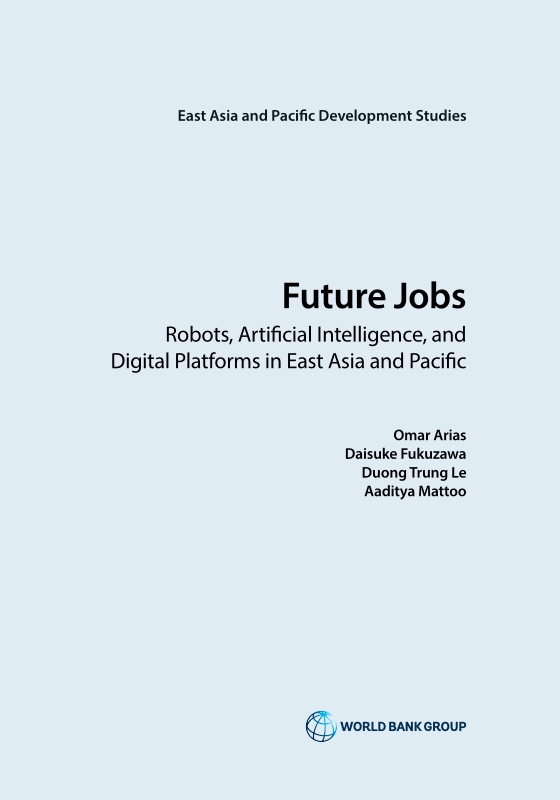
Title page 1
Contents 7
Foreword 13
Acknowledgments 15
About the Authors 17
Overview 19
Abbreviations 37
1. Stylized Facts about EAP Labor Markets 39
Introduction 39
Overall employment and earnings 39
Employment and earnings across sociodemographic groups 42
Trends in jobs and structural transformation 52
Notes 58
References 58
2. Technology and the Labor Market: Conceptual and Empirical Framework 60
Introduction 60
Technical feasibility: Tasks and job exposure to technology 61
Economic viability: Drivers of technology adoption 65
The technical feasibility and economic viability of technology 69
Notes 74
References 74
SPOTLIGHT 2.1. Measuring the Task Content of Jobs 76
3. Automation in Manufacturing: Industrial Robots 84
Introduction 84
Technical and economic drivers of the adoption of robots 84
Labor market impacts of robot adoption 90
Robots and jobs in Viet Nam 96
Notes 103
References 103
SPOTLIGHT 3.1. Technology, Agricultural Productivity, and Jobs in EAP and the World 108
4. Artificial Intelligence and Jobs 114
Introduction 114
Exposure to AI 114
AI exposure and labor market outcomes 125
Note 127
References 127
5. Working with Digital Technologies 129
Introduction 129
Digital jobs 129
Digital platforms 145
References 151
6. Technology, Jobs, and Structural Transformation: An Integrated View 157
Introduction 157
Summary of the empirical evidence 157
Cross-sectoral impacts of technology adoption on jobs 159
References 166
7. Policy Implications 168
Introduction 168
Skills 168
Facilitating labor and capital mobility 178
Removing factor price distortions 181
Expanding social protection to the informal sector 183
References 185
APPENDIX: Supplementary Data 191
Tables 12
TABLE 6.1. Linking stylized facts about EAP labor markets and the implications of technology adoption 158
Figures 9
FIGURE O.1. The task structure of jobs, EAP and advanced economies 21
FIGURE O.2. Correlation between labor costs and robot prices and labor costs and robot adoption, EAP and the world 23
FIGURE O.3. The stock of industrial robots and trends in robot adoption, EAP, 2000-22 24
FIGURE O.4. Relative labor costs and employment, by routine task intensity and country 26
FIGURE O.5. Effects of robot adoption on employment, wages, and informality, Viet Nam, 2014-20 27
FIGURE O.6. Estimated effects of robot adoption on district employment and wages, by age group, Viet Nam 28
FIGURE O.7. Exposure to AI: Correlation with sex, educational attainment, and wages, EAP, circa 2022 29
FIGURE O.8. Wages and the digital intensity of jobs, by formality and work experience, Indonesia, 2023 30
FIGURE O.9. Agricultural mechanization, robot adoption, and employment in agriculture and industry, EAP and the world, 1991-2021 32
FIGURE 1.1. Share of the working-age population in the total population and ratio of employment to working-age population, by country or grouping, 2010-23 40
FIGURE 1.2. Hourly wage and labor productivity growth, EAP, circa 2010-22 41
FIGURE 1.3. Unemployment rates and labor force participation rates, by age group, circa 2023 43
FIGURE 1.4. Wages: Youth and workers over age 50 relative to prime-age workers, five countries, 2010 or 2011 and 2019 44
FIGURE 1.5. Labor force status and changes in female participation rates, by sex, EAP 45
FIGURE 1.6. Changes in the gender wage gap in salaried jobs, five EAP countries, 2010 or 2011 and 2019 47
FIGURE 1.7. The educational attainment of the working-age population, East Asian countries and the Pacific Islands, circa 2010 and 2022 49
FIGURE 1.8. Wage premiums in secondary and tertiary education relative to primary education, five countries, 2010 or 2011 and 2019 51
FIGURE 1.9. Changes in employment share and real wages, by sector, EAP, 2010-19 53
FIGURE 1.10. Changes in the informal employment rate, by country and region, 2010-22 55
FIGURE 1.11. Changes in employment, by formal and informal status and type of work, five ASEAN countries, 2010-19 56
FIGURE 1.12. Real wage growth, by sector, five ASEAN countries, 2010-circa 2019 56
FIGURE 1.13. Average real wage growth, by occupation, EAP, 2010-19 57
FIGURE 2.1. The effects of new technologies on routine and nonroutine tasks: An integrated view 63
FIGURE 2.2. Employment by job task content, EAP and other regions 65
FIGURE 2.3. Economic viability of technology: Robot prices, labor costs, and robot adoption, the world 66
FIGURE 2.4. Jobs and technology in the EAP region: Technical susceptibility and economic viability 70
FIGURE 2.5. Relative labor costs and employment routine task intensity, by country 73
FIGURE 3.1. Adoption trends and the composition of industrial robots, EAP, 2000-22 89
FIGURE 3.2. Robot adoption and employment growth across industries, EAP, 2010-20 91
FIGURE 3.3. Total employment and average wage effects of robot adoption, five ASEAN countries 92
FIGURE 3.4. Industry composition of the stock of robots, Viet Nam, 2010-22 96
FIGURE 3.5. Estimated effects of robot adoption on employment and wages, by educational attainment, Viet Nam, 2014-20 98
FIGURE 3.6. Estimated effects of robot adoption on formal employment and the informality rate, Viet Nam, 2014-20 100
FIGURE 3.7. Estimated effects of robot adoption on district employment and wages, by sex, Viet Nam, 2014-20 101
FIGURE 3.8. Estimated effects of robot adoption on district employment and wages, by age group, Viet Nam, 2014-20 102
FIGURE 4.1. Exposure and complementarity with AI, by routine task intensity of physical and cognitive jobs, EAP and advanced economies 118
FIGURE 4.2. Exposure and complementarity with AI, EAP and other country groups 124
FIGURE 4.3. Exposure to AI: Correlation with sex, educational attainment, and sector of employment, EAP 125
FIGURE 4.4. Exposure to automation and AI, by age group, five EAP countries 126
FIGURE 4.5. The correlation of exposure to AI with earnings and employment growth, five countries in EAP 127
FIGURE 5.1. The share of employment in digitally intensive occupations, EAP and other selected economies 134
FIGURE 5.2. Earnings premiums and employment growth associated with digitally intensive occupations, five EAP countries 139
FIGURE 5.3. The effect of education and digital intensity on earnings, five EAP countries 140
FIGURE 5.4. Growth in earnings and employment, by sex, five EAP countries, 2010-19 141
FIGURE 5.5. Digital intensity and computer use among workers, by age group, five EAP countries 145
FIGURE 5.6. Top 100 digital platforms worldwide and the market value of the EAP digital economy 146
FIGURE 5.7. Growth in user traffic on digital platforms, the Philippines and Viet Nam 147
FIGURE 5.8. The effects of platform diffusion on firm productivity, value added, and employment, the Philippines and Viet Nam 148
FIGURE 5.9. Own-sector effects of platforms on enterprise and labor force composition and firm performance, Viet Nam 149
FIGURE 6.1. The structure of employment and economic development in EAP and the world, circa 1991-2023 162
FIGURE 6.2. Technology adoption, changes in employment structure, and economic development, EAP and the world, 1991-2021 163
FIGURE 6.3. Trends in the level and the share of employment in manufacturing, EAP and the world, 1990-2022 165
FIGURE 7.1. Meta-analysis of socioemotional learning programs: Average impacts 172
FIGURE 7.2. The supply of STEM graduates, EAP region, circa 2020 175
FIGURE 7.3. Correlation coefficient with engineering density, selected indicators, United States 176
FIGURE 7.4. Share of workers employed in agriculture in total employment, by birth cohort, 1999 and 2019 179
FIGURE 7.5. Robot adoption and the relative taxation of capital and labor, 2018 182
FIGURE 7.6. Likelihood of choosing a social insurance package over no insurance, Malaysia 185
Maps 12
MAP 3.1. Robot penetration and employment share of foreign-owned manufacturers, Viet Nam, annual averages, by district, 2014-20 97
Boxes 8
Box 2.1. Estimating robot prices across manufacturing industries 67
Box 3.1. Empirical evidence on the determinants of the adoption of robots 85
Box 3.2. The employment effects of industrial robots across the world: A literature review 93
Box 4.1. Who is adopting artificial intelligence? The correlates of AI adoption by individuals and firms 115
Box 4.2. AI exposure and differences in the tasks within occupations 120
Box 5.1. The creation of digital jobs in China 130
Box 5.2. The literature on employment and the labor impacts of digital connectivity 131
Box 5.3. Measuring the digital intensity of occupations 135
Box 5.4. Digital jobs, informality, and female labor force participation in Indonesia 141
Box 5.5. Income effect of ride-sharing platforms 150
Box 6.1. General equilibrium impacts of technology adoption on jobs 160
Box 7.1. Policy responses to the emergence of artificial intelligence in the Philippines 170
Box 7.2. Fostering the socioemotional skills of children 173
Box 7.3. Building advanced technical skills to harness digital technologies 177
Box 7.4. Innovative approaches to fostering social insurance for gig and self-employed workers 183
Box Tables 12
TABLE B2.3.1. Estimation of global-average robot prices, by robot type 68
TABLE B5.1.1. Examples of newly added digital occupations, China 130
TABLE B5.3.1. Digital intensity score and the share of occupations, by countries 136
Box Figures 10
FIGURE B3.1.1. Robot adoption: Determinants and correlation with sectoral wage 85
FIGURE B3.1.2. Correlation between robot adoption per worker and population aging 88
FIGURE B3.2.1. Meta-analysis of estimates on the employment effects of robotization 95
FIGURE B4.1.1. The correlates of AI adoption, by the characteristics of firms and individuals 116
FIGURE B4.2.1. A comparison of AI exposure estimates, by country 121
FIGURE B4.2.2. Decomposition of the differences in average AI exposure, by country 122
FIGURE B5.3.1. The digital intensity score and the share of workers using digital technologies, by occupations, Viet Nam, 2021 138
FIGURE B5.4.1. Share of workers using digital technologies, by sex and formal or informal status, Indonesia, 2018-23 142
FIGURE B5.4.2. The digital premium, by formal and informal status and job tenure, Indonesia 143
FIGURE B5.4.3. Share of workers who have insurance or pensions, by digital work and formal or informal status, Indonesia, 2023 144
FIGURE B5.5.1. The effects of ride-hailing platform entry on the earnings of motorbike and car drivers, Viet Nam 151
Spotlight Figures 10
FIGURE S2.1.1. Occupational structure by the task intensity of jobs, EAP and advanced economies 77
FIGURE S2.1.2. Routine task intensity, survey versus O*NET measures, EAP and other economies 80
FIGURE S2.1.3. The drivers of differences in routine task intensity across economies 82
FIGURE S3.1.1. Log agricultural machinery versus log gross domestic product per capita, EAP and the world, 1991 109
FIGURE S3.1.2. Trends in agricultural machinery and farm labor productivity, EAP, 1991-2022 110
FIGURE S3.1.3. Trends in farm employment and the mechanization effect 111
Appendix Tables 12
TABLE A.1. Regression results: Agricultural mechanization, employment, and productivity 204
Appendix Figures 12
FIGURE A.1. Task intensity and artificial intelligence exposure, EAP 192
FIGURE A.2. Unit price of technology, 1971-2023 199
FIGURE A.3. Change in robot adoption and wages, 2014-19 200
FIGURE A.4. Trends in employment in agriculture and services, 1990-2022 205
Appendix Boxes 9
Box A.1. Exposure to artificial intelligence and complementarity 201
Appendix Box Figures 12
FIGURE A1.1. AI exposure and complementarity among routine and nonroutine cognitive tasks, by occupation 202

*표시는 필수 입력사항입니다.
| 전화번호 |
|---|
| 기사명 | 저자명 | 페이지 | 원문 | 기사목차 |
|---|
| 번호 | 발행일자 | 권호명 | 제본정보 | 자료실 | 원문 | 신청 페이지 |
|---|
도서위치안내: / 서가번호:

우편복사 목록담기를 완료하였습니다.
*표시는 필수 입력사항입니다.
저장 되었습니다.
