본문 바로가기 주메뉴 바로가기
국회도서관 홈으로 정보검색 소장정보 검색

결과 내 검색

동의어 포함

목차보기


List of Abbreviations
Acknowledgments
Introduction
Bibliography
1  Connecting the Dots: Recognition of the Link between Humanity and Nature
1.1 Human Rights and Environmental Protection
1.2 The Link between Environmental Law and Human Rights Law
1.3 Right to a Healthy Environment and Greening of Established Human Rights
1.4 Internationally Recognized Right to a Healthy Environment: Illusory Concept?
1.4.1 Right to a Healthy Environment at the Regional Level
1.4.2 Right to a Healthy Environment as a Part of Customary Law
1.4.3 Right to a Healthy Environment at International Level
Bibliography
2  The Research Approach: Analysis of Established Human Rights
2.1 Human Rights: Divided Categories or Interdependent Concepts?
2.2 Procedural Rights in Light of Hermeneutical Interpretation
2.3 Procedural Rights as a Communication Channel
2.4 Environmental Procedural Rights in the Age of the Anthropocene
2.5 Comparative Research: Functionalism and Cultural Aspects
2.6 Elements of Empirical Research
Bibliography
3  Environmental Dimensions of Established Human Rights
3.1 Right to Life
3.1.1 Right to Life in the Jurisprudence of the ECHR
3.1.2 Right to Life in the Jurisprudence of Other Human Rights Bodies
3.1.3 Right to Life in the Indian Jurisprudence
3.2 Right to Private Life in the Jurisprudence of the ECHR
3.3 Freedom of Expression and the Right to Information in the Jurisprudence of the ECHR
3.4 Freedom of Expression in the Inter-American Human Rights Framework
3.5 Right to Fair Trial in the Jurisprudence of the ECHR
3.6 Right to Personal Freedom in the Jurisprudence of the ECHR
3.7 Right to Property in the Jurisprudence of the ECHR
3.8 Right of Indigenous People to Enjoy Their Own Culture
3.9 Right of Indigenous People to Property, Land, and Natural Resources
3.10 Right to a Healthy Environment in the African Charter on Human and Peoples’ Rights
3.11 International Covenant on Economic, Social and Cultural Rights
3.11.1 Right to Health
3.11.2 Right to Water
3.11.3 Right to Adequate Food
3.12 Preliminary Conclusions
Bibliography
4  EU, India, and China: Justification for the Choice of Regions
4.1 EU and Its Selected Member States
4.1.1 Implementation of the Aarhus Convention in the EU
4.1.2 The CJEU’s Jurisprudence Strengthening Procedural Rights
4.1.3 Protective Law Doctrine in Austria and Germany
4.1.4 Implementation of the Aarhus Convention in Germany
4.1.5 Bringing the Standards Closer to the Aarhus Convention in Slovakia
4.1.6 Environmental Judiciary and Court-Like Bodies
4.2 Insight into India’s Environmental Law Framework
4.2.1 Public Interest Litigation
4.2.2 National Green Tribunal
4.3 Insight into China’s Environmental Law Framework
4.3.1 Right to Information and Public Participation in Environmental Matters
4.3.2 Civil Society in China
4.3.3 Public Interest Litigation
4.3.4 Environmental Judiciary and the Solving of Environmental Disputes
4.3.5 Enforcement of Environmental Laws in China
Bibliography
5  Case Study: Comparative Analysis
5.1 Aarhus Convention, EU Legislation, and National Laws
5.1.1 The Notion of the Public Concerned
5.1.2 EU Legislation on Public Participation in Environmental Matters
5.1.3 Environmental Impact Assessment
5.1.4 Integrated Pollution Prevention and Control
5.1.5 The Role of Art. 9 (2) of the Aarhus Convention
5.1.6 Environmental Liability and Seveso-III Directives
5.1.7 The Role of Art. 9 (3) of the Aarhus Convention
5.1.8 Adequate Procedures and Effective Remedies
5.1.9 The Križan Case: Stop the Landfill Site
5.1.10 Informal Forms of Public Participation
5.1.11 Procedural Rights: The Other Side of the Coin
5.2 Public Participation and Access to Justice in the Context of India
5.2.1 Public Participation in EIA
5.2.2 Public Involvement in Forest Matters
5.2.3 The NGT’s Role in Protecting the Environment and People
5.3 Public Participation and Access to Justice in the Context of China
5.3.1 The Notion of the Public in the Context of China
5.3.2 Public Participation in Environmental Matters in China
5.3.3 Environmental Impact Assessment
5.3.4 Access to Justice: Public Interest Litigation
Bibliography
6  Lessons Learned from the Comparison of Regions
Bibliography
7  Conclusion
Index

이용현황보기

Human rights and environmental protection : environmental procedural rights in the EU, India and China 이용현황 표 - 등록번호, 청구기호, 권별정보, 자료실, 이용여부로 구성 되어있습니다.
등록번호 청구기호 권별정보 자료실 이용여부
0003199521 LM 344.046 -A25-13 서울관 법률정보센터(206호) 이용가능

출판사 책소개

알라딘제공

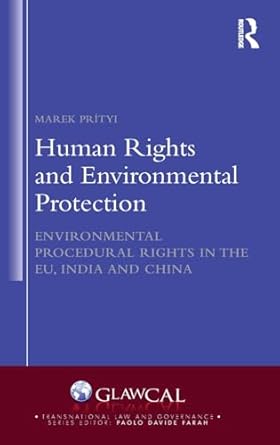
This book explores the complex relationship between human rights and environmental protection. It analyzes the concept of environmental procedural rights from a comparative perspective in the European Union, India, and China. Arguing the need to apply a holistic approach which acknowledges the interlinkages between democracy, environmental protection, and climate change, it examines both theoretical and practical dimensions of the topic, with case studies drawn from empirical research. The work highlights the important role of environmental procedural rights at the intersection of environmental law and human rights, emphasizing the need for effective channels of communication between citizens and public authorities. The study calls for the taking into account of non-binding recommendations, such as the Maastricht Recommendations on Promoting Effective Public Participation in Environmental Matters, for developing public participation procedures in a manner that allows authorities to tailor these to the needs and situations of marginalized people. The book will be a valuable resource for academics, researchers and policy makers working in the areas of environmental law, international human rights law and transnational law and governance.


This book explores the relationship between human rights and environmental protection, analysing the concept of environmental procedural rights from a comparative perspective in the EU, India and China. It argues the need to apply a holistic approach acknowledging interlinkages between democracy, environmental protection and climate change.


