1 Introduction 1 1.1 Situating the Research Topic Within the Academic Debate 1 1.2 The Case Study and Research Questions 10 1.3 Labour and Education Policies: Towards Neoliberalism? 13 1.4 Different Tales of Neoliberalism? 17 1.5 The Theoretical Framework 23 1.6 Methodology 25 1.7 Book Outline 29 1.7.1 Chapter 2 29 1.7.2 Chapter 3 30 1.7.3 Chapter 4 31 1.7.4 Chapter 5 32 1.7.5 Chapter 6 33 References 36 2 The Historical and Ideological Premises of the Emergence of Neoliberalism: A Neo-Gramscian Analysis 41 2.1 A Neo-Gramscian Analysis of Neoliberalism: Theories and Concepts 41 2.1.1 Introduction 41 2.1.2 A Theoretical Premise: Why a Neo-Gramscian Approach 44 2.1.3 Neo-Gramscian Theories and the State 47 2.1.4 Gramsci’s Concept of Hegemony: Why Are Some Classes Subordinated and Subaltern to Others? 49 2.1.5 Historical Bloc 53 2.1.6 Hegemony in International Relations: Towards a Neo-Gramscian Reading of Neoliberalism 55 2.1.7 Hegemony and Ideology: The Intertwined Relation Between Subjective and Objective Processes Within the Reorganisation of Capitalism 58 2.1.8 Common Sense: The ‘Affective’ Dimension of Hegemony and the Battle to Shape Its Common Sense 62 2.2 Understanding Neoliberalism 64 2.2.1 The Roots of Neoliberalism: Between Ideology and Praxis 64 2.2.2 The European Path Towards Neoliberalism: Between Domestic and Transnational Transformations 67 2.3 Neoliberalism, Italy, and the Italian Left 73 2.3.1 Neoliberalism and the Socio-economic Transformation of Italy Since the 1970s 73 2.3.2 Conclusions 78 References 80 3 Between International and European Pressures: The Global Market of Education and Labour 85 3.1 The Europeanisation of Labour and Educational Policies: The Bologna Process and the European Employment Strategy 86 3.1.1 The Keynesian Period and the Role of the State in Education Policies 86 3.1.2 The Theoretical Background: Education as a Parental Matter 88 3.1.3 The International Dimension and Education Policies: A Brief Overview 90 3.1.4 Neoliberalism and the Europeanisation of Education Policies 92 3.1.5 The Bologna Process 93 3.1.6 Neoliberalism and the Europeanisation of Employment Policies 95 3.1.7 The European Employment Strategy 96 3.2 Considering Power Relations: The Case of the EMU 101 xviii CONTENTS 3.2.1 The 1990s: Neoliberalism and the Process of European Integration: The Role of Organised Interests 101 3.2.2 The Position of Socio-economic Groups in Italy Towards the EMU 103 3.2.3 Conclusions 107 References 107 4 Neoliberal Education? The Path Towards Marketisation. From the Berlinguer Reform to the Good School 111 4.1 Education Policies: The International, European and Domestic Dimensions 111 4.1.1 Introduction 111 4.1.2 The International Level 112 4.1.3 The European Level 116 4.1.4 The Domestic Level: Supply-Side Education in Italy 119 4.2 The Relationship Between Education and Production in Marx and Gramsci 121 4.2.1 Marx’s Political Economy of Education 121 4.2.2 Education in Gramsci 124 4.3 Neoliberal Education? The Berlinguer Reform and ‘The Good School’ 130 4.3.1 The Path Towards School Autonomy: The Prodi Government and the Berlinguer Reform 130 4.3.2 Taking Disintermediation Forward: The Renzi Government and the Good School 138 4.3.3 Educational Policies: The Relationship Between Governments and Socio-economic Groups from the Berlinguer Reform to the Good School: The Road Towards Authoritarian and Constitutional Neoliberalism? 148 4.3.4 Conclusion 152 References 154 5 Between Disintermediation and Flexibility: The Transformation of Labour and Industrial Relations in Italy 159 5.1 Labour Market Reforms in Neoliberal Italy: From the Pacchetto Treu to the Jobs Act 160 CONTENTS xix 5.1.1 Introduction 160 5.1.2 From Concertation to Disintermediation, from Labour Rights to Flexibility 161 5.2 The Emergence of the ‘Social Dialogue’ and the Fight Against Unions: The Emergence of Authoritarian Neoliberalism? 173 5.2.1 The Jobs Act 173 5.2.2 The Impact of the Reform on Employment 180 5.3 Privileged Testimonies: Exploring Politics, Ideology, and Power Relations 185 5.3.1 The Nature of the Jobs Act and the Road Towards Disintermediation 185 5.3.2 Insiders vs Outsiders: Constructing the Generational Conflict 192 5.3.3 Breaking up Unions’ Unity 195 5.3.4 The European Dimension 197 5.3.5 The Legacy of the Jobs Act 198 5.3.6 Conclusion 200 References 201 6 From Gramsci to Renzi, from the Italian Communist Party to the Democratic Party: Exploring the Subjective and Objective Dimensions of Transformation Processes 205 6.1 From the First to the Second Republic: Lost in Transition? 206 6.1.1 Introduction 206 6.1.2 The 1990s: The Democratic Party of the Left (PDS), the Democrats of the Left (DS), and the Reorganisation of the Italian Left 208 6.1.3 The Various Mutations of the Political Parties and Their Symbols: From the PCI to the PD 214 6.1.4 From the PCI to the Democratic Party: Towards a Catch-All Party? 218 6.2 From the Mass Party to the Electoral Party: The Democratic Party 222 6.2.1 The Democratic Party: Renzi and the Transformation of the PD 222 6.2.2 The Decline in Perspective: A Brief Overview 225 6.2.3 A Structural Problem: The Democratic Party 228 xx CONTENTS 6.2.4 The Original Contradiction: An Electoral Party Without Members 233 6.2.5 From Members to Electors: The Introduction of the ‘Citizen Elector’ 235 6.3 The Statute of the Democratic Party: A Focus on Its Functioning 239 6.3.1 A Deeper Look into the Statute of the PD, Between Continuity and (Timid) Improvements: The 2015 Statute 239 6.3.2 Members and Electors as the Central Actors: A Blurry Line 240 6.3.3 The Roles of Congress, the National Assembly, and the National Direction 243 6.3.4 A Plebiscitarian Party? 244 6.3.5 Zingaretti’s Reform of the Statute 247 6.3.6 New Modifications Under Letta 248 6.3.7 A Look in Detail: The Revision of the Statute 248 6.3.8 An Immobilised Party: Privileged Perspective 251 6.3.9 A Brief Chronology of the Primary Elections 255 6.3.10 The Democratic Party: Concluding Remarks 259 6.4 Renzi and the Transformation of the Democratic Party: The Road to Power 261 6.4.1 The Road Towards Renzism: Conquering and Transforming the Political Culture and Socio-economic Alliances of the Party 261 6.4.2 The Strategic Transformation of the Party: The Two Versions of Renzi 263 6.4.3 The Seeds of Renzi’s Consensus 268 6.4.4 Between Opportunism, Ideology, and Authoritarianism: The Creation and Maintenance of Internal Support 270 6.4.5 From the 2013 Elections to Renzi: The Road Towards Power Continues 275 6.4.6 The Decisive Moment in the Road to Power: The ‘101’ 277 6.4.7 Bersani’s Resignation, Letta, and Renzi 279 6.5 What Was Renzism? 281 CONTENTS xxi 6.5.1 Internal, External, and Contingent Elements: The Various Forces at Play in Shaping the Course of Events 281 6.5.2 What Was Renzism? Between Disintermediation and Power 284 6.5.3 The Socio-economic Alliances of Renzism: Transforming the PD into an Elitist Political Party 289 6.5.4 Different Tales of Neoliberalism: Extreme Diversity Within Similar Ideological Coordinates 291 6.5.5 Conclusion 296 References 301 7 Conclusions and Final Remarks 307 References 332
이용현황보기
Moving right : the changing role of the left in neoliberal Europe : the case of Italy 이용현황 표 - 등록번호, 청구기호, 권별정보, 자료실, 이용여부로 구성 되어있습니다.
등록번호
청구기호
권별정보
자료실
이용여부
0003281309
320.945 -A26-2
서울관 사회과학자료실(208호)
이용가능
출판사 책소개
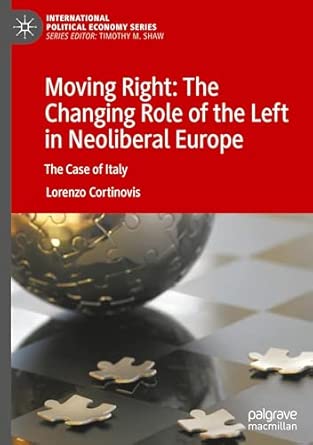
This book explores neoliberalism's emergence as a global ideology, contextualizing its rise within the broader capitalist restructuring that followed the decline of the Keynesian state. Understanding the ideological dimension is challenging due to the difficulties in defining it and tracing its connections across domestic, European, and global contexts. The book aims to address this complexity by examining a case of the Italian left, analyzing the labor and education policies of the Prodi (1996) and Renzi (2013) governments. This is made possible through interviews with politicians, journalists, and trade unionists. Within this transformation, Renzi's era symbolized the final victory of neoliberal culture over the political culture(s) that had animated the left until that point. The future of the left will depend on its ability to reckon with this legacy and to recover an independent vision capable of countering the growth of nationalist right-wing movements in Europe and globally.


 대표어