
 대표어
대표어
 https://documents.worldbank.org/en/publication/documents-reports/documentdetail/099042126155135711
권호기사보기
| 기사명 | 저자명 | 페이지 | 원문 | 기사목차 |
|---|
결과 내 검색
동의어 포함
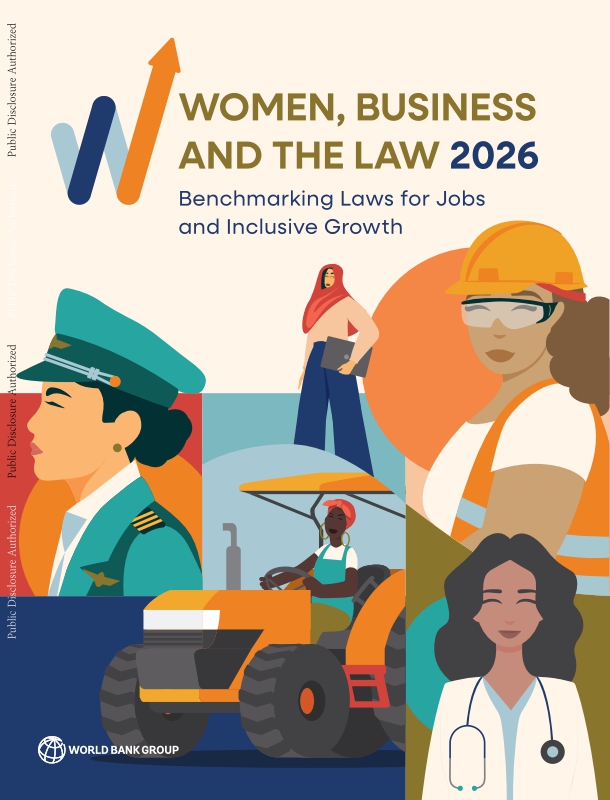
Title page 1
Contents 6
Foreword 10
Acknowledgments 13
Main Messages 15
Executive Summary 18
Chapter 1. Women, Business and the Law and Women's Access to Jobs and Inclusive Growth 39
Women's economic participation: A driver of jobs, productivity, and growth 39
The barriers holding women back: Human capital, norms, and legal constraints 41
Women, Business and the Law: A diagnostic tool for jobs and inclusive growth 44
References 52
Chapter 2. Women, Business and the Law 2.0: A New Frontier for Measuring Access to Jobs 59
From law to opportunity: How Women, Business and the Law measures equality 59
Women, Business and the Law topics 62
Methodological innovations to enhance policy relevance 65
Strengthening transparency and data quality 75
Annex 2A. Women, Business and the Law 2.0 questions 76
Notes 84
References 84
Chapter 3. The State of Women's Economic Rights 86
An uneven landscape: Full economic rights for women not yet achieved 86
Global findings: Stronger laws, weaker implementation and enforcement 87
Deep regional and income inequalities across laws, supportive frameworks, and enforcement 92
Comparing the three pillars: Alignment but no parity 98
Women's rights across the life cycle: Topic-level gaps worldwide 103
Reform momentum: Where women's rights are strengthening 121
Conclusions: From laws to lasting equality 129
Annex 3A. Summaries of Reforms 131
Annex 3B. Women, Business and the Law 2026 Scores 143
Note 150
References 150
FIGURE ES.1. Equality laws are associated with more women working, owning businesses, and participating in politics, as well as a reduced... 20
FIGURE ES.2. Global averages reveal stark gaps in women's legal rights regarding economic participation 23
FIGURE ES.3. Legal equality is lowest among groups and in regions in which the share of women entering the workforce is the highest 24
FIGURE ES.4. More legal equality for women usually means stronger supportive systems and enforcement 26
FIGURE ES.5. Legal frameworks are stronger than supportive systems and enforcement perceptions in respect to almost every Women,... 27
FIGURE ES.6. In 2023-25, 68 economies across all regions enacted reforms toward legal gender equality 29
FIGURE 1.1. Women's participation in the labor market remains lower than men's, with higher rates of part-time work and unemployment,... 41
FIGURE 1.2. Equality laws are associated with more women working, owning businesses, and participating in politics, as well as smaller gender gaps 47
FIGURE 1.3. Female labor force participation is found to be higher where legal protections are stronger 49
FIGURE 2.1. Women, Business and the Law assesses women's economic rights across three interconnected pillars and 10 topics 62
FIGURE 2.2. The enforcement perceptions pillar tailors questions based on the particular type of law reviewed and whether it exists... 70
FIGURE 3.1. An uneven legal landscape: Unequal laws continue to limit women's opportunities for more and better jobs 87
FIGURE 3.2. Global averages reveal laws are much stronger than support or enforcement 88
FIGURE 3.3. Economies show the widest range of scores on the legal frameworks index, followed by narrower ranges for supportive frameworks... 91
FIGURE 3.4. Legal frameworks index scores vary across and within regions and income groups 93
FIGURE 3.5. Supportive frameworks are strongest in advanced economies 96
FIGURE 3.6. Scores on the enforcement perceptions index are lowest in South Asia and low-income economies 97
FIGURE 3.7. Scores on the supportive frameworks index are higher where laws are stronger, but they still fall short of scores on the legal frameworks index 99
FIGURE 3.8. Legal equality and enforcement are positively aligned, though enforcement perceptions trail laws 102
FIGURE 3.9. Legal equality across a woman's economic life cycle: Strongest in the areas of Mobility, Pay, and Marriage; weakest in the areas of... 104
FIGURE 3.10. Supportive frameworks across a woman's economic life cycle: Strongest in the areas of Mobility, Marriage, and Safety;... 107
FIGURE 3.11. Perceived enforcement across a woman's economic life cycle: Strongest in the areas of Mobility, Marriage, and Assets;... 112
FIGURE 3.12. Legal frameworks are stronger than supportive frameworks and enforcement perceptions in respect to almost every Women,... 116
FIGURE 3.13. Pronounced weaknesses in the areas of Safety and Childcare drive uneven performance across all regions and income groups 118
FIGURE 3.14. In 2023-25, 68 economies across all regions enacted reforms toward legal equality 122
Boxes 7
BOX ES.1. Women, Business and the Law is the World Bank Group's benchmark for bridging economic gender gaps 20
BOX 1.1. Reforms across all areas measured by Women, Business and the Law are associated with more and better jobs and growth 46
BOX 1.2. Women, Business and the Law data inform country reforms and have global impact 50
BOX 2.1. Building reliable data: Experts' inputs and rigorous validation 65
BOX 2.2. Women, Business and the Law applies general and topic-specific parameters to ensure data comparability 66
BOX 2.3. Women, Business and the Law 2026 uses vignette-based questions to capture expert perceptions of how laws are enforced in practice 71
BOX 3.1. Identifying legal and policy barriers at the subnational level: Evidence from Nigeria 94
BOX 3.2. Supportive frameworks across economies put laws into action 100
BOX 3.3. Technology and women's economic participation: Both a cross-cutting enabler and a growing barrier 109
BOX 3.4. Do laws translate into equal pay? Evidence from a Women, Business and the Law-Gallup pilot survey 114
FIGURE BES.1.1. Women, Business and the Law assesses women's economic rights across three pillars and 10 topics 21
FIGURE B2.3.1. Respondents accurately understood hypothetical scenarios that showed low, medium, and high levels of enforcement 72
FIGURE B3.1.1. A subnational study in Nigeria reveals critical legal and implementation gaps for women's economic opportunity across states 95
FIGURE B3.4.1. Perceived pay equality across pilot economies 115
Map 9
MAP 3.1. Laws, supportive frameworks, and enforcement vary across economies 89
*표시는 필수 입력사항입니다.
| 전화번호 |
|---|
| 기사명 | 저자명 | 페이지 | 원문 | 기사목차 |
|---|
| 번호 | 발행일자 | 권호명 | 제본정보 | 자료실 | 원문 | 신청 페이지 |
|---|
도서위치안내: / 서가번호:

우편복사 목록담기를 완료하였습니다.
*표시는 필수 입력사항입니다.
저장 되었습니다.
