대표어
대표어
 https://documents.worldbank.org/en/publication/documents-reports/documentdetail/099091726170539292





권호기사보기
| 기사명 | 저자명 | 페이지 | 원문 | 기사목차 |
|---|
결과 내 검색
동의어 포함
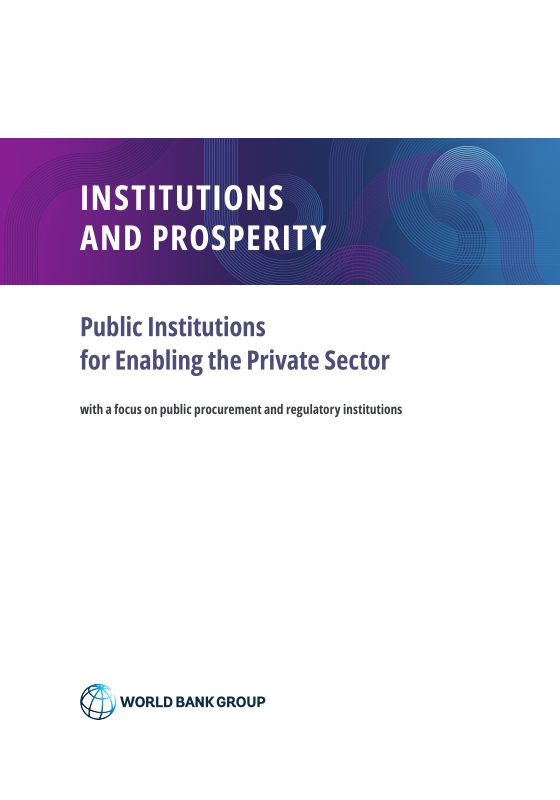
Title page 1
Contents 6
Foreword 10
Acknowledgments 12
Executive Summary 14
Introduction 14
Organizational dimensions 18
Governance dimensions 21
References 26
Abbreviations 27
Chapter 1. A Framework for Understanding Public Institutions 28
Introduction 28
Defining public institutions, institutional capacity, and policy mandates 30
Conceptual framework: The role of public institutions 31
Organizational dimensions 34
Governance dimensions 41
Applying the framework 47
Applying the framework to procurement and regulatory institutions 47
Notes 51
References 51
Chapter 2. Public Institutions That Procure from the Private Sector 57
Introduction 57
Framework for public procurement institutions 57
Policy mandates 59
Organizational dimensions 61
Governance dimensions 71
Institutional challenges in procurement span multiple dimensions 76
Applying the framework: Corruption and passive waste in public procurement 78
Notes 80
References 80
Chapter 3. Public Institutions That Regulate the Private Sector 84
Introduction 84
Framework for regulatory institutions 85
Policy mandates 88
Organizational dimensions 91
Governance dimensions 97
Regulatory institutional challenges span multiple dimensions 102
Applying the framework: Case study on telecommunications regulatory institutions in Peru 105
Competitive spectrum auctions 106
Regulatory delays 108
Notes 110
References 111
Appendix A. Methodology for Assessing Procurement Systems Indicators 114
FIGURE ES.1. Variation in institutional capacity within countries across 10 policy areas 15
FIGURE ES.2. From policies to outcomes: Public institutions framework 16
FIGURE ES.3. Relationship between country-level measures of the quality of procurement personnel and ease of contracting with the government 19
FIGURE ES.4. Number of countries with electronic government procurement systems, along with their features over time, 1990-2023 20
FIGURE ES.5. Decision-maker tenure and regulatory milestones in Peru's telecommunications sector 23
FIGURE ES.6. Organizational and governance dimensions in procurement and regulation 24
FIGURE 1.1. From policies to outcomes: Public institutions framework 32
FIGURE 1.2. Distribution of the share of public servants recruited through interviews, by public institution 36
FIGURE 1.3. Budget execution in Armenia, Paraguay, and Uganda, by public institution, 2011-21 37
FIGURE 1.4. Percentage of countries with information systems, by type of information system, and percentage of countries with interoperable... 39
FIGURE 1.5. Distribution of the share of public servants stating that their organization sets clear targets across public institutions in Ghana and Guatemala 41
FIGURE 1.6. Distribution of the share of public servants across public institutions of the same country acknowledging that political connections... 44
FIGURE 1.7. Number of countries with no systems, with systems but without publishing information, and with systems and publishing information,... 45
FIGURE 2.1. Framework applied to procurement institutions 58
FIGURE 2.2. Relationship between country-level measures of the quality of procurement personnel and ease of contracting with the government 63
FIGURE 2.3. Distribution of the ratio of investment spending to spending on procurement office, by ministry, department, or agency,... 64
FIGURE 2.4. Number of countries with electronic government procurement systems, along with their features over time, 1990-2023 67
FIGURE 2.5. Country-level measures of transparency in the procurement system 77
FIGURE 3.1. Framework applied to regulatory institutions 86
FIGURE 3.2. Scores for government-provided services that support regulatory compliance, by type of service 87
FIGURE 3.3. Country-level data on regulatory restrictions and price for a data-only mobile broadband basket 90
FIGURE 3.4. Distribution of appointment authority for telecommunications regulatory institutions 92
FIGURE 3.5. Country-level share of bank regulators specializing in bank functions 93
FIGURE 3.6. Financing mechanisms for regulators in countries, by tercile of income distribution 94
FIGURE 3.7. Interoperability of different information systems, by country 96
FIGURE 3.8. Within-country and across-sector variation in the setting and disclosure of strategic objectives 98
FIGURE 3.9. Share of OECD sector regulators accountable to either the legislature or the public 100
FIGURE 3.10. Country-level measures of the independence of regulatory agencies and their financial resources, across sectors 103
FIGURE 3.11. Decision-maker tenure and regulatory milestones in Peru's telecommunications sector 109
Boxes 7
Box 1.1. Public institutions for procurement and regulation: Insights from World Bank Group Diagnostics 49
Box 2.1. Accountability in public procurement: Example of Burkina Faso 72
Maps 9
MAP 3.1. Level of transparency in electricity regulations across the African continent, 2022 101

*표시는 필수 입력사항입니다.
| 전화번호 |
|---|
| 기사명 | 저자명 | 페이지 | 원문 | 기사목차 |
|---|
| 번호 | 발행일자 | 권호명 | 제본정보 | 자료실 | 원문 | 신청 페이지 |
|---|
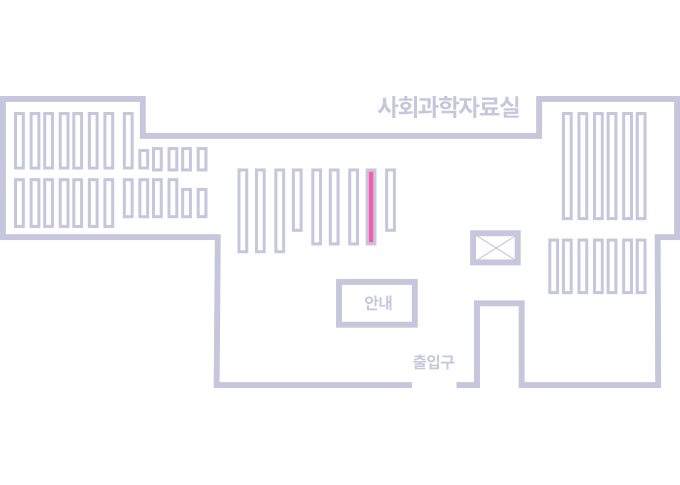
도서위치안내: / 서가번호:
우편복사 목록담기를 완료하였습니다.
*표시는 필수 입력사항입니다.
저장 되었습니다.