
 대표어
대표어
 https://www.dcaf.ch/node/13591
권호기사보기
| 기사명 | 저자명 | 페이지 | 원문 | 기사목차 |
|---|
결과 내 검색
동의어 포함
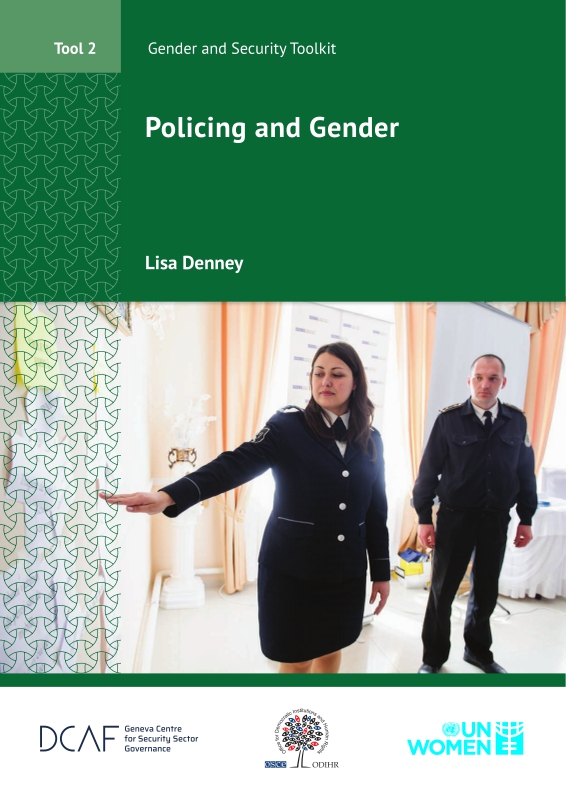
Title page
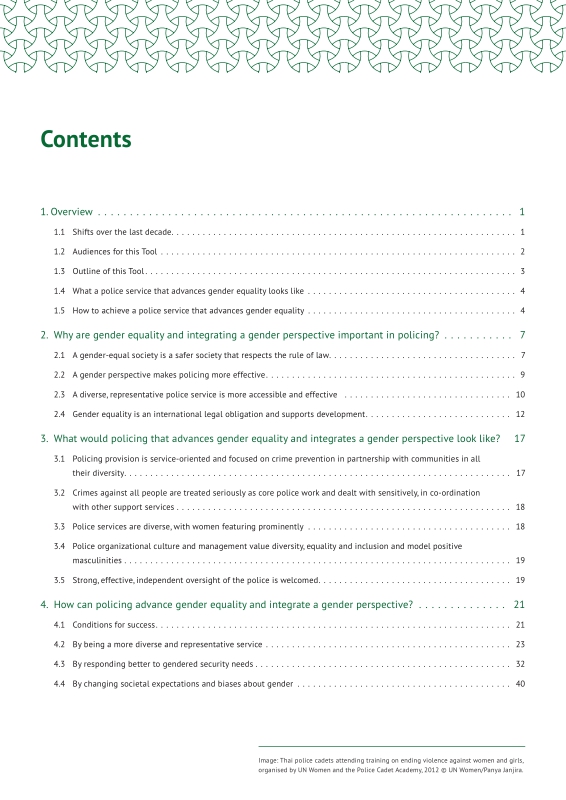
Contents
Acknowledgements 2
1. Overview 9
1.1. Shifts over the last decade 9
1.2. Audiences for this Tool 10
1.3. Outline of this Tool 11
1.4. What a police service that advances gender equality looks like 12
1.5. How to achieve a police service that advances gender equality 12
2. Why are gender equality and integrating a gender perspective important in policing? 15
2.1. A gender-equal society is a safer society that respects the rule of law 15
2.2. A gender perspective makes policing more effective 17
2.3. A diverse, representative police service is more accessible and effective 18
2.4. Gender equality is an international legal obligation and supports development 20
3. What would policing that advances gender equality and integrates a gender perspective look like? 25
3.1. Policing provision is service-oriented and focused on crime prevention in partnership with communities in all their diversity 25
3.2. Crimes against all people are treated seriously as core police work and dealt with sensitively, in co-ordination with other support services 26
3.3. Police services are diverse, with women featuring prominently 26
3.4. Police organizational culture and management value diversity, equality and inclusion and model positive masculinities 27
3.5. Strong, effective, independent oversight of the police is welcomed 27
4. How can policing advance gender equality and integrate a gender perspective? 29
4.1. Conditions for success 29
4.2. By being a more diverse and representative service 31
4.3. By responding better to gendered security needs 40
4.4. By changing societal expectations and biases about gender 48
5. Case studies 53
Case study 1: The Palestinian Civil Police's Gender Unit and Gender Strategy 53
Case study 2: Recruitment and advancement of women police in South Africa 54
Case study 3: Police-civil society partnership for domestic violence training in Kazakhstan 55
Case study 4: Training to tackle LGBTI-phobic crime in Hungary 56
Case study 5: Women's police stations in Brazil and India 57
Case study 6: The OSCE Community Security Initiative in Kyrgyzstan 59
Case study 7: Masculinity training for the Pakistan police 60
6. Guiding questions for institutional self-assessment 63
7. Additional resources 69
Boxes
Box 1. Police and policing 11
Box 2. Gender terminology 16
Box 3. Diverse sexual orientations and gender identities and expressions 16
Box 4. International instruments relevant to advancing gender equality in policing 20
Box 5. Gender assessments and audits 31
Box 6. Example of gender action plan (to be adapted to context) 32
Box 7. Competencies in police officer job descriptions 33
Box 8. Women in international police deployments 36
Box 9. Checklist for sexual harassment policies 39
Box 10. Integrating a gender perspective in policing peaceful assemblies 40
Box 11. Community security action plans 47
*표시는 필수 입력사항입니다.
| 전화번호 |
|---|
| 기사명 | 저자명 | 페이지 | 원문 | 기사목차 |
|---|
| 번호 | 발행일자 | 권호명 | 제본정보 | 자료실 | 원문 | 신청 페이지 |
|---|
도서위치안내: / 서가번호:

우편복사 목록담기를 완료하였습니다.
*표시는 필수 입력사항입니다.
저장 되었습니다.
