
 대표어
대표어
 https://www.dcaf.ch/node/13593
권호기사보기
| 기사명 | 저자명 | 페이지 | 원문 | 기사목차 |
|---|
결과 내 검색
동의어 포함
Title page
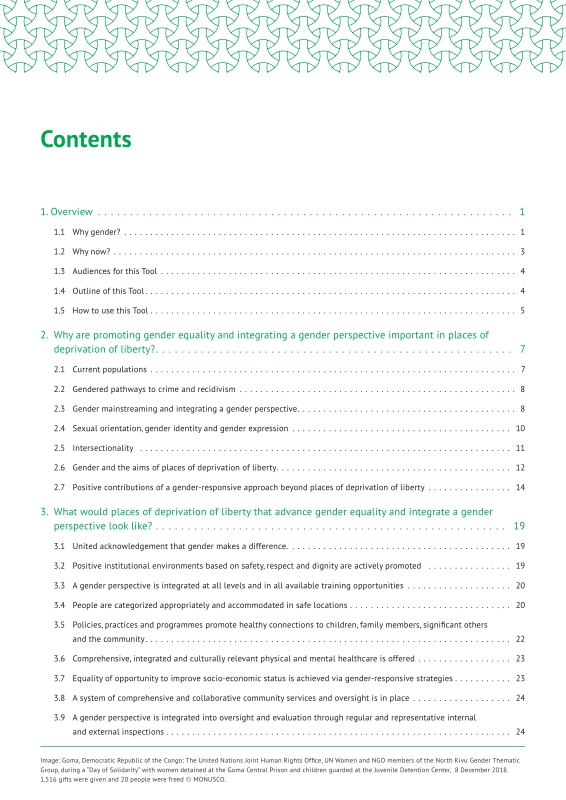
Contents
Acknowledgements 2
1. Overview 9
1.1. Why gender? 9
1.2. Why now? 11
1.3. Audiences for this Tool 12
1.4. Outline of this Tool 12
1.5. How to use this Tool 13
2. Why are promoting gender equality and integrating a gender perspective important in places of deprivation of liberty? 15
2.1. Current populations 15
2.2. Gendered pathways to crime and recidivism 16
2.3. Gender mainstreaming and integrating a gender perspective 16
2.4. Sexual orientation, gender identity and gender expression 18
2.5. Intersectionality 19
2.6. Gender and the aims of places of deprivation of liberty 20
2.7. Positive contributions of a gender-responsive approach beyond places of deprivation of liberty 22
3. What would places of deprivation of liberty that advance gender equality and integrate a gender perspective look like? 27
3.1. United acknowledgement that gender makes a difference 27
3.2. Positive institutional environments based on safety, respect and dignity are actively promoted 27
3.3. A gender perspective is integrated at all levels and in all available training opportunities 28
3.4. People are categorized appropriately and accommodated in safe locations 28
3.5. Policies, practices and programmes promote healthy connections to children, family members, significant others and the community 30
3.6. Comprehensive, integrated and culturally relevant physical and mental healthcare is offered 31
3.7. Equality of opportunity to improve socio-economic status is achieved via gender-responsive strategies 31
3.8. A system of comprehensive and collaborative community services and oversight is in place 32
3.9. A gender perspective is integrated into oversight and evaluation through regular and representative internal and external inspections 32
4. Guidance for advancing gender equality within places of deprivation of liberty 35
4.1. Guidance for state/national involvement 35
4.2. Guidance for places of deprivation of liberty 39
4.3. Guidance for civil society 52
5. Institutional self-assessment checklist 59
6. Additional resources 73
Figure 1. Increase in female prison population 15
Figure 2. Key differences between a gender-neutral approach and approaches that integrate a gender perspective 17
Figure 3. Personal characteristics and institutional contexts that can cause multiple layers of discrimination 20
Boxes
Box 1. US study of gender-neutral versus gender-responsive interventions 18
Box 2. Intersectionality 19
Box 3. Multiple forms of gendered safety 22
Box 4. Accommodation for women in Canada 29
Box 5. Albania's law reform on gender-based violence 36
Box 6. Leadership and national-level approach in Thailand 37
Box 7. Data collection for contextual understanding in the USA 39
Box 8. Women-centred training in Canada 40
Box 9. Common mistakes in prison management 41
Box 10. Waiting commission and positive environment in Albanian places of deprivation of liberty 42
Box 11. Implementing a gender perspective during pre-trial assessment in Kenya Context analysis 43
Box 12. Scotland's guidance on searching transgender prisoners 45
Box 13. Women's risk need assessment 46
Box 14. Promising initiatives in the management of women's physical and mental health in Australia 47
Box 15. Usable skills development for women in prison in Hong Kong 48
Box 16. Access to programmes for mothers with babies in Georgia 49
Box 17. Equality in conjugal visits in Costa Rica 50
Box 18. Engaging men and boys in SGBV prevention in Jordan 51
Box 19. The Prisons and Probation Ombudsman for England and Wales' independent investigation and recommendations for the care and management of transgender prisoners 53
Box 20. Making training accessible for women in Pakistan 54
Box 21. Efforts to reduce prisoner rape in South Africa 55
*표시는 필수 입력사항입니다.
| 전화번호 |
|---|
| 기사명 | 저자명 | 페이지 | 원문 | 기사목차 |
|---|
| 번호 | 발행일자 | 권호명 | 제본정보 | 자료실 | 원문 | 신청 페이지 |
|---|
도서위치안내: / 서가번호:

우편복사 목록담기를 완료하였습니다.
*표시는 필수 입력사항입니다.
저장 되었습니다.
