
 대표어
대표어
 https://www.bruegel.org/2022/04/the-private-sector-advances-in-china-the-evolving-ownership-structures-of-the-largest-companies-in-the-xi-jinping-era/



권호기사보기
| 기사명 | 저자명 | 페이지 | 원문 | 기사목차 |
|---|
결과 내 검색
동의어 포함
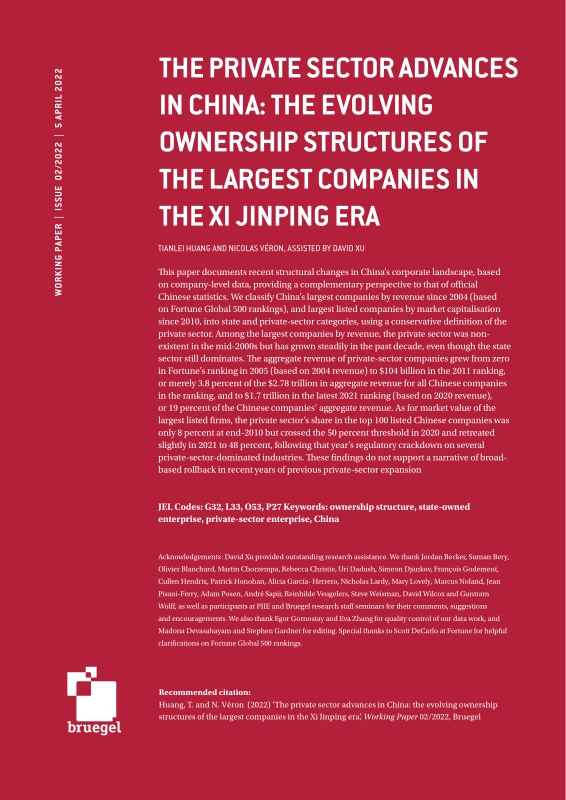
Title page
Contents
INTRODUCTION 2
1. CORPORATE STRUCTURES WITH CHINESE CHARACTERISTICS 4
1.1. Varieties of state ownership 5
1.2. Listing status 13
1.3. Examples 18
1.4. CCP influence in the private sector 25
2. MAPPING THE LANDSCAPE OF CHINA'S LARGEST COMPANIES 28
2.1. Findings on China's largest companies by revenue 31
2.2. Findings on China's largest listed companies by market cap 38
2.3. Drivers 43
CONCLUSION 54
REFERENCES 56
APPENDIX A: METHODOLOGICAL CHOICES ON METRICS, DATA, SAMPLING, AND CODING 60
APPENDIX B: CHINESE COMPANIES IN 2021 FORTUNE GLOBAL 500 RANKING 68
APPENDIX C: CHINESE TOP LISTED 100 COMPANIES BY MARKET CAPITALISATION AT END-2021 77
Figure 1. Subset of Chinese companies in the Fortune Global 500 rankings 29
Figure 2. Aggregate revenue of Chinese Fortune 500 companies, by ownership category, 2004-20 32
Figure 3. Share of the private sector (nonpublic enterprises) in subset of Chinese Fortune 500 companies across different metrics, 2004-20 32
Figure 4. Share of aggregate revenue of Chinese Fortune 500 companies accounted for by listed companies, 2004-20 34
Figure 5. Revenue of state-owned enterprises (SOEs) and mixed-ownership enterprises (MOEs) among Chinese Fortune 500 companies, by listing status... 35
Figure 6. Listing status of nonpublic enterprises (NPEs) among Chinese Fortune 500 companies, 2004-20 36
Figure 7. Aggregate market capitalization of Chinese Listed Top 100 companies, by ownership category, 2010-21 39
Figure 8. Share of the private sector (nonpublic enterprises) in Chinese Listed Top 100 companies across different aggregates, 2010-21 40
Figure 9. Platform-services companies among nonpublic enterprises (NPEs) in Chinese Listed Top 100, 2010-21 41
Figure 10. State ownership in 2010 versus 2020 among Chinese Listed Top 100 by market capitalisation at end-2010 47
Figure 11. "New" vs "old" listings among Chinese Listed Top 100, aggregate market capitalisation, by ownership category, 2010-21 49
Figure 12. Number of Chinese listed companies, by listing jurisdiction, 2010-21 50
Figure 13. Sectoral mix of Chinese Fortune 500 companies, by aggregate revenue, 2004-20 51
Figure 14. Sectoral mix of Chinese Listed Top 100 companies, by aggregate market capitalisation, 2010-21 51
Figure 15. Revenue of Chinese Fortune 500 companies, by sector and ownership category, 2004-20 52
Figure 16. Market capitalisation of Chinese Listed Top 100 companies, by sector and ownership category, 2010-21 53
Boxes
Box 1. 'Actual controller' in mainland Chinese law and statistics 6
Box 2. China's SASACs and other state holding entities 11
Box 3. China's variable-interest entities 17
*표시는 필수 입력사항입니다.
| 전화번호 |
|---|
| 기사명 | 저자명 | 페이지 | 원문 | 기사목차 |
|---|
| 번호 | 발행일자 | 권호명 | 제본정보 | 자료실 | 원문 | 신청 페이지 |
|---|
도서위치안내: / 서가번호:

우편복사 목록담기를 완료하였습니다.
*표시는 필수 입력사항입니다.
저장 되었습니다.
