
 대표어
대표어
 https://www.iza.org/publications/dp/16863/still-waters-run-deep-groundwater-contamination-and-education-outcomes-in-india
권호기사보기
| 기사명 | 저자명 | 페이지 | 원문 | 기사목차 |
|---|
결과 내 검색
동의어 포함
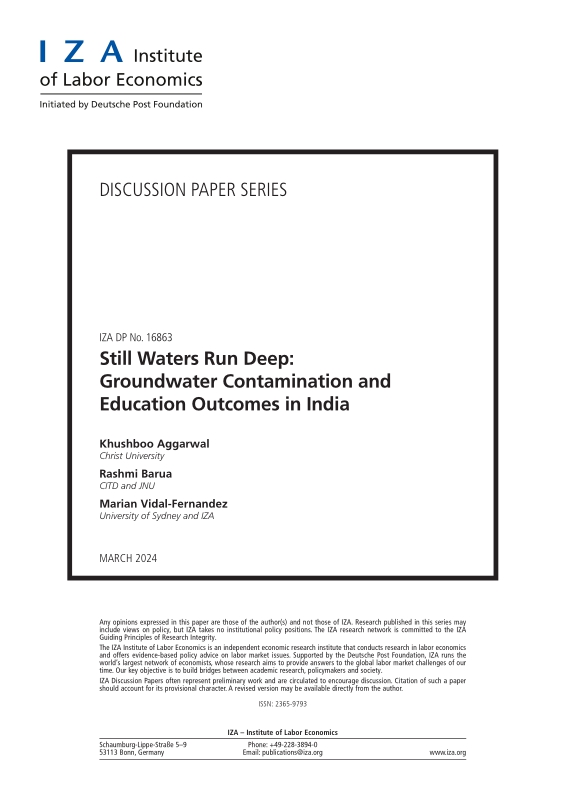
Title page
Contents
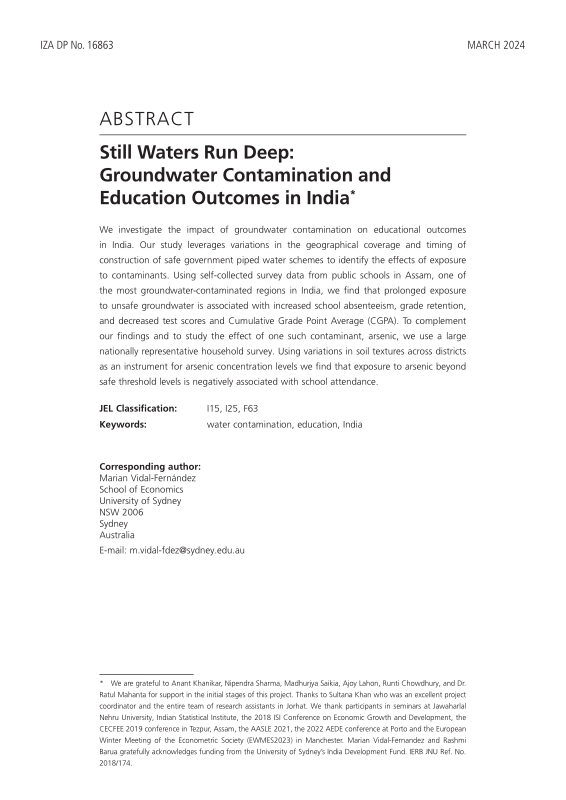
Abstract 3
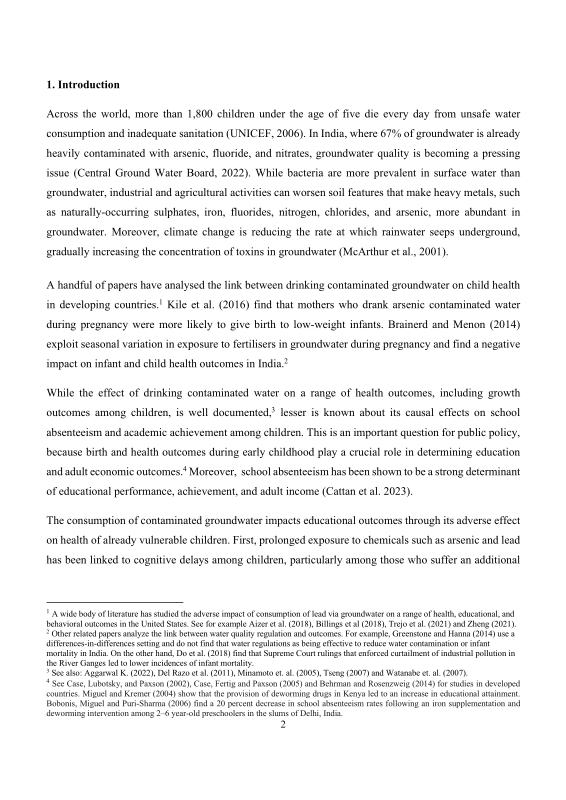
1. Introduction 4
2. Background and Data 8
2.1. Background: Groundwater Contamination and Water Sanitation Programs in Assam 8
2.2. Newly Collected School Survey 10
3. Empirical Strategy 11
3.1. Two-way Fixed Effect Differences-in-Differences 11
3.2. TWFEDD Cohort Analysis 14
3.3. Staggered DD Treatment and Treatment Effect Heterogeneity 15
4. Results and Threats to Identification 17
4.1. Results 17
4.2. Threats to Internal Validity and Robustness Checks 18
5. Effects of Arsenic in Groundwater on School Absenteeism Using a National Survey 20
5.1. India Human Development Survey (IHDS) 20
5.2. Other Variables 20
5.3. Instrumental Variable Approach 21
5.4. Threats to Identification 22
5.5. IV Results from the IHDS 23
6. Discussion 26
References 27
Appendix 44
Figure 1. Geographical location of Titabor Block in Jorhat District of Assam 32
Figure 2. School Sampling Cascade 33
Figure 3. Event Study Plots from the Dynamic DID Model 34
Figure 4. Event Study Plots from the Sun-Abraham Estimator 35
Figure A.1. Geographical Distribution of Arsenic Levels Across States of India 44
Figure A.2. Location of Doyang River, Water Treatment Plant (WTP) and Pipe Water Supply Schemes (PWSS) to villages in Titabor 45
Figure A.3. Location of Dhansiri River, Water Treatment Plant (WTP) and Pipe Water Supply Schemes (PWSS) to villages in Titabor 46
*표시는 필수 입력사항입니다.
| 전화번호 |
|---|
| 기사명 | 저자명 | 페이지 | 원문 | 기사목차 |
|---|
| 번호 | 발행일자 | 권호명 | 제본정보 | 자료실 | 원문 | 신청 페이지 |
|---|
도서위치안내: / 서가번호:

우편복사 목록담기를 완료하였습니다.
*표시는 필수 입력사항입니다.
저장 되었습니다.
