
 대표어
대표어
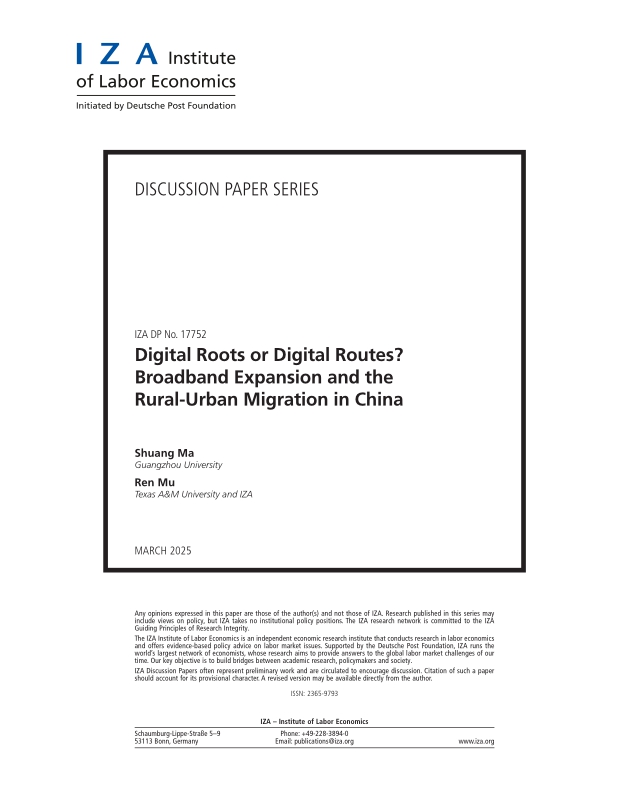
 https://www.iza.org/publications/dp/17752/digital-roots-or-digital-routes-broadband-expansion-and-the-rural-urban-migration-in-china
권호기사보기
| 기사명 | 저자명 | 페이지 | 원문 | 기사목차 |
|---|
결과 내 검색
동의어 포함
Title page 1
Contents 1
Abstract 3
1. Introduction 4
2. Internet Connectivity and Migration Decisions 9
3. The Broadband China Strategy and the UBTS 11
4. Data and the Identification Strategy 14
5. Results 20
5.1. Impacts of UBTS on Migration Decisions 21
5.2. Heterogeneities in Migration Effects 25
5.3. Mechanisms: Information-Seeking Behavior and Consumption Patterns 27
6. Conclusion 28
References 30
Tables 36
Table 1. The UBTS Pilot Village Distribution: National Data and CHFS Sample 36
Table 2. Summary Statistics of Initial Village and Individual Characteristics (2015) 37
Table 3. Determinants of UBTS Pilot Village Selection (2015) 38
Table 4. Event Study Regression Results: UBTS and Individual Migration Decisions 39
Table 5. Robustness Checks: UBTS and Individual Migration Decisions with Different Control Groups 40
Table 6. Heterogeneity Analyses of Individual Migration Decisions (Total Migration) by Initial Village Characteristics 41
Table 7. Heterogeneity Analyses of Individual Migration Decisions (Total Migration) by Initial Individual Characteristics 42
Figures 43
Figure 1. Event Study of UBTS and Broadband Access 43
Figure 2. Robustness Checks: Migration Effects Including all UBTS pilot Villages (2016-2021 Implementation) 44
Figure 3. Robustness Checks: The Availability and Constructions of Other Infrastructures 45
Figure 4. Event Study of UBTS and Changes in Information Seeking & Online Shopping 46
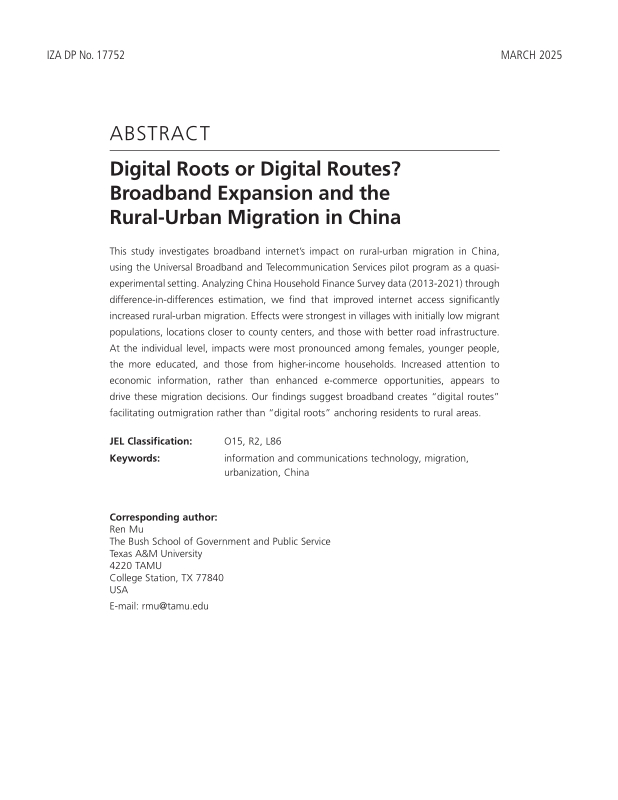
This study investigates broadband internet’s impact on rural-urban migration in China, using the Universal Broadband and Telecommunication Services pilot program as a quasi-experimental setting.
Analyzing China Household Finance Survey data (2013-2021) through difference-in-differences estimation, we find that improved internet access significantly increased rural-urban migration.
Effects were strongest in villages with initially low migrant populations, locations closer to county centers, and those with better road infrastructure.
At the individual level, impacts were most pronounced among females, younger people, the more educated, and those from higher-income households.
Increased attention to economic information, rather than enhanced e-commerce opportunities, appears to drive these migration decisions.
Our findings suggest broadband creates “digital routes” facilitating outmigration rather than “digital roots” anchoring residents to rural areas.*표시는 필수 입력사항입니다.
| 전화번호 |
|---|
| 기사명 | 저자명 | 페이지 | 원문 | 기사목차 |
|---|
| 번호 | 발행일자 | 권호명 | 제본정보 | 자료실 | 원문 | 신청 페이지 |
|---|
도서위치안내: / 서가번호:

우편복사 목록담기를 완료하였습니다.
*표시는 필수 입력사항입니다.
저장 되었습니다.
