
 대표어
대표어
 https://www.iza.org/publications/dp/17756/the-short-term-effects-of-covid-19-on-labour-market-outcomes-of-recent-immigrants-to-canada
권호기사보기
| 기사명 | 저자명 | 페이지 | 원문 | 기사목차 |
|---|
결과 내 검색
동의어 포함
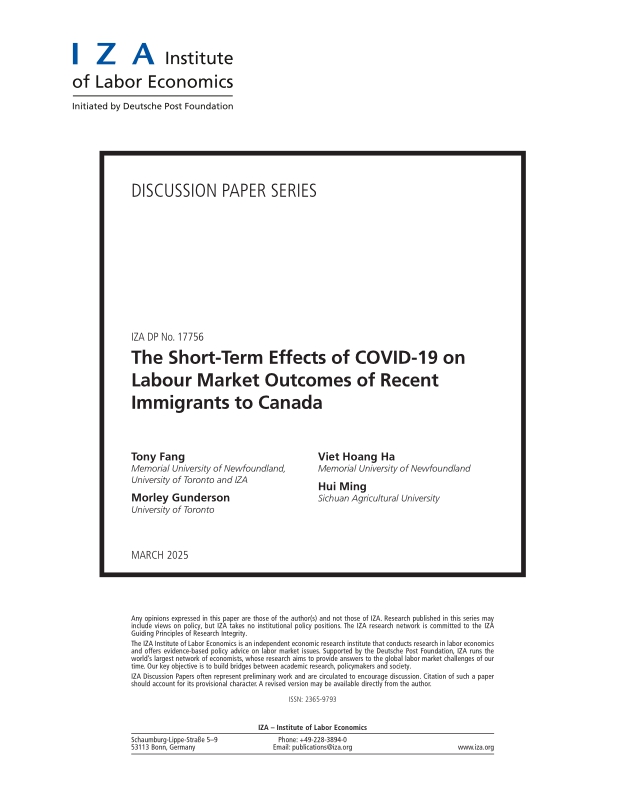
Title page 1
Contents 1
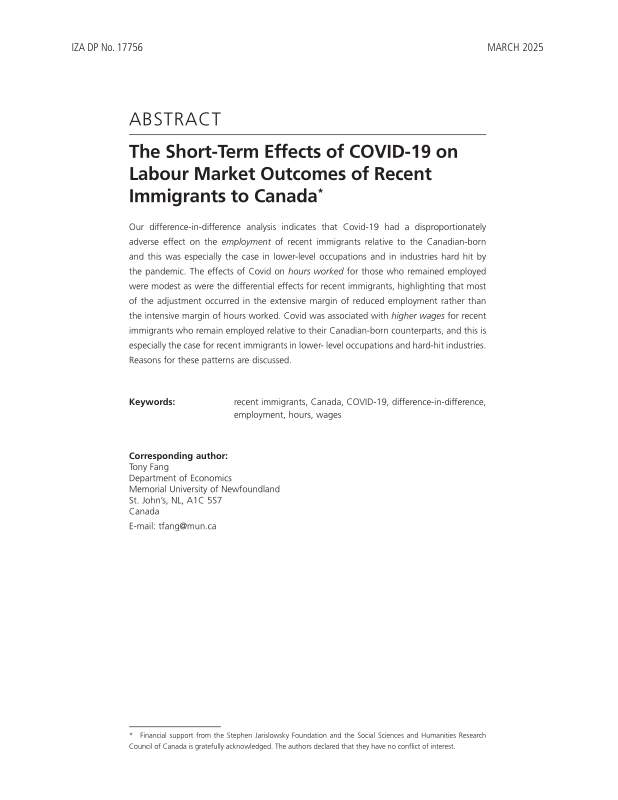
ABSTRACT 3
1. INTRODUCTION 4
2. DIRECTLY RELATED LITERATURE 5
3. EXPECTED RELATIONSHIPS 9
4. DATA AND ESTIMATION EQUATIONS 11
5. RESULTS 15
6. CONCLUDING OBSERVATIONS 22
REFERENCES 27
Tables 32
Table 1A. Descriptive Statistics for Full Sample of Employed and Not Employed 32
Table 1B. Descriptive Statistics for Sub-Sample of Employed 34
Table 2. Difference-in-Differences Results, Three Outcomes, All Workers and Higher-level and Lower-level Occupation Separate (Probit marginal effects... 36
Table 3. Difference-in-Differences Results, Three Outcomes, All Workers and Low-Hit and Hard-Hit Sectors Separate (Probit marginal effects... 37
Our difference-in-difference analysis indicates that Covid-19 had a disproportionately adverse effect on the employment of recent immigrants relative to the Canadian-born and this was especially the case in lower-level occupations and in industries hard hit by the pandemic.
The effects of Covid on hours worked for those who remained employed were modest as were the differential effects for recent immigrants, highlighting that most of the adjustment occurred in the extensive margin of reduced employment rather than the intensive margin of hours worked.
Covid was associated with higher wages for recent immigrants who remain employed relative to their Canadian-born counterparts, and this is especially the case for recent immigrants in lower-level occupations and hard-hit industries.
Reasons for these patterns are discussed.*표시는 필수 입력사항입니다.
| 전화번호 |
|---|
| 기사명 | 저자명 | 페이지 | 원문 | 기사목차 |
|---|
| 번호 | 발행일자 | 권호명 | 제본정보 | 자료실 | 원문 | 신청 페이지 |
|---|
도서위치안내: / 서가번호:

우편복사 목록담기를 완료하였습니다.
*표시는 필수 입력사항입니다.
저장 되었습니다.
