
 대표어
대표어
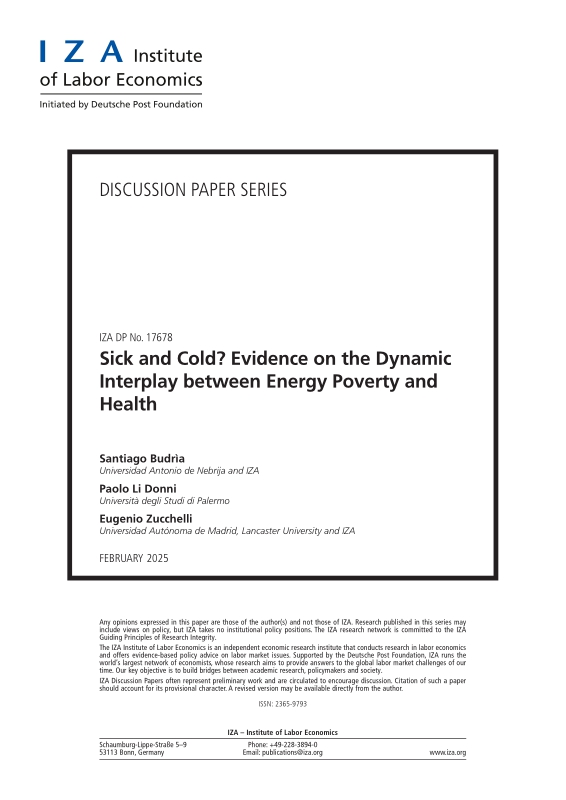
 https://www.iza.org/publications/dp/17678/sick-and-cold-evidence-on-the-dynamic-interplay-between-energy-poverty-and-health
권호기사보기
| 기사명 | 저자명 | 페이지 | 원문 | 기사목차 |
|---|
결과 내 검색
동의어 포함
Title page 1
Contents 1
Abstract 3
1. Introduction 4
2. Data 6
2.1. Measures of Energy Poverty 6
2.2. Measures of Health 7
2.3. Covariates 8
2.4. Descriptive Statistics 8
3. Empirical Approach 9
3.1. Static Random Effects Model 9
3.2. Dynamic Random Effects Model 10
3.3. Dynamic Latent Class Model 10
4. Main Results 13
4.1. Marginal Effects 13
4.2. Latent States 16
4.3. Robustness 18
4.4. Socioeconomic Gradient of Latent States and Energy prices 18
5. Conclusions 20
References 22
Tables 8
Table 1. Variable descriptions with sample statistics for pooled data 8
Table 2. Estimated average marginal effects of the SRE models 14
Table 3. Estimated average marginal effects of the DRE models 15
Table 4. Model selection criteria for the DLC model 15
Table 5. Estimated average marginal effects of the DLC model 16
Table 6. Conditional average probabilities and transition probabilities 17
Table 7. Estimated average marginal effects of the DLC model for a general index of energy deprivation 18
Table 8. Estimated average marginal effects of being in an observed state 19
Figures 11
Figure 1. Path diagram of the DLC model 11
Figure 2. Estimated average probability of each latent state at every year 17
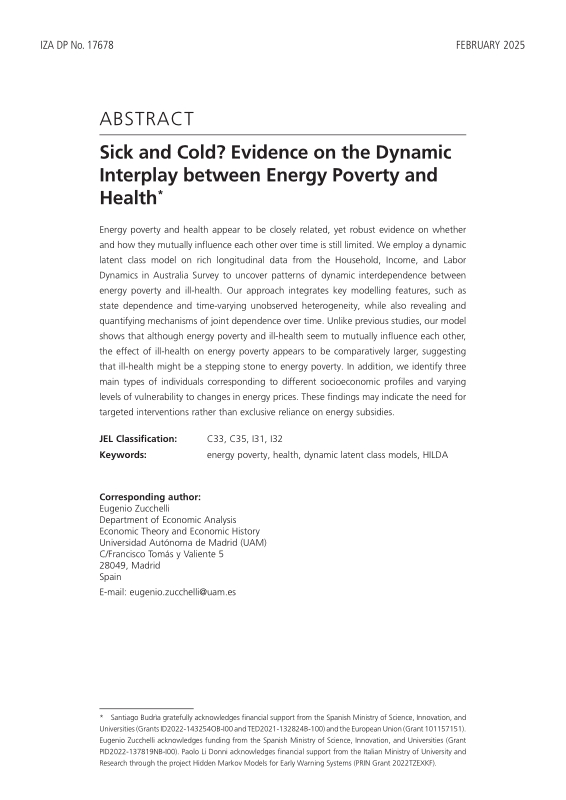
Energy poverty and health appear to be closely related, yet robust evidence on whether and how they mutually influence each other over time is still limited. We employ a dynamic latent class model on rich longitudinal data from the Household, Income, and Labor Dynamics in Australia Survey to uncover patterns of dynamic interdependence between energy poverty and ill-health.
Our approach integrates key modelling features, such as state dependence and time-varying unobserved heterogeneity, while also revealing and quantifying mechanisms of joint dependence over time. Unlike previous studies, our model shows that although energy poverty and ill-health seem to mutually influence each other, the effect of ill-health on energy poverty appears to be comparatively larger, suggesting that ill-health might be a stepping stone to energy poverty.
In addition, we identify three main types of individuals corresponding to different socioeconomic profiles and varying levels of vulnerability to changes in energy prices. These findings may indicate the need for targeted interventions rather than exclusive reliance on energy subsidies.*표시는 필수 입력사항입니다.
| 전화번호 |
|---|
| 기사명 | 저자명 | 페이지 | 원문 | 기사목차 |
|---|
| 번호 | 발행일자 | 권호명 | 제본정보 | 자료실 | 원문 | 신청 페이지 |
|---|
도서위치안내: / 서가번호:

우편복사 목록담기를 완료하였습니다.
*표시는 필수 입력사항입니다.
저장 되었습니다.
