
 대표어
대표어
 https://www.iza.org/publications/dp/17681/the-educated-class-and-the-fragility-of-consumer-society
권호기사보기
| 기사명 | 저자명 | 페이지 | 원문 | 기사목차 |
|---|
결과 내 검색
동의어 포함
Title page 1
Contents 1
Abstract 3
1. Introduction 4
2. Static model 7
3. Equilibrium determination 10
3.1. Type I equilibrium 10
3.2. Type II equilibrium 11
3.3. Equilibria: Existence, type and multiplicity 12
4. Comparing equilibria 14
5. Comparative statics 17
6. Aggregate welfare 19
7. Dynamics: Skill acquisition and the collapse of the educated class 22
7.1. Steady states 26
7.2. Surges and collapses 27
7.3. Dynamics following a surge 27
7.4. Dynamics following a collapse 28
8. Conclusion 29
9. Appendix 30
References 53
Tables 56
Table 1. Comparison between the two equilibria in the example of figure 16
Figures 56
Figure 1. Multiple equilibria 56
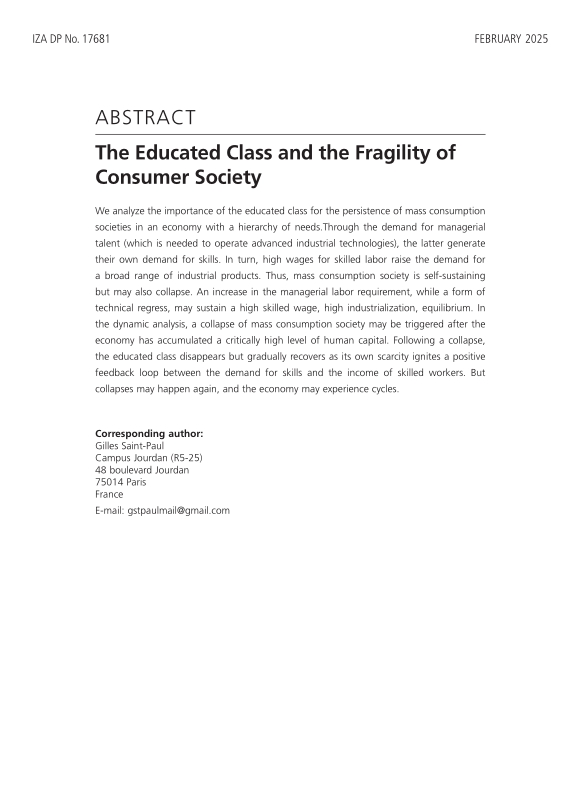
We analyze the importance of the educated class for the persistence of mass consumption societies in an economy with a hierarchy of needs. Through the demand for managerial talent (which is needed to operate advanced industrial technologies), the latter generate their own demand for skills. In turn, high wages for skilled labor raise the demand for a broad range of industrial products. Thus, mass consumption society is self-sustaining but may also collapse.
An increase in the managerial labor requirement, while a form of technical regress, may sustain a high skilled wage, high industrialization equilibrium. In the dynamic analysis, a collapse of mass consumption society may be triggered after the economy has accumulated a critically high level of human capital. Following a collapse, the educated class disappears but gradually recovers as its own scarcity ignites a positive feedback loop between the demand for skills and the income of skilled workers. But collapses may happen again, and the economy may experience cycles.*표시는 필수 입력사항입니다.
| 전화번호 |
|---|
| 기사명 | 저자명 | 페이지 | 원문 | 기사목차 |
|---|
| 번호 | 발행일자 | 권호명 | 제본정보 | 자료실 | 원문 | 신청 페이지 |
|---|
도서위치안내: / 서가번호:

우편복사 목록담기를 완료하였습니다.
*표시는 필수 입력사항입니다.
저장 되었습니다.
