
 대표어
대표어
 https://www.iza.org/publications/dp/17620/the-economy-the-ghost-in-your-gene-and-the-escape-from-premature-mortality

권호기사보기
| 기사명 | 저자명 | 페이지 | 원문 | 기사목차 |
|---|
결과 내 검색
동의어 포함
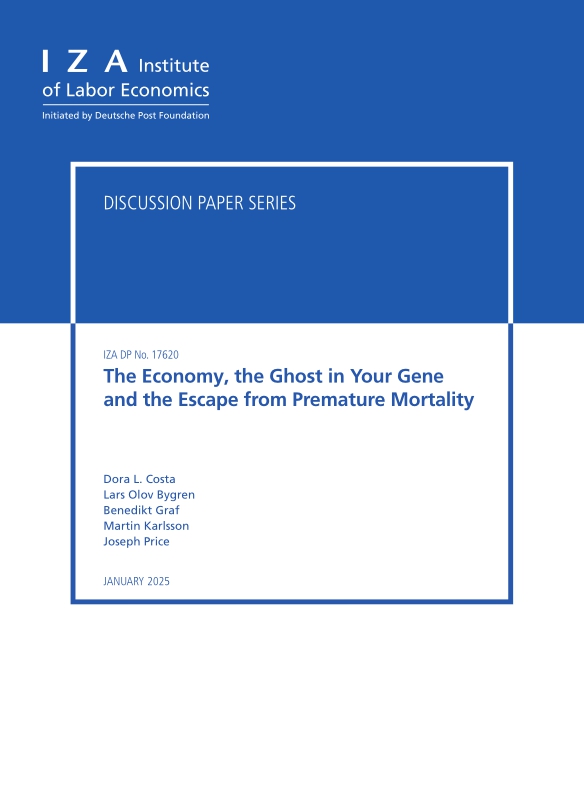
Title page 1
Contents 1
Abstract 3
1. Harvests in Sweden 8
2. Data 11
3. Methods 15
4. Results 19
4.1. Robustness 23
5. Mechanisms 24
6. Explaining Mortality Trends 28
7. Conclusion 30
References 32
Online Appendix 44
Tables 41
Table 1. Grandsons' Mortality and Paternal Grandfathers' Radical Change and Own Bad Harvest in Utero, Contemporaneous Disease, and Socioeconomic Status 41
Table 2. Within Family Association Between Paternal Grandfathers' Radical Change and Grandchildren's Mortality 42
Table 3. Estimated Increase in Life Expectancy at Age 40 from the Elimination of Harvest Swings and the Decline in Infectious Disease Mortality 43
Figures 38
Figure 1. Harvests Swings in Sweden 38
Figure 2. Grandsons' and Granddaughters' Kaplan-Meier Survival Curves and Paternal Grandfathers' Radical Change 39
Figure 3. Grandsons' and Granddaughters' Mortality Increases at Ages 40-80 and Paternal Grandfathers' (FF) Radical Harvest Change 40
Appendix Tables 54
Table A1. Probability of Good and Bad Harvests, Before and After 1840 54
Table A2. Bad Harvests and Parish Mortality Rates 55
Table A3. Bad Harvests and Weather Shocks, Before and After 1840 56
Table A4. Harvests and Harvest Prices 57
Table A5. Geographical Distibution of the Analytical Sample and the Population of Sweden 58
Table A6. Estimates of Standard Errors on Paternal Grandfathers' Radical Change at Ages 9-12 Under Different Clustering and Spatial Standard Error Assumptions 59
Table A7. P-values for Synthetic Outcome Tests for Paternal Grandfathers' Radica Change at Ages 9-12 60
Table A8. Benjamini-Hochberg Critical Values for Effect of Paternal Grandfather's Radical Change at Ages 9-12 on Grandsons' Longevity 61
Table A9. Type of Radical Harvest Change of Paternal Grandfathers at Ages 9-12 and Grandsons' Mortality 62
Table A10. Grandsons' Mortality and Paternal Grandfathers' Radical Change at Ages 9-12, Different Age Groups 63
Table A11. Own and Father's Semester of Birth and the Paternal Grandfather's Radical Change at Ages 9-12 64
Table A12. Mortality Among Spouses 65
Table A13. Grandchildren's Parents' Mortality and Paternal Grandfathers' Radical Change at Ages 9-12 66
Table A14. Fertility of Fathers and their Fathers' Harvest Swings at Age 9-12 67
Table A15. Coefficient on Paternal Grandfathers' Radical Change at Ages 9-12 and Grandsons' Mortality Under Different Ancestral Birth Year Cut-offs 68
Table A16. Census Linkage Rates 69
Table A17. Household Participation in Agriculture 70
Appendix Figures 50
Figure A1. Analytical Sample with Median Birth and Death Dates 50
Figure A2. Granddaughters' and Grandsons' Mortality Increases at Ages 40-80 and Paternal Grandmothers' (FM) Radical Harvest Change 51
Figure A3. Mortality Increases at Ages 40-80 for 1) Grandsons and Yearly Radical Harvest Change of Paternal Grandfathers (FF) and 2) for Granddaughters... 52
Figure A4. Variance Decomposition of Socioeconomic Index 53
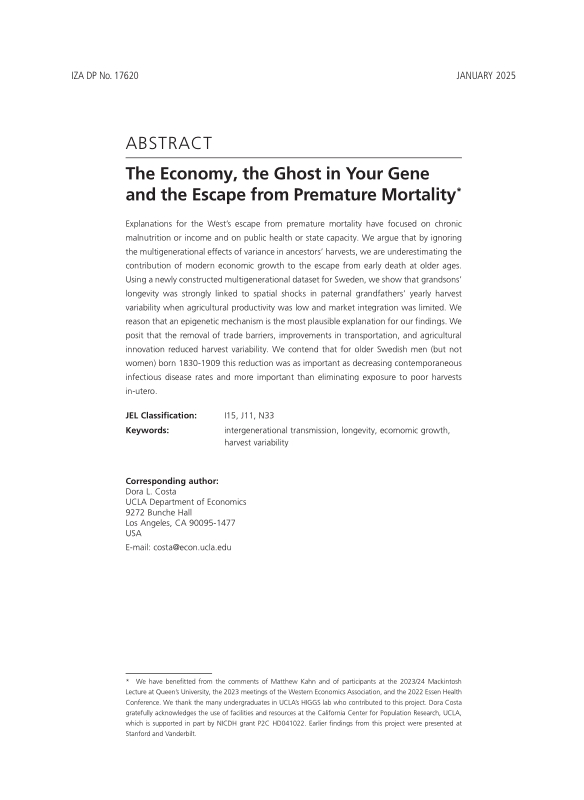
Explanations for the West’s escape from premature mortality have focused on chronic malnutrition or income and on public health or state capacity. We argue that by ignoring the multigenerational effects of variance in ancestors’ harvests, we are underestimating the contribution of modern economic growth to the escape from early death at older ages.
Using a newly constructed multigenerational dataset for Sweden, we show that grandsons’ longevity was strongly linked to spatial shocks in paternal grandfathers’ yearly harvest variability when agricultural productivity was low and market integration was limited. We reason that an epigenetic mechanism is the most plausible explanation for our findings.
We posit that the removal of trade barriers, improvements in transportation, and agricultural innovation reduced harvest variability. We contend that for older Swedish men (but not women) born 1830-1909, this reduction was as important as decreasing contemporaneous infectious disease rates and more important than eliminating exposure to poor harvests in-utero.*표시는 필수 입력사항입니다.
| 전화번호 |
|---|
| 기사명 | 저자명 | 페이지 | 원문 | 기사목차 |
|---|
| 번호 | 발행일자 | 권호명 | 제본정보 | 자료실 | 원문 | 신청 페이지 |
|---|
도서위치안내: / 서가번호:

우편복사 목록담기를 완료하였습니다.
*표시는 필수 입력사항입니다.
저장 되었습니다.
