
 대표어
대표어
 https://cset.georgetown.edu/publication/promoting-ai-innovation-through-competition/
권호기사보기
| 기사명 | 저자명 | 페이지 | 원문 | 기사목차 |
|---|
결과 내 검색
동의어 포함
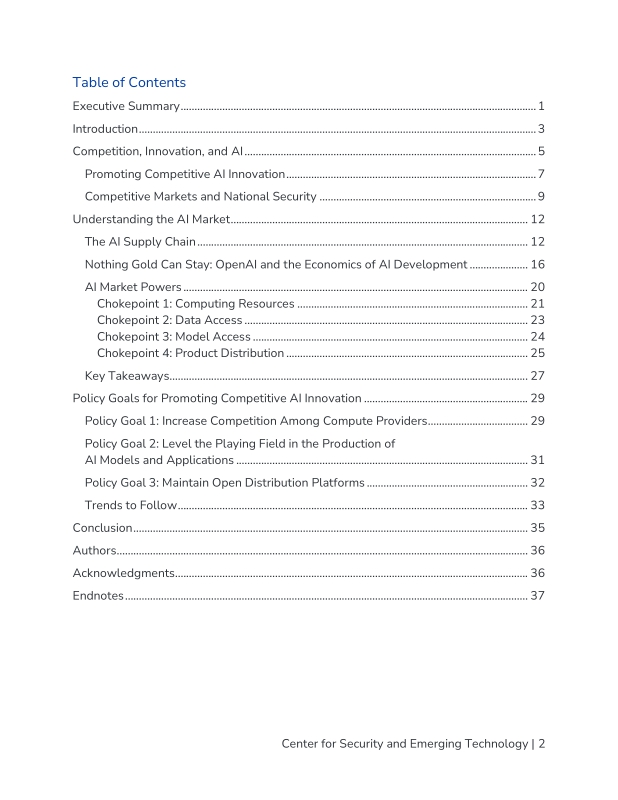
Title page 1
Contents 3
Executive Summary 2
Introduction 4
Competition, Innovation, and AI 6
Promoting Competitive AI Innovation 8
Competitive Markets and National Security 10
Understanding the AI Market 13
The AI Supply Chain 13
Nothing Gold Can Stay: OpenAI and the Economics of AI Development 17
AI Market Powers 21
Chokepoint 1: Computing Resources 22
Chokepoint 2: Data Access 24
Chokepoint 3: Model Access 25
Chokepoint 4: Product Distribution 26
Key Takeaways 28
Policy Goals for Promoting Competitive AI Innovation 30
Policy Goal 1: Increase Competition Among Compute Providers 30
Policy Goal 2: Level the Playing Field in the Production of AI Models and Applications 32
Policy Goal 3: Maintain Open Distribution Platforms 33
Trends to Follow 34
Conclusion 36
Authors 37
Acknowledgments 37
Endnotes 38
Figures 14
Figure 1. The AI Supply Chain 14
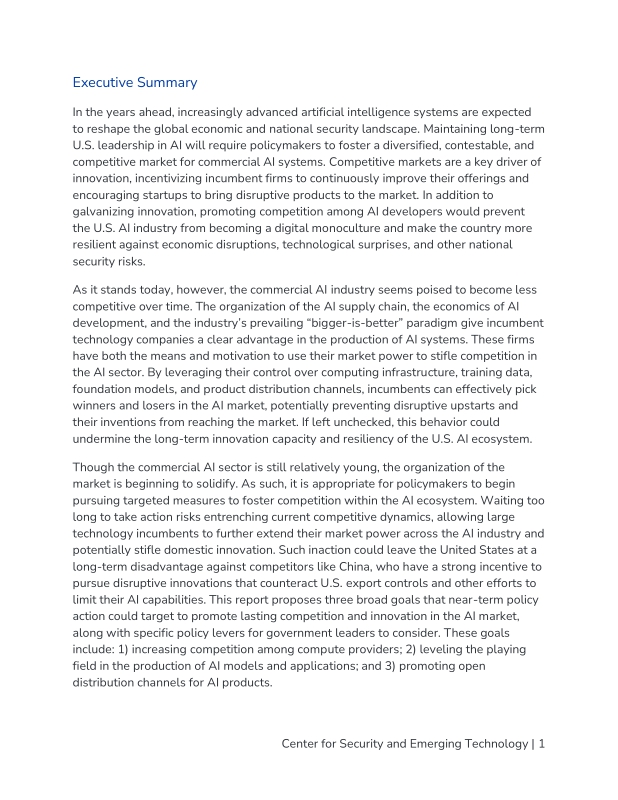
In the years ahead, increasingly advanced artificial intelligence systems are expected to reshape the global economic and national security landscape. Maintaining long-term U.S. leadership in AI will require policymakers to foster a diversified, contestable, and competitive market for commercial AI systems. Competitive markets are a key driver of innovation, incentivizing incumbent firms to continuously improve their offerings and encouraging startups to bring disruptive products to the market. In addition to galvanizing innovation, promoting competition among AI developers would prevent the U.S. AI industry from becoming a digital monoculture and make the country more resilient against economic disruptions, technological surprises, and other national security risks.
As it stands today, however, the commercial AI industry seems poised to become less competitive over time. The organization of the AI supply chain, the economics of AI development, and the industry’s prevailing “bigger-is-better” paradigm give incumbent technology companies a clear advantage in the production of AI systems. These firms have both the means and motivation to use their market power to stifle competition in the AI sector. By leveraging their control over computing infrastructure, training data, foundation models, and product distribution channels, incumbents can effectively pick winners and losers in the AI market, potentially preventing disruptive upstarts and their inventions from reaching the market. If left unchecked, this behavior could undermine the long-term innovation capacity and resiliency of the U.S. AI ecosystem.
Though the commercial AI sector is still relatively young, the organization of the market is beginning to solidify. As such, it is appropriate for policymakers to begin pursuing targeted measures to foster competition within the AI ecosystem. Waiting too long to take action risks entrenching current competitive dynamics, allowing large technology incumbents to further extend their market power across the AI industry and potentially stifle domestic innovation. Such inaction could leave the United States at a long-term disadvantage against competitors like China, who have a strong incentive to pursue disruptive innovations that counteract U.S. export controls and other efforts to limit their AI capabilities.
This report proposes three broad goals that near-term policy action could target to promote lasting competition and innovation in the AI market, along with specific policy levers for government leaders to consider. These goals include: 1) Increasing competition among compute providers; 2) Leveling the playing field in the production of AI models and applications; and 3) Promoting open distribution channels for AI products.*표시는 필수 입력사항입니다.
| 전화번호 |
|---|
| 기사명 | 저자명 | 페이지 | 원문 | 기사목차 |
|---|
| 번호 | 발행일자 | 권호명 | 제본정보 | 자료실 | 원문 | 신청 페이지 |
|---|
도서위치안내: / 서가번호:

우편복사 목록담기를 완료하였습니다.
*표시는 필수 입력사항입니다.
저장 되었습니다.
