
 대표어
대표어
 https://documents.worldbank.org/en/publication/documents-reports/documentdetail/099052824075522441/P164825139456e05a1a9a0165f8ccfbe986


권호기사보기
| 기사명 | 저자명 | 페이지 | 원문 | 기사목차 |
|---|
결과 내 검색
동의어 포함
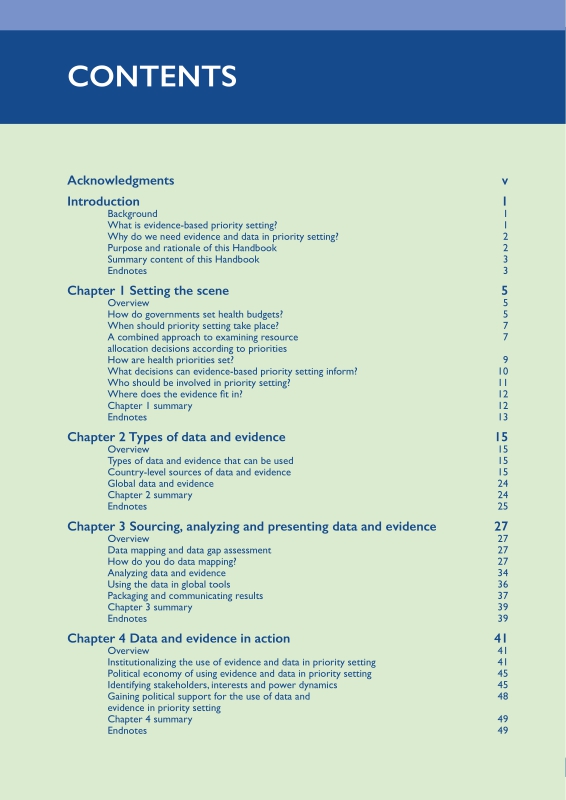
Title page 1
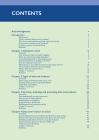
Contents 5
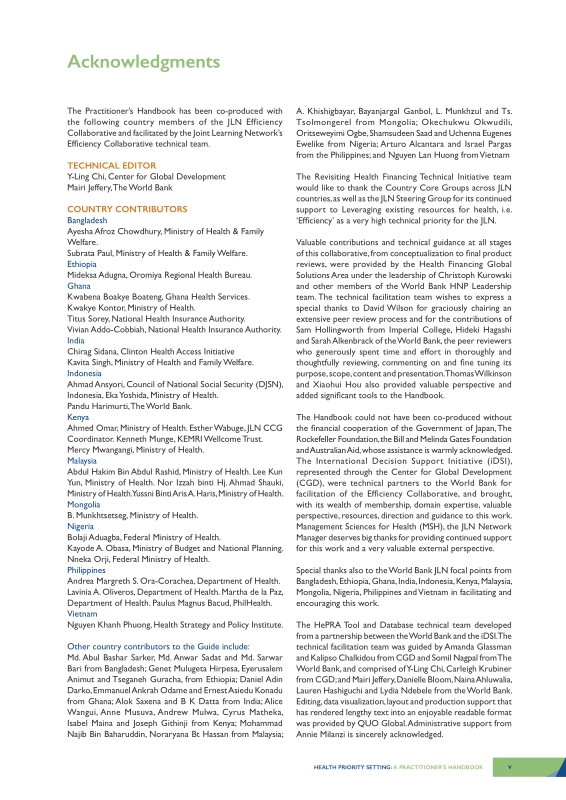
Acknowledgments 4
Introduction 9
Background 9
What is evidence-based priority setting? 9
Why do we need evidence and data in priority setting? 10
Purpose and rationale of this Handbook 10
Summary content of this Handbook 11
Endnotes 11
Chapter 1. Setting the scene 13
Overview 13
How do governments set health budgets? 13
When should priority setting take place? 15
A combined approach to examining resource allocation decisions according to priorities 15
How are health priorities set? 17
What decisions can evidence-based priority setting inform? 18
Who should be involved in priority setting? 19
Where does data and evidence fit in? 20
Chapter 1 summary 20
Endnotes 21
Chapter 2. Types of data and evidence 23
Overview 23
Types of data and evidence that can be used 23
Country-level sources of data and evidence 23
Global data and evidence 32
Chapter 2 summary 32
Endnotes 33
Chapter 3. Sourcing, analyzing and presenting data and evidence 35
Overview 35
Data mapping and data gap assessment 35
How do you do data mapping? 35
Mapping out different scenarios from the data mapping and data gap assessment 36
The bad news: no local data and evidence available 37
Local evidence is available 39
Analyzing data and evidence 42
Using the data in global tools 44
Packaging and communicating results 45
Chapter 3 summary 47
Endnotes 47
Chapter 4. Data and evidence in action 49
Overview 49
Institutionalizing the use of evidence and data in priority setting 49
Political economy of using evidence and data in priority setting 53
Identifying stakeholders, interests and power dynamics 53
Stakeholder analysis 54
Gaining political support for the use of data and evidence in priority setting 56
Creating a culture around the use of evidence and data 56
Chapter 4 summary 57
Endnotes 57
Appendix 1: Strengths and weaknesses of the data sources 59
Appendix 2: Critical appraisal of the suitability of data and evidence 61
Appendix 3: Decision tree: scenario from data mapping 62
Appendix 4: Health Interventions Prioritization Tool 63
Figures 6
Figure 1. The policy cycle 13
Figure 2. The budget cycle 14
Figure 3. Aligned policy and budget cycle 16
Figure 4. Commonly observed problems in data and evidence use 36
Figure 5. Example of making a simple prediction: Catastrophic medical expenditure (CME) 42
Figure 6. Example of using a pre-established target: Health care indicators 42
Figure 7. Example of time trend analysis: Public health expenditure for drugs 43
Figure 8. Example of country comparisons: Dialysis cost per year 43
Figure 9. Example of comparing different courses of action: Total budget for immunization program 43
Boxes 6
Box 1. Country example: Identifying health spending in Mongolia [Not yet verified] 15
Box 2. Country example: National Expanded Program on Immunization in Vietnam 19
Box 3. Country example: The relationship between the Ministry of Health and the National Health Insurance Agency in Ghana 20
Box 4. Country example: Kenya Integrated Household Budget Survey 2015-2016 25
Box 5. Country example: Use of Global Burden of Disease data in the Philippines 25
Box 6. Types of economic evaluation for priority setting 28
Box 7. Tufts Database 29
Box 8. Country example: National Data Warehouse in India 30
Box 9. Country example: MyHealthData Warehouse and National Health Morbidity Survey in Malaysia 31
Box 10. Country example: Data mapping in India 35
Box 11. Support for researchers on economic evaluation: The Guide to Economic Analysis and Research 37
Box 12. Country example: Antiretroviral adherence in HIV-positive women in the United States 41
Box 13. Country example: National Council for Social Security (Dewan Jaminan Sosial Nasional) in Indonesia 41
Box 14. Country example: Kenya National Immunization Technical Advisory Group 51
Box 15. Useful resources for political economy analysis 54
Box 16. Country example: Political economy of priority setting in Bangladesh 55
*표시는 필수 입력사항입니다.
| 전화번호 |
|---|
| 기사명 | 저자명 | 페이지 | 원문 | 기사목차 |
|---|
| 번호 | 발행일자 | 권호명 | 제본정보 | 자료실 | 원문 | 신청 페이지 |
|---|
도서위치안내: / 서가번호:

우편복사 목록담기를 완료하였습니다.
*표시는 필수 입력사항입니다.
저장 되었습니다.
