
 대표어
대표어
 https://www.accc.gov.au/about-us/publications/serial-publications/digital-platform-services-inquiry-2020-25-reports/digital-platform-services-inquiry-final-report-march-2025
권호기사보기
| 기사명 | 저자명 | 페이지 | 원문 | 기사목차 |
|---|
결과 내 검색
동의어 포함
Title page 1
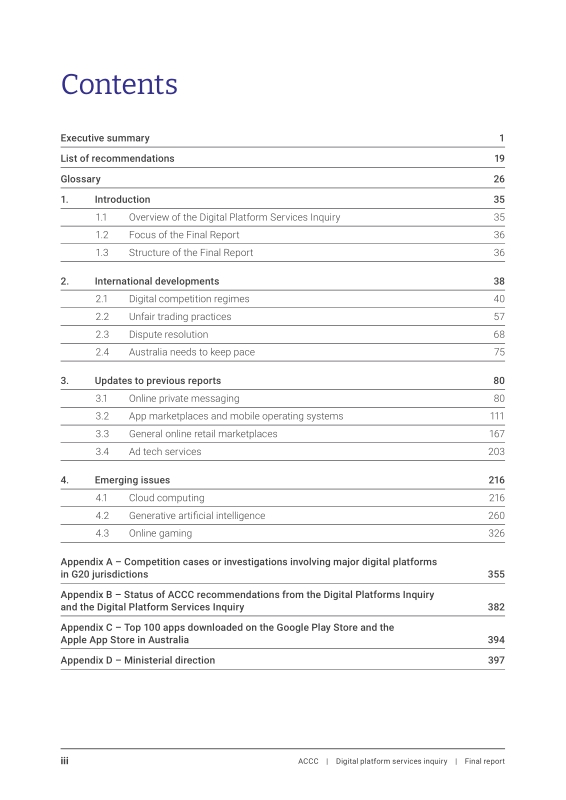
Contents 3
Executive summary 4
List of recommendations 22
Glossary 29
1. Introduction 37
1.1. Overview of the Digital Platform Services Inquiry 38
1.2. Focus of the Final Report 39
1.3. Structure of the Final Report 39
2. International developments 40
2.1. Digital competition regimes 43
2.1.1. Why is ex ante digital competition regulation needed? 43
2.1.2. There is international support for regulatory reform in digital markets 48
2.1.3. The DMA has increased consumer choice and may affect innovation 51
2.1.4. Australia's path towards a new ex ante digital competition regime 57
2.2. Unfair trading practices 60
2.2.1. Evolving digital markets continue to give rise to new consumer and small business harms 60
2.2.2. International jurisdictions already prohibit unfair trading practices in digital markets or are expanding consumer protections 63
2.2.3. Australia's path towards prohibiting unfair trading practices 69
2.3. Dispute resolution 71
2.3.1. Dispute resolution processes for consumer and business interactions with digital platforms are needed 71
2.3.2. International jurisdictions are providing mechanisms for external dispute resolution 74
2.4. Australia needs to keep pace 78
2.4.1. Australia needs to keep pace on addressing systemic competition concerns in digital markets 78
2.4.2. Australia needs to address unfair trading practices and provide an external dispute resolution body 80
3. Updates to previous reports 82
3.1. Online private messaging 83
3.1.1. The ACCC has previously identified competition issues in online private messaging 84
3.1.2. Recent developments in online private messaging 85
3.1.3. Potential competition issues in online private messaging 101
3.1.4. Online private messaging services continue to give rise to consumer harms 107
3.2. App marketplaces and mobile operating systems 114
3.2.1. ACCC's previous consideration of app marketplaces and mobile OS 115
3.2.2. Updates to app marketplaces and mobile OS, including following international regulatory reform and litigation 122
3.2.3. Harms arising from a lack of competition 132
3.2.4. Consumer issues 159
3.3. General online retail marketplaces 170
3.3.1. The ACCC has previously considered competition and consumer issues in general online retail marketplaces 172
3.3.2. Developments in general online retail marketplaces 172
3.3.3. Potential competition issues in general online retail marketplaces 179
3.3.4. Consumers continue to experience harms on general online retail marketplaces 182
3.4. Ad tech services 206
3.4.1. Significant competition harm in ad tech services 206
3.4.2. There is international momentum towards addressing competition harms in ad tech 210
4. Emerging issues 218
4.1. Cloud computing 219
4.1.1. Introduction to cloud computing services 220
4.1.2. Use of cloud infrastructure services is continuing to grow in Australia 227
4.1.3. Key providers of cloud infrastructure services 229
4.1.4. Dynamics and key trends in cloud infrastructure services 237
4.1.5. Potential risks to competition in the supply of cloud infrastructure services 243
4.1.6. A lack of competition in cloud infrastructure services could impact competition in the generative AI sector 261
4.2. Generative artificial intelligence 263
4.2.1. Introduction to generative AI 265
4.2.2. Key firms operating in the generative AI stack 280
4.2.3. Dynamics and key trends in generative AI 289
4.2.4. Potential risks to competition across the generative AI stack 305
4.2.5. Potential impacts of generative AI on competition in related markets 324
4.3. Online gaming 329
4.3.1. Online gaming in Australia 330
4.3.2. Potential harms to consumers 338
Appendix A - Competition cases or investigations involving major digital platforms in G20 jurisdictions 357
Appendix B - Status of ACCC recommendations from the Digital Platforms Inquiry and the Digital Platform Services Inquiry 384
Appendix C - Top 100 apps downloaded on the Google Play Store and the Apple App Store in Australia 396
Appendix D - Ministerial direction 399
Tables 52
Table 2.1. Changes in products and services in the EU/European Economic Area following the DMA 52
Table 3.1. Comparison of general online retail marketplaces' returns policies 201
Table 3.2. ACCC's estimates of Google's share of revenue and impressions for main ad tech services, Australia, 2020 207
Table 3.3. Potential application of service-specific code measures to ad tech concerns 210
Table 4.1. Examples of SaaS, PaaS, and IaaS 225
Table 4.2. Egress fees where customers are transferring data out of selected cloud providers in Australia to the internet, routing on the public internet, March 2025 257
Table 4.3. Types and examples of AI partnerships 306
Figures 55
Figure 2.1. Increased alternate browser downloads in Europe following the Digital Markets Act's effective date (6 March 2024) (iOS and Android devices) 55
Figure 2.2. Australians' support for an external dispute resolution body for digital services 73
Figure 3.1. Types and examples of online private messaging services 87
Figure 3.2. Change in daily active users of online private messaging services (excluding Apple iMessage and Facetime), June 2020 vs June 2024 90
Figure 3.3. Monthly active users and total time spent on online private messaging services (excluding iMessage and FaceTime), June 2024 90
Figure 3.4. Change in monthly active users of online private messaging services (excluding iMessage and FaceTime), June 2020 vs June 2024 92
Figure 3.5. Monthly active users and average time spent per month on online private messaging services (excluding iMessage and FaceTime), June 2024 93
Figure 3.6. Online private messaging services used by Australians for messaging, audio or video calling 94
Figure 3.7. Selected online private messaging services used by Australians, by age 95
Figure 3.8. Number of online private messaging services used by Australians for messaging, audio or video calling within the last month 96
Figure 3.9. Proportion of users of each service that used another messaging service within the last month, for select online messaging services 97
Figure 3.10. Messaging service used most often by consumers who multi-home, for select online messaging services 98
Figure 3.11. Usage of Instagram and TikTok by Australians for messaging, by age 99
Figure 3.12. Australian businesses' total financial losses from scams, 2020-2024 109
Figure 3.13. A view from the Apps Tab of both Apple's App Store and Google's Play Store 115
Figure 3.14. Potential avenues for consumers to access apps from third party app developers 117
Figure 3.15. Example of a warning prompt shown to users when attempting to enable the installation of apps from sources other than the Play Store 119
Figure 3.16. Number of app downloads in Australia, January 2016 to September 2024 124
Figure 3.17. Most popular apps in Australia by daily active users in October 2024 125
Figure 3.18. Average time (minutes per day) spent on the top 20 apps by daily active users in Australia, 1 May to 31 October 2024 126
Figure 3.19. Proportion of Australians who switched or considered switching to a smartphone with a different OS between their current and previous smartphone 128
Figure 3.20. Proportion of Australians who are likely to choose a phone with a different OS the next time they get a new smartphone 129
Figure 3.21. Stylised example of the choice screen shown to a user under Google's User Choice Billing System 134
Figure 3.22. Annual number of reported scams via mobile apps and total losses between 2020 and 2024 161
Figure 3.23. Monthly average users of general online retail marketplace apps, June 2020 to June 2024 174
Figure 3.24. Monthly average users of general online retail marketplace websites, October 2021 to October 2024 174
Figure 3.25. Use of general online retail marketplaces by Australian consumers 176
Figure 3.26. Australian consumer views on whether online marketplaces clearly explain how search results are sorted and displayed by default 180
Figure 3.27. Rates at which online marketplace shoppers have experienced certain potentially unfair practices 184
Figure 3.28. Influence of consumer product reviews on online marketplace shoppers' purchasing decisions 189
Figure 3.29. Frequency with which consumers encounter fake or suspected fake reviews 190
Figure 3.30. Example of reviews for 'similar items' being displayed on Temu 191
Figure 3.31. Consumer support for minimum standards to prevent fake reviews on online marketplaces 193
Figure 3.32. Consumers' levels of satisfaction when attempting to resolve disputes with online marketplaces 200
Figure 3.33. Consumer views on the importance of an independent, external dispute resolution body for general online retail marketplaces, compared to other types... 203
Figure 3.34. Consumer support for an external dispute resolution body by digital platform service 204
Figure 4.1. The cloud computing stack 223
Figure 4.2. An example of a streaming service in the SaaS, PaaS, and IaaS stack 225
Figure 4.3. Actual and forecast spending on IaaS and PaaS in Australia 228
Figure 4.4. Estimates of global and Australian IaaS market shares 231
Figure 4.5. Stylised representation of the vertical cloud stack 239
Figure 4.6. Global cloud revenue of Amazon Web Services, Google and Microsoft from Q3 2022 to Q4 2024 241
Figure 4.7. Usage frequency for selected generative AI tools 269
Figure 4.8. Purposes for using generative AI in the last 6 months, by age group 270
Figure 4.9. Consumers' views on whether Meta should allow Australians to opt out of having their data used to train its generative AI 271
Figure 4.10. Layers in the generative AI technology stack 272
Figure 4.11. Process for training and deploying a foundation model 274
Figure 4.12. The generative AI stack 280
Figure 4.13. Generative AI value chain examples 289
Figure 4.14. Vertical integration & integration of generative AI in digital markets 291
Figure 4.15. Screenshot of an email from Microsoft to a Microsoft 365 Personal subscriber regarding an upcoming price increase, received 9 January 2025 321
Figure 4.16. Use of games and gaming devices by Australians 330
Figure 4.17. Types of gaming devices in Australia 332
Figure 4.18. Australian game players' awareness and views on fairness of licensing of games 340
Figure 4.19. Australian game players' approach to reading terms of use of digital game stores where they access games 342
Boxes 49
Box 2.1. Stakeholders' views on international ex ante digital regimes 49
Box 2.2. Key elements of the Australian Government's proposal for a new digital competition regime 59
Box 2.3. Findings of the EU's Digital Fitness Check 61
Box 2.4. The EU's proposed Digital Fairness Act 65
Box 2.5. Enforcement action against digital platforms by the Italian Competition Authority 66
Box 2.6. Federal Trade Commission v Amazon (Prime) 67
Box 2.7. Australian Government consultation on unfair trading practices regulation 71
Box 2.8. Examples of external dispute resolution schemes in Australia 74
Box 2.9. Dispute resolution bodies appointed under the DMA and Digital Services Act 76
Box 3.1. European Commission's investigation into Microsoft Teams 104
Box 3.2. European Commission's designation of WhatsApp and Facebook Messenger under the DMA 105
Box 3.3. US Department of Justice's (US DOJ) consideration of cross-platform messaging interoperability on iOS 107
Box 3.4. International responses to children's safety and privacy issues 112
Box 3.5. Potential measures to address issues identified in the ACCC's Report on App Marketplaces 121
Box 3.6. International regulatory developments related to app payment terms 136
Box 3.7. International regulatory developments related to communication of payment options 138
Box 3.8. International regulatory developments related to third-party browser engines 146
Box 3.9. International developments relating to interoperability of hardware, software and functionality of mobile OS 149
Box 3.10. International regulatory developments in relation to self-preferencing 155
Box 3.11. Amazon's designation under the DMA 182
Box 3.12. International regulatory efforts to address manipulative practices on general online retail marketplaces 185
Box 3.13. Examples of international regulatory action on fake reviews 192
Box 3.14. Reports of product safety injury - hooded jumpers sold on Temu 195
Box 3.15. Australian Product Safety Pledge (the Pledge) 196
Box 3.16. International legislation and enforcement action regarding product safety concerns on general online retail marketplaces 197
Box 3.17. Examples of international legislation and regulatory action to establish dispute resolution mechanisms on online marketplaces 202
Box 3.18. Australian class actions in relation to competition harms in ad tech services 208
Box 3.19. Recommendations for service-specific rules in ad tech 209
Box 3.20. Action against alleged anti-competitive conduct in the US 211
Box 3.21. European Commission investigation into Google Ad Tech 213
Box 3.22. Canadian Competition Bureau case into Google ad tech 214
Box 3.23. Enforcement cases in France seeking to address self-preferencing conduct 215
Box 3.24. CMA investigation into ad tech 216
Box 3.25. Google's Privacy Sandbox proposal 217
Box 4.1. Previous ACCC consideration of cloud computing services 222
Box 4.2. What are 'hyperscalers'? 230
Box 4.3. Data centre investments by key cloud providers in Australia 232
Box 4.4. Vertical integration in cloud through agreement, joint venture or merger 238
Box 4.5. EU Data Act 255
Box 4.6. Previous consideration of work on AI and algorithms by the Digital Platform Regulators Forum 266
Box 4.7. Global shortages of AI chips 277
Box 4.8. Ongoing policy considerations outside of competition 304
Box 4.9. DeepSeek's 'low cost' foundation model 311
Box 4.10. Stakeholders are concerned about their intellectual property and copyrighted content being used to train AI models 312
Box 4.11. Privacy implications of using consumer data in generative AI training 313
Box 4.12. Consumer concerns from bundling or tying products - Microsoft 365 subscriptions with generative AI features 320
Box 4.13. Algorithmic collusion in other areas of the economy 328
Box 4.14. Gaming subscription services 334
Box 4.15. Cloud game streaming services 335
Box 4.16. Australian and international consideration of potential links between paid loot boxes and addiction 347
Box 4.17. Consumer guarantee provisions of the Australian Consumer Law 354
Box 4.18. Relevant overseas enforcement action against online gaming businesses 356
Appendix Figures 397
Figure C.1. Google Play Store - Top 100 apps by number of downloads in Australia, 31 July 2023-31 July 2024 397
Figure C.2. Apple App Store - Top 100 apps by number of downloads in Australia, 31 July 2023-31 July 2024 398
*표시는 필수 입력사항입니다.
| 전화번호 |
|---|
| 기사명 | 저자명 | 페이지 | 원문 | 기사목차 |
|---|
| 번호 | 발행일자 | 권호명 | 제본정보 | 자료실 | 원문 | 신청 페이지 |
|---|
도서위치안내: / 서가번호:

우편복사 목록담기를 완료하였습니다.
*표시는 필수 입력사항입니다.
저장 되었습니다.
