
 대표어
대표어
 https://ecfr.eu/publication/from-ore-to-more-mineral-partnerships-for-african-industrialisation/
권호기사보기
| 기사명 | 저자명 | 페이지 | 원문 | 기사목차 |
|---|
결과 내 검색
동의어 포함
Title page 1
Contents 1
Summary 1
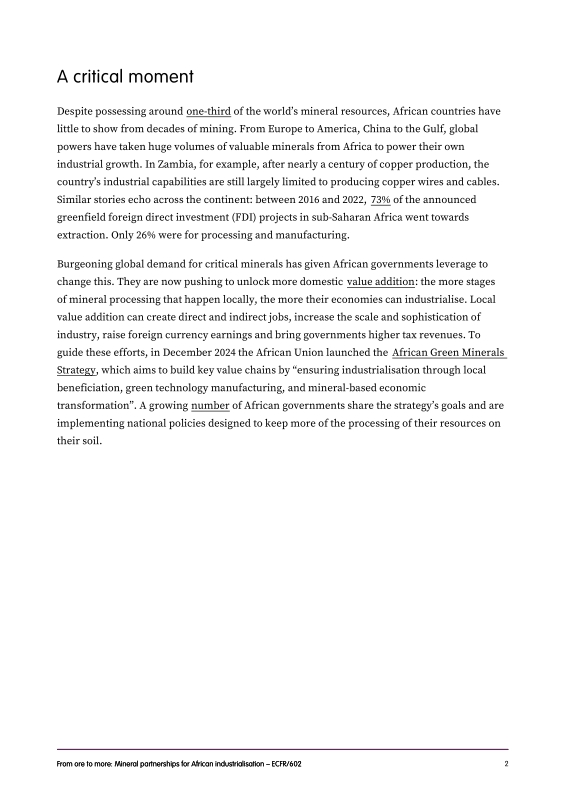
A critical moment 2
Mind the expectations gap 7
When ambition meets reality 8
Partnering up 12
The challenges of boosting local value addition 15
1. A lack of affordable and reliable utilities 16
2. Scarcity and high price of mineral inputs in local markets 17
3. Skill scarcity in the workforce 18
4. Failure to reach economies of scale 19
5. Weak regional cooperation 19
Recommendations 20
Mining for the future 23
Acknowledgments 24
- The future of European energy and military security depends on secure and diversified sources of critical minerals. Currently, however, the EU heavily relies on supply from China—its strategic rival.
- Direct sourcing from African countries presents an alternative. But after a long history of seeing minerals simply extracted and exported, African governments are keen to keep more stages of mineral processing and manufacturing, known as value addition, on home soil.
- The EU has signed critical mineral agreements with several African countries, yet progress on local value addition projects has been slow. And while African countries have ambitious agendas to produce consumer goods, EU authorities see Africa’s role as more limited to mineral processing.
- To help realise their ambitions, African governments are imposing export restrictions on unprocessed minerals. But to make local value addition economically viable and attractive for foreign investment, more on-the-ground reforms and investments are needed.
- To be better partners, Europeans should make policy adjustments to encourage European participation in African mineral value chains. In a sector crowded with other powers, most notably China, a genuine commitment to supporting local value addition in African partner countries will make the European offer stand out.*표시는 필수 입력사항입니다.
| 전화번호 |
|---|
| 기사명 | 저자명 | 페이지 | 원문 | 기사목차 |
|---|
| 번호 | 발행일자 | 권호명 | 제본정보 | 자료실 | 원문 | 신청 페이지 |
|---|
도서위치안내: / 서가번호:

우편복사 목록담기를 완료하였습니다.
*표시는 필수 입력사항입니다.
저장 되었습니다.
