
 대표어
대표어
 https://openknowledge.worldbank.org/entities/publication/541313e8-9bc5-4502-b7e5-6f7595b9bc25
권호기사보기
| 기사명 | 저자명 | 페이지 | 원문 | 기사목차 |
|---|
결과 내 검색
동의어 포함
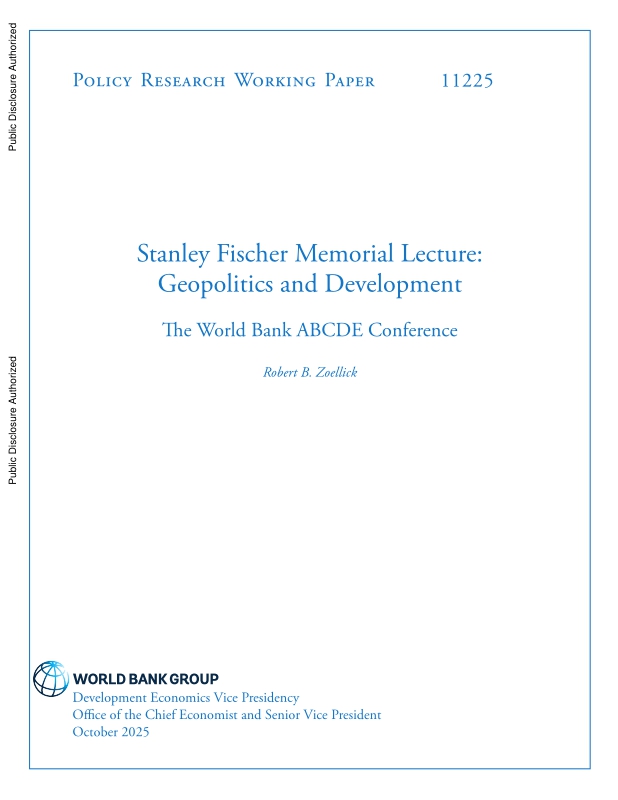
Title page 1
Contents 1
Abstract 2
Introduction: Stanley Fischer 4
Economic History and Geopolitics 4
The European Age of Discovery: Mercantilism and Imperialism 4
The International Economy in the 19th Century 5
The Great War and Government Controls 6
The International Economy between the Wars 6
Bretton Woods and an Adaptive International Economy 7
The International Economy of the Cold War 7
Early Theories of Development Economics 8
The World Bank and Development Research 8
The 1970s: Shocks, Breakdowns, and New Ideas 8
The End of the Cold War 9
The 2000s: Wars, the Great Recession, and Economic Nationalism 9
Globalization in 2025: The Phenomena versus Governance 10
The Geopolitical Outlook: Security 10
Energy and Climate, Demographics, and Migration 11
Finance and Debt 11
Trade and Development 11
An International Economy of Big Power Politics 12
The Role of the Multilaterals? 12
Development Research and Practice: A Thanks to Stanley Fischer 13
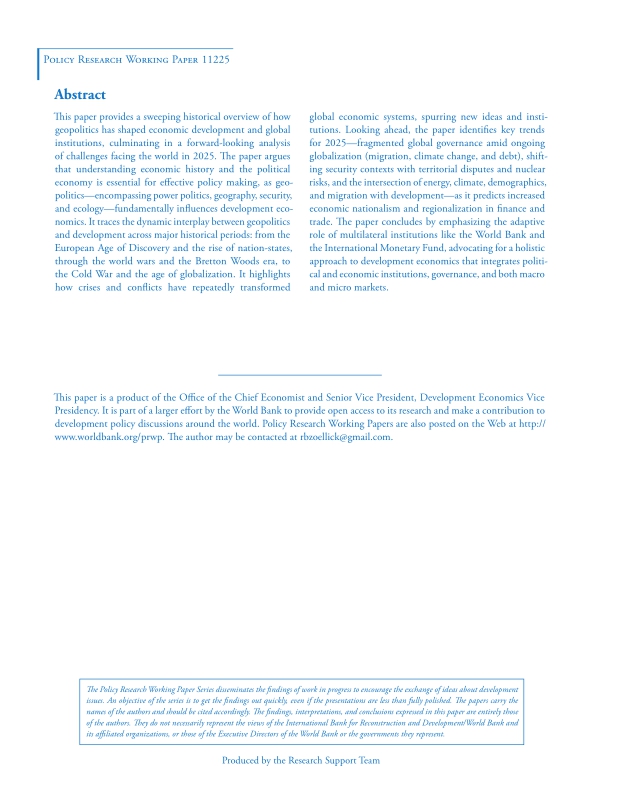
This paper provides a sweeping historical overview of how geopolitics has shaped economic development and global institutions, culminating in a forward-looking analysis of challenges facing the world in 2025. The paper argues that understanding economic history and the political economy is essential for effective policy making, as geopolitics—encompassing power politics, geography, security, and ecology—fundamentally influences development economics.
It traces the dynamic interplay between geopolitics and development across major historical periods: from the European Age of Discovery and the rise of nation-states, through the world wars and the Bretton Woods era, to the Cold War and the age of globalization. It highlights how crises and conflicts have repeatedly transformed global economic systems, spurring new ideas and institutions.
Looking ahead, the paper identifies key trends for 2025—fragmented global governance amid ongoing globalization (migration, climate change, and debt), shifting security contexts with territorial disputes and nuclear risks, and the intersection of energy, climate, demographics, and migration with development—as it predicts increased economic nationalism and regionalization in finance and trade. The paper concludes by emphasizing the adaptive role of multilateral institutions like the World Bank and the International Monetary Fund, advocating for a holistic approach to development economics that integrates political and economic institutions, governance, and both macro and micro markets.*표시는 필수 입력사항입니다.
| 전화번호 |
|---|
| 기사명 | 저자명 | 페이지 | 원문 | 기사목차 |
|---|
| 번호 | 발행일자 | 권호명 | 제본정보 | 자료실 | 원문 | 신청 페이지 |
|---|
도서위치안내: / 서가번호:

우편복사 목록담기를 완료하였습니다.
*표시는 필수 입력사항입니다.
저장 되었습니다.
