
 대표어
대표어
 https://www.cgdev.org/publication/weak-private-investment-trends-emdes-what-can-governments-do-about-it

권호기사보기
| 기사명 | 저자명 | 페이지 | 원문 | 기사목차 |
|---|
결과 내 검색
동의어 포함
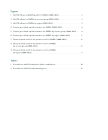
Title page 1
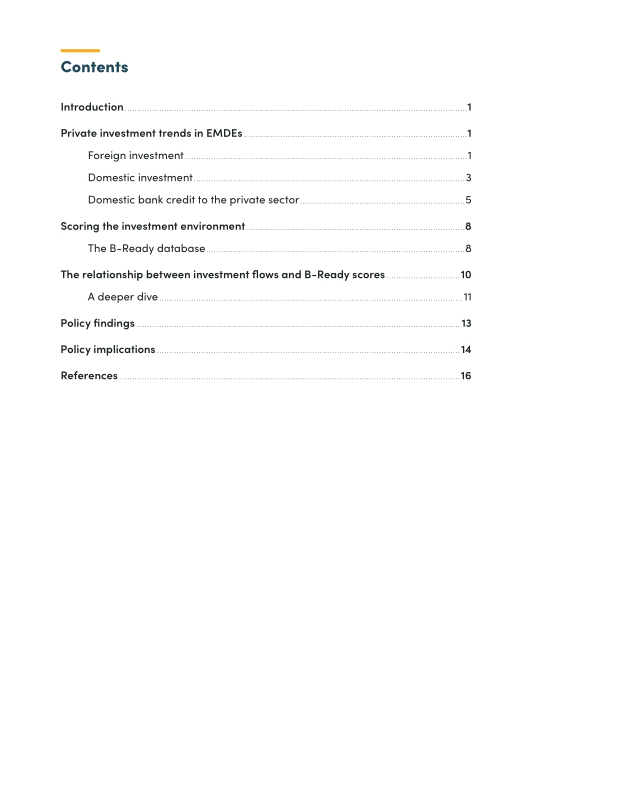
Contents 3
Abstract 1
Introduction 5
Private investment trends in EMDEs 5
Foreign investment 5
Domestic investment 7
Domestic bank credit to the private sector 9
Scoring the investment environment 12
The B-Ready database 12
The relationship between investment flows and B-Ready scores 14
A deeper dive 15
Policy findings 17
Policy implications 18
References 20
Tables 4
TABLE 1. Correlations with B-Ready topic-pillar combinations 14
TABLE 2. Correlations with B-Ready subcategories 16
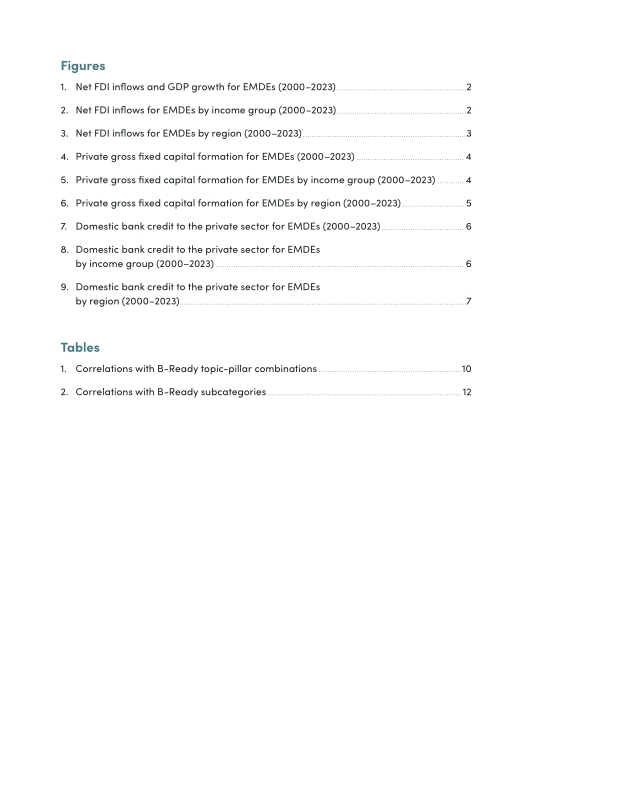
Figures 4
FIGURE 1. Net FDI inflows and GDP growth for EMDEs (2000-2023) 6
FIGURE 2. Net FDI inflows for EMDEs by income group (2000-2023) 6
FIGURE 3. Net FDI inflows for EMDEs by region (2000-2023) 7
FIGURE 4. Private gross fixed capital formation for EMDEs (2000-2023) 8
FIGURE 5. Private gross fixed capital formation for EMDEs by income group (2000-2023) 8
FIGURE 6. Private gross fixed capital formation for EMDEs by region (2000-2023) 9
FIGURE 7. Domestic bank credit to the private sector for EMDEs (2000-2023) 10
FIGURE 8. Domestic bank credit to the private sector for EMDEs by income group (2000-2023) 10
FIGURE 9. Domestic bank credit to the private sector for EMDEs by region (2000-2023) 11
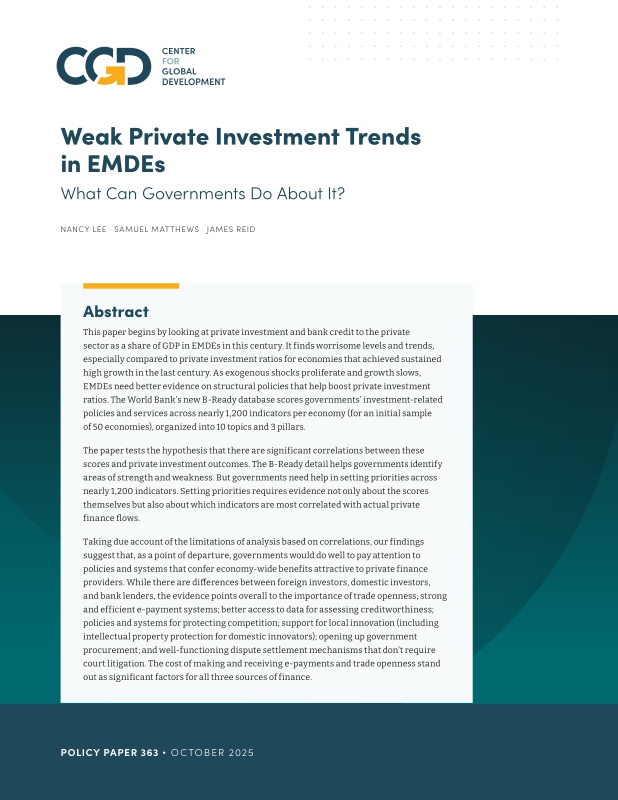
This paper begins by looking at private investment and bank credit to the private sector as a share of GDP in EMDEs in this century. It finds worrisome levels and trends, especially compared to private investment ratios for economies that achieved sustained high growth in the last century. As exogenous shocks proliferate and growth slows, EMDEs need better evidence on structural policies that help boost private investment ratios. The World Bank’s new B-Ready database scores governments’ investment-related policies and services across nearly 1,200 indicators per economy (for an initial sample of 50 economies), organized into 10 topics and 3 pillars.
The paper tests the hypothesis that there are significant correlations between these scores and private investment outcomes. The B-Ready detail helps governments identify areas of strength and weakness. But governments need help in setting priorities across nearly 1,200 indicators. Setting priorities requires evidence not only about the scores themselves but also about which indicators are most correlated with actual private finance flows.
Taking due account of the limitations of analysis based on correlations, our findings suggest that, as a point of departure, governments would do well to pay attention to policies and systems that confer economy-wide benefits attractive to private finance providers. While there are differences between foreign investors, domestic investors, and bank lenders, the evidence points overall to the importance of trade openness; strong and efficient e-payment systems; better access to data for assessing creditworthiness; policies and systems for protecting competition; support for local innovation (including intellectual property protection for domestic innovators); opening up government procurement; and well-functioning dispute settlement mechanisms that don’t require court litigation. The cost of making and receiving e-payments and trade openness stand out as significant factors for all three sources of finance.*표시는 필수 입력사항입니다.
| 전화번호 |
|---|
| 기사명 | 저자명 | 페이지 | 원문 | 기사목차 |
|---|
| 번호 | 발행일자 | 권호명 | 제본정보 | 자료실 | 원문 | 신청 페이지 |
|---|
도서위치안내: / 서가번호:

우편복사 목록담기를 완료하였습니다.
*표시는 필수 입력사항입니다.
저장 되었습니다.
