
 대표어
대표어
 https://openknowledge.worldbank.org/entities/publication/4ab2d8d7-0457-498c-92a9-4537fc5399ab
권호기사보기
| 기사명 | 저자명 | 페이지 | 원문 | 기사목차 |
|---|
결과 내 검색
동의어 포함
Title page 1
Contents 1
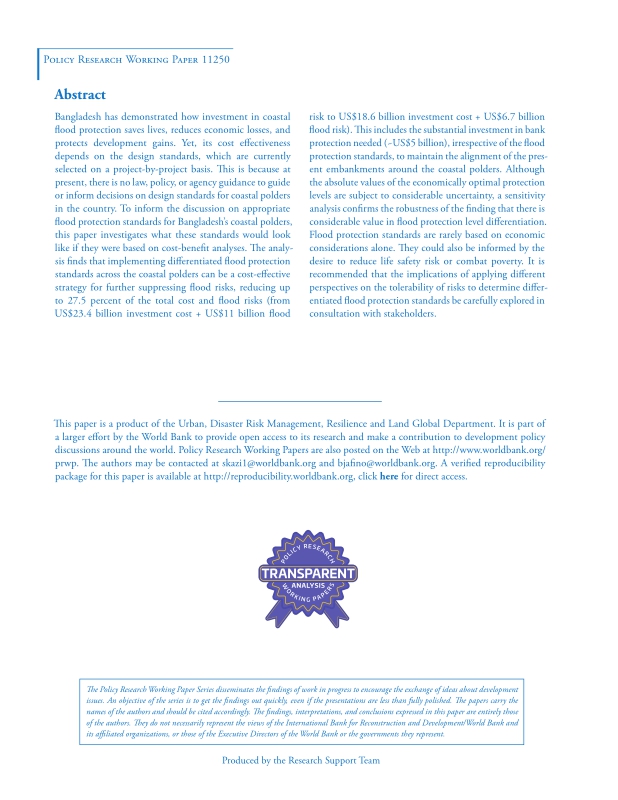
Abstract 2
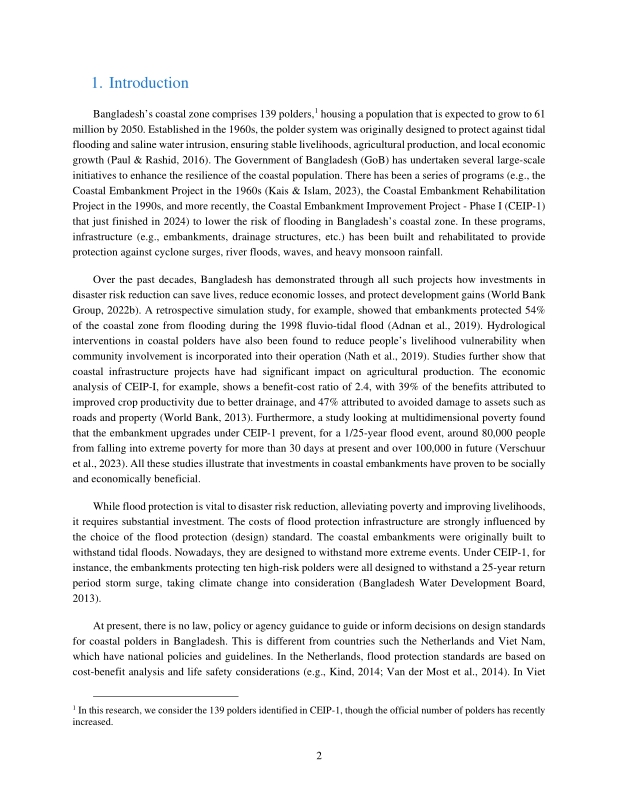
1. Introduction 4
2. Methodology 5
2.1. Design standards based on economic risk 6
2.2. Key modeling steps and assumptions 8
2.3. Input data 10
3. Results 10
3.1. Present coastal flood risk estimates 10
3.2. 'Hold the Line' scenario with a fixed 10-year protection level 12
3.3. Economically optimal protection levels 13
3.4. Sensitivity analyses 16
4. Protection standards based on life safety risk 16
4.1. Limiting individual risk 17
4.2. Minimizing expected life loss 18
5. Conclusions 18
5.1. Discussion and recommendations 18
5.2. Limitations 19
References 21
Appendix A: Economic model 24
Appendix B: Accounting for O&M Costs 26
Appendix C: Calculating the conditional expectation of flood damage 27
Appendix D: Adjusting damage estimates from bathtub inundation models 32
Appendix E: Case study data 34
Appendix F: Sensitivity analyses 43
Appendix G: Standards based on life loss minimization 46
Tables 13
Table 1. Overview of cost of the 'Hold the Line' scenario 13
Table 2. Results of total investment for a 10-, 30- or 100-year protection level incl. optimal scenario 16
Table 3. Total damage estimates for polder 32 from bathtub inundation models 29
Table 4. Total damage estimates for polder 32 from bathtub inundation models with adjusted return periods 33
Table 5. Comparison of land use values for two polders from different studies 42
Table 6. Uncertainty bands of data 43
Figures 6
Figure 1. Coastal polders delineated by their embankments 6
Figure 2. Cost, benefits, total costs and economically optimal protection level from economic perspective 7
Figure 3. Present protection levels based on the current embankment elevations 11
Figure 4. Potential damage from flooding for a 25-year cyclone event 11
Figure 5. Risk per surface area present wind corrected 12
Figure 6. The economically optimal protection level for polder 5 and 32 (black dot). This point is found by minimizing the sum of the investment and... 14
Figure 7. Economically optimal protection levels for all polders in the coastal zone 14
Figure 8. The required elevation associated with the optimal solution (left) and the variable cost per embankment length for a 30 year protection standard (right) 15
Figure 9. Results for sensitivity analysis through Monte Carlo simulation as recorded Appendix F 16
Figure 10. Damage calculation for polder 32: the interpolation and extrapolation of the damage estimates from the bathtub model (top left panel), the expected... 30
Figure 11. Damage calculation for polder 32 using optimistic loglinear extrapolation to lower water levels: the interpolation and extrapolation of the damage estimates... 31
Figure 12. Damage calculation for a fictious case in which the damage from flooding is the same for every outside water level: the interpolation and... 32
Figure 13. Comparison of the inundation depths from a bathtub model and an inundation simulation (from: TUDelft, draft policy research paper, July 2022) 33
Figure 14. Damage calculation for polder 32 with 'bathtub model adjustment': the interpolation and extrapolation of the damage estimates from the bathtub model... 34
Figure 15. River dike (left) and coastal dike (right) cross section. Main difference between both cross sections is the outer slope, which is 1:3 for a river dike and... 38
Figure 16. Factions of river versus coastal dike per polder 39
Figure 17. Faction of polder circumference requiring slope protection 40
Figure 18. satellite image of polder 32 before and after Cyclone Aila, showing flooding in the polder through the Nalian breach 41
Figure 19. Protection levels with 50% of the unit rates for variable costs (right) compared to the baseline (left) 44
Figure 20. Protection levels with 10% of the slope protection length (right) compared to the baseline (left) 44
Figure 21. Optimal levels when increasing the bathtub scaling times 5 (10 year = 50 year), to the right, compared to the baseline scenario (left) 45
Figure 22. Optimal levels when removing the correction for wind damage to structures (right) compared to the baseline scenario 45
Figure 23. Optimal protection levels when doubling sea level rise (right) compared to the baseline scenario (left) 46
Figure 24. Minimizing AELL for Polder 32 "hold the line" with shelters 48
Figure 25. Minimizing AELL for Polder 32 "hold the line" with shelters with Ni= 67,000 49
*표시는 필수 입력사항입니다.
| 전화번호 |
|---|
| 기사명 | 저자명 | 페이지 | 원문 | 기사목차 |
|---|
| 번호 | 발행일자 | 권호명 | 제본정보 | 자료실 | 원문 | 신청 페이지 |
|---|
도서위치안내: / 서가번호:

우편복사 목록담기를 완료하였습니다.
*표시는 필수 입력사항입니다.
저장 되었습니다.
