
 대표어
대표어
 https://www.accc.gov.au/about-us/publications/recent-developments-in-ai-industry-snapshot
권호기사보기
| 기사명 | 저자명 | 페이지 | 원문 | 기사목차 |
|---|
결과 내 검색
동의어 포함
Title page 1
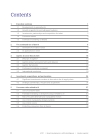
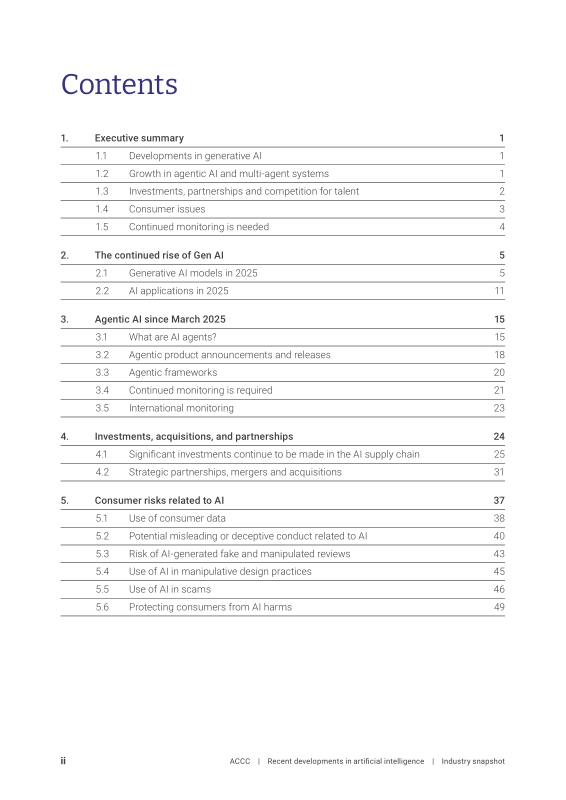
Contents 3
1. Executive summary 4
1.1. Developments in generative AI 4
1.2. Growth in agentic AI and multi-agent systems 4
1.3. Investments, partnerships and competition for talent 5
1.4. Consumer issues 6
1.5. Continued monitoring is needed 7
2. The continued rise of Gen AI 8
2.1. Generative AI models in 2025 8
2.1.1. Benchmarks indicate significant improvements in new models 10
2.1.2. New types of models are being released 11
2.2. AI applications in 2025 14
2.2.1. AI increasingly draws on personalised data 14
2.2.2. AI is being integrated across digital ecosystems 14
2.2.3. AI could change how the internet is accessed 15
2.2.4. Firms are exploring monetisation strategies for AI apps 17
2.2.5. Firms have released new AI image and video apps 17
3. Agentic AI since March 2025 18
3.1. What are AI agents? 18
3.2. Agentic product announcements and releases 21
3.3. Agentic frameworks 23
3.4. Continued monitoring is required 24
3.5. International monitoring 26
4. Investments, acquisitions, and partnerships 27
4.1. Significant investments continue to be made in the AI supply chain 28
4.1.1. Significant investments are being made in AI infrastructure 28
4.1.2. Key players are investing to vertically integrate and self-supply compute 31
4.2. Strategic partnerships, mergers and acquisitions 34
4.2.1. Partnerships for investment in AI infrastructure 34
4.2.2. Interdependencies across the AI supply chain 36
4.2.3. Competition for technical experts 37
5. Consumer risks related to AI 40
5.1. Use of consumer data 41
5.2. Potential misleading or deceptive conduct related to AI 43
5.2.1. Use of generative AI to facilitate false representations 44
5.2.2. Use of AI chatbots in customer service 44
5.2.3. 'AI-washing' practices 45
5.3. Risk of AI-generated fake and manipulated reviews 46
5.4. Use of AI in manipulative design practices 48
5.4.1. Hypernudging 48
5.5. Use of AI in scams 49
5.6. Protecting consumers from AI harms 52
Figures 5
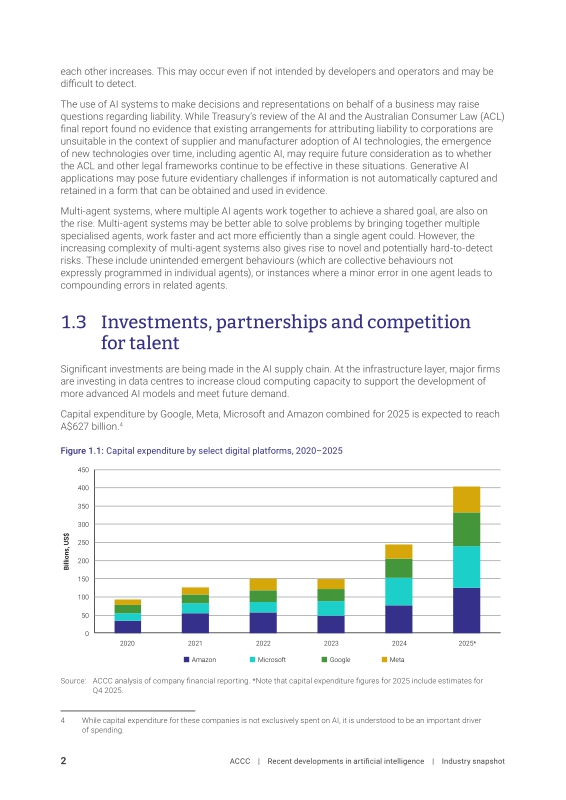
Figure 1.1. Capital expenditure by select digital platforms, 2020-2025 5
Figure 1.2. Interdependencies in the AI supply chain 6
Figure 2.1. A selection of notable AI model releases in 2025 10
Figure 2.2/Figure 2.3. Example of a simulated environment using Google's Genie 3 13
Figure 3.1. An augmented LLM AI agent 19
Figure 3.2. Multi-agent systems can be set up in various architectures 20
Figure 3.3. Examples of agentic framework releases by major AI firms since March 2025 24
Figure 4.1. Comparison of digital platforms' capital expenditure and Australian spending 29
Figure 4.2. Capital expenditure by select digital platforms, 2020-2025 29
Figure 4.3. Vertical integration across the AI stack 32
Figure 4.4. Interdependencies in the AI supply chain 37
Figure 5.1. Consumer views regarding consent to use personal data to train AI 41
Figure 5.2. Screenshots of landing page 50
Figure 5.3. Screenshots of landing page 51
Figure 5.4. Screenshot from alternate landing page 51
Boxes 9
Box 2.1. Examples of new AI model releases 9
Box 2.2. Benchmarks provide an indication of model quality 11
Box 3.1. Case study - ChatGPT Instant Checkout uses OpenAI's open-source Agentic Commerce Protocol 23
Box 4.1. AI infrastructure in Australia 33
Box 4.2. Competition authorities internationally continue to scrutinise mergers, acquisitions and partnerships 39
Box 5.1. ACCC action on alleged misleading Microsoft 365 subscription 43
Box 5.2. US authorities are scrutinising claims about advanced AI functionality 45
Box 5.3. Selected international legislative and regulatory developments on AI-generated fake reviews 47
Box 5.4. General prohibition on unfair trading practices to be introduced in Australia 48
Box 5.5. Example AI-washing investment scam website 50
Box 5.6. Selected recent AI regulatory and policy developments in Australia 53
*표시는 필수 입력사항입니다.
| 전화번호 |
|---|
| 기사명 | 저자명 | 페이지 | 원문 | 기사목차 |
|---|
| 번호 | 발행일자 | 권호명 | 제본정보 | 자료실 | 원문 | 신청 페이지 |
|---|
도서위치안내: / 서가번호:

우편복사 목록담기를 완료하였습니다.
*표시는 필수 입력사항입니다.
저장 되었습니다.
