
 대표어
대표어
 https://www.accc.gov.au/about-us/publications/guidelines-for-authorisation-of-conduct
권호기사보기
| 기사명 | 저자명 | 페이지 | 원문 | 기사목차 |
|---|
결과 내 검색
동의어 포함
Title page 1
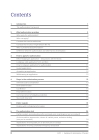
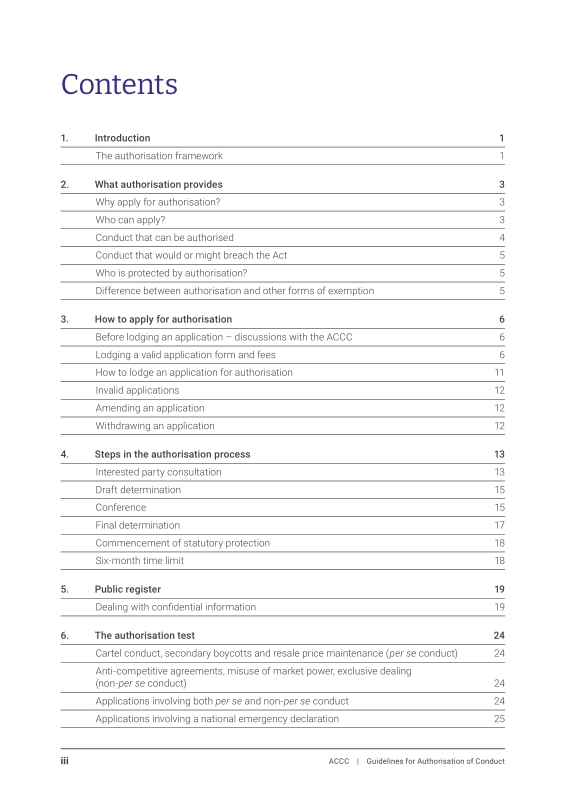
Contents 3
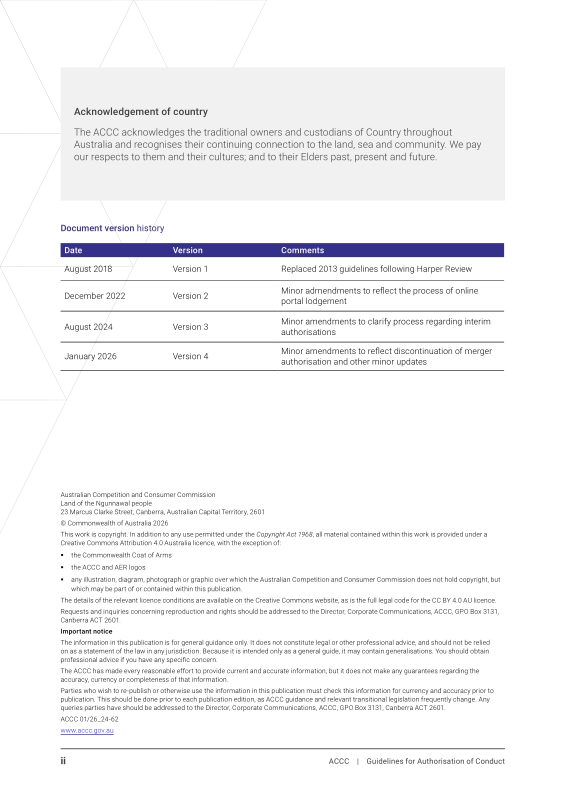
Acknowledgement of country 2
1. Introduction 5
The authorisation framework 5
2. What authorisation provides 7
Why apply for authorisation? 7
Who can apply? 7
Conduct that can be authorised 8
Conduct that would or might breach the Act 9
Who is protected by authorisation? 9
Difference between authorisation and other forms of exemption 9
3. How to apply for authorisation 10
Before lodging an application - discussions with the ACCC 10
Lodging a valid application form and fees 10
How to lodge an application for authorisation 15
Invalid applications 16
Amending an application 16
Withdrawing an application 16
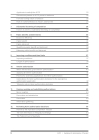
4. Steps in the authorisation process 17
Interested party consultation 17
Draft determination 19
Conference 19
Final determination 21
Commencement of statutory protection 22
Six-month time limit 22
5. Public register 23
Dealing with confidential information 23
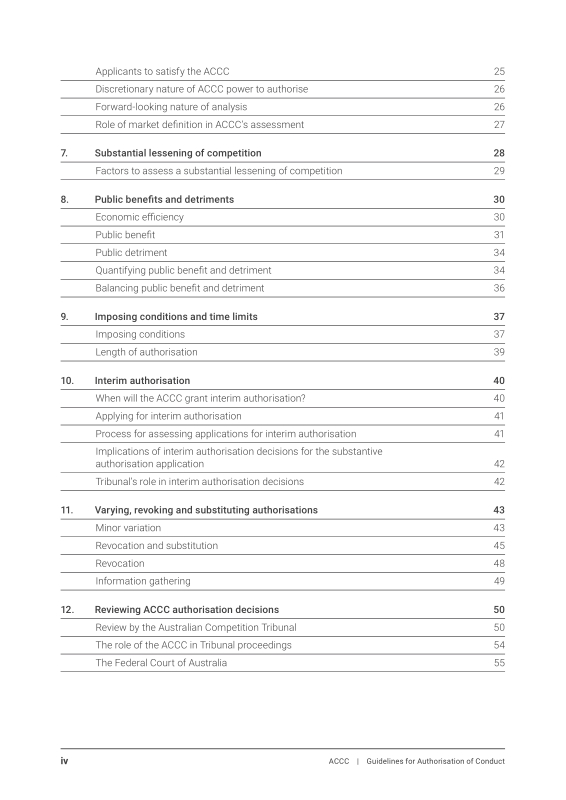
6. The authorisation test 28
Cartel conduct, secondary boycotts and resale price maintenance (per se conduct) 28
Anti-competitive agreements, misuse of market power, exclusive dealing (non-per se conduct) 28
Applications involving both per se and non-per se conduct 28
Applications involving a national emergency declaration 29
Applicants to satisfy the ACCC 29
Discretionary nature of ACCC power to authorise 30
Forward-looking nature of analysis 30
Role of market definition in ACCC's assessment 31
7. Substantial lessening of competition 32
Factors to assess a substantial lessening of competition 33
8. Public benefits and detriments 34
Economic efficiency 34
Public benefit 35
Public detriment 38
Quantifying public benefit and detriment 38
Balancing public benefit and detriment 40
9. Imposing conditions and time limits 41
Imposing conditions 41
Length of authorisation 43
10. Interim authorisation 44
When will the ACCC grant interim authorisation? 44
Applying for interim authorisation 45
Process for assessing applications for interim authorisation 45
Implications of interim authorisation decisions for the substantive authorisation application 46
Tribunal's role in interim authorisation decisions 46
11. Varying, revoking and substituting authorisations 47
Minor variation 47
Revocation and substitution 49
Revocation 52
Information gathering 53
12. Reviewing ACCC authorisation decisions 54
Review by the Australian Competition Tribunal 54
The role of the ACCC in Tribunal proceedings 58
The Federal Court of Australia 59
Charts 6
Chart 1. Usual steps and indicative times for the authorisation process 6
*표시는 필수 입력사항입니다.
| 전화번호 |
|---|
| 기사명 | 저자명 | 페이지 | 원문 | 기사목차 |
|---|
| 번호 | 발행일자 | 권호명 | 제본정보 | 자료실 | 원문 | 신청 페이지 |
|---|
도서위치안내: / 서가번호:

우편복사 목록담기를 완료하였습니다.
*표시는 필수 입력사항입니다.
저장 되었습니다.
