
 대표어
 https://openknowledge.worldbank.org/entities/publication/50cfe25f-9a42-4446-98fe-86cafd2defd8
권호기사보기
| 기사명 | 저자명 | 페이지 | 원문 | 기사목차 |
|---|
결과 내 검색
동의어 포함
Title page 1
Contents 1
Abstract 2
1. Introduction 4
2. Methods and data 5
2.1. Microsimulation model 5
2.2. Poverty estimation 5
2.3. Scenario setup 7
3. Results 8
3.1. Globally, 12.7 million people in extreme poverty due to disasters 8
3.2. Risk to assets, consumption, and well-being 10
3.3. The benefits of adaptive social protection 11
3.3.1. Uniform post-disaster support 12
3.3.2. Proportional post-disaster support 14
3.3.3. PDS cost-effectiveness 15
3.3.4. Income diversification 16
3.3.5. Asset vulnerability reduction 17
3.3.6. Exposure reduction 19
4. Discussion and conclusions 20
References 24
Supplementary information 28
A. Text supplement 29
A.1. Transfers and disaster resilience 29
B. Supplementary figures 30
C. Supplementary tables 37
Tables 9
Table 1. Datasets used 9
Figures 7
Figure 1. Illustration of poverty risk metrics 7
Figure 2. Estimated global poverty impact of disasters 11
Figure 3. Risk to assets, consumption, and well-being in the baseline scenario 12
Figure 4. Reduced damages and losses due to uniform post-disaster support 13
Figure 5. Reduced risk of poverty due to uniform post-disaster support 13
Figure 6. Reduced damages and losses due to proportional post-disaster support 14
Figure 7. Reduced risk of poverty due to proportional post-disaster support 14
Figure 8. Cost-effectiveness of post-disaster support measures 15
Figure 9. Reduced damages and losses due to income diversification 17
Figure 10. Reduced risk of poverty due to income diversification 17
Figure 11. Reduced damages and losses due to vulnerability reduction 18
Figure 12. Reduced risk of poverty due to vulnerability reduction 18
Figure 13. Reduced damages and losses due to exposure reduction 19
Figure 14. Reduced risk of poverty due to exposure reduction 19
Figure 15. Optimal expansion trajectories for all protection measures by country income group 23
Supplementary Tables 28
Supplementary Table 1. Baseline disaster risks 37
Supplementary Figures 28
Supplementary Figure 1. Risk of being pushed into poverty by country income group 31
Supplementary Figure 2. Time in poverty 32
Supplementary Figure 3. Damages and losses due to disasters by country income group 33
Supplementary Figure 4. Benefit-cost ratios for post-disaster support with extreme poverty 34
Supplementary Figure 5. Annual average poverty due to disasters without hazard protection 35
Supplementary Figure 6. The relationship between disaster impacts and transfers 36
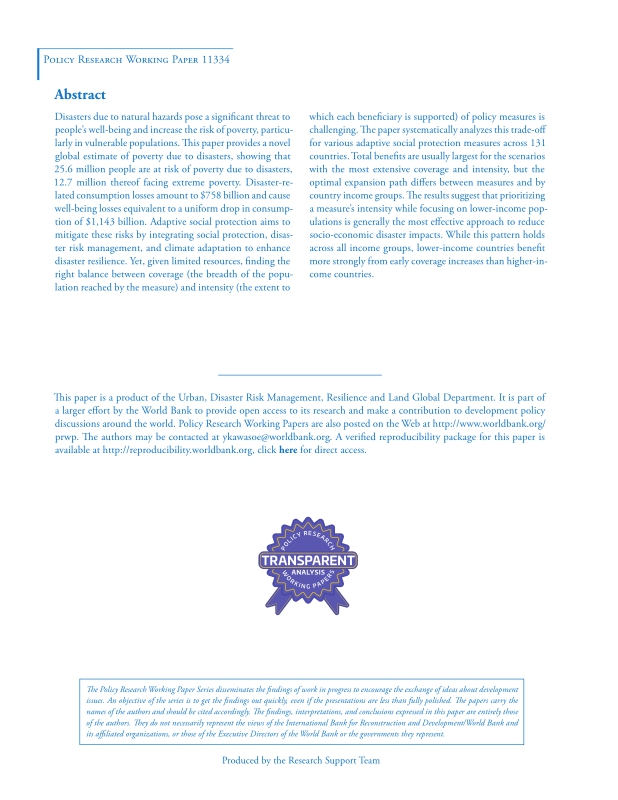
Disasters due to natural hazards pose a significant threat to people’s well-being and increase the risk of poverty, particularly in vulnerable populations. This paper provides a novel global estimate of poverty due to disasters, showing that 25.6 million people are at risk of poverty due to disasters, 12.7 million thereof facing extreme poverty. Disaster-related consumption losses amount to $758 billion and cause well-being losses equivalent to a uniform drop in consumption of $1,143 billion.
Adaptive social protection aims to mitigate these risks by integrating social protection, disaster risk management, and climate adaptation to enhance disaster resilience. Yet, given limited resources, finding the right balance between coverage (the breadth of the population reached by the measure) and intensity (the extent to which each beneficiary is supported) of policy measures is challenging. The paper systematically analyzes this trade-off for various adaptive social protection measures across 131 countries.
Total benefits are usually largest for the scenarios with the most extensive coverage and intensity, but the optimal expansion path differs between measures and by country income groups. The results suggest that prioritizing a measure’s intensity while focusing on lower-income populations is generally the most effective approach to reduce socio-economic disaster impacts. While this pattern holds across all income groups, lower-income countries benefit more strongly from early coverage increases than higher-income countries.*표시는 필수 입력사항입니다.
| 전화번호 |
|---|
| 기사명 | 저자명 | 페이지 | 원문 | 기사목차 |
|---|
| 번호 | 발행일자 | 권호명 | 제본정보 | 자료실 | 원문 | 신청 페이지 |
|---|
도서위치안내: / 서가번호:

우편복사 목록담기를 완료하였습니다.
*표시는 필수 입력사항입니다.
저장 되었습니다.
