
 대표어
대표어
 https://documents.worldbank.org/en/publication/documents-reports/documentdetail/099041726025022797
권호기사보기
| 기사명 | 저자명 | 페이지 | 원문 | 기사목차 |
|---|
결과 내 검색
동의어 포함
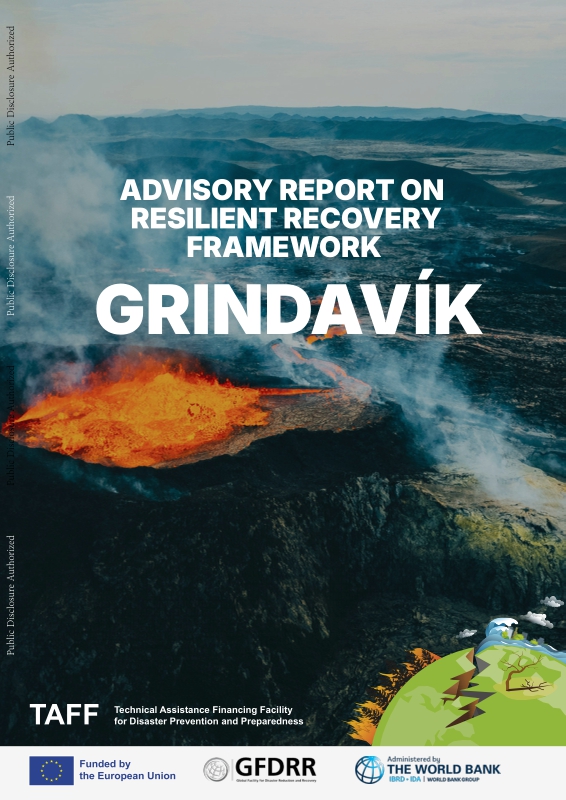
Title page 1
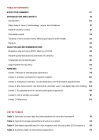
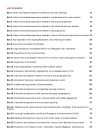
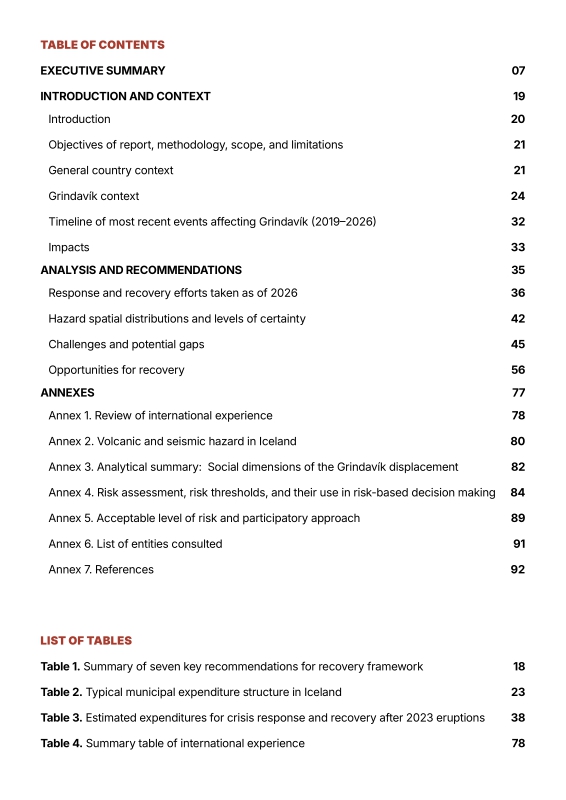
Contents 3
ACKNOWLEDGEMENTS 2
EXECUTIVE SUMMARY 9
INTRODUCTION AND CONTEXT 21
INTRODUCTION 22
OBJECTIVES OF REPORT, METHODOLOGY, SCOPE, AND LIMITATIONS 23
GENERAL COUNTRY CONTEXT 23
GRINDAVÍK CONTEXT 26
TIMELINE OF MOST RECENT EVENTS AFFECTING GRINDAVÍK (2019-2026) 34
IMPACTS 35
ANALYSIS AND RECOMMENDATIONS 37
RESPONSE AND RECOVERY EFFORTS TAKEN AS OF 2026 38
HAZARD SPATIAL DISTRIBUTIONS AND LEVELS OF CERTAINTY 44
CHALLENGES AND POTENTIAL GAPS 47
OPPORTUNITIES FOR RECOVERY 58
ANNEX 1. REVIEW OF INTERNATIONAL EXPERIENCE 80
ANNEX 2. VOLCANIC AND SEISMIC HAZARD IN ICELAND 82
ANNEX 3. ANALYTICAL SUMMARY: SOCIAL DIMENSIONS OF THE GRINDAVÍK DISPLACEMENT 84
ANNEX 4. RISK ASSESSMENT, RISK THRESHOLDS, AND THEIR USE IN RISK-BASED DECISION MAKING 86
ANNEX 5. ACCEPTABLE LEVEL OF RISK AND PARTICIPATORY APPROACH 91
ANNEX 6. LIST OF ENTITIES CONSULTED 93
ANNEX 7. REFERENCES 94
Tables 3
Table 1. Summary of seven key recommendations for recovery framework 20
Table 2. Typical municipal expenditure structure in Iceland 25
Table 3. Estimated expenditures for crisis response and recovery after 2023 eruptions 40
Table 4. Summary table of international experience 80
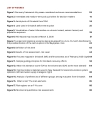
Figures 4
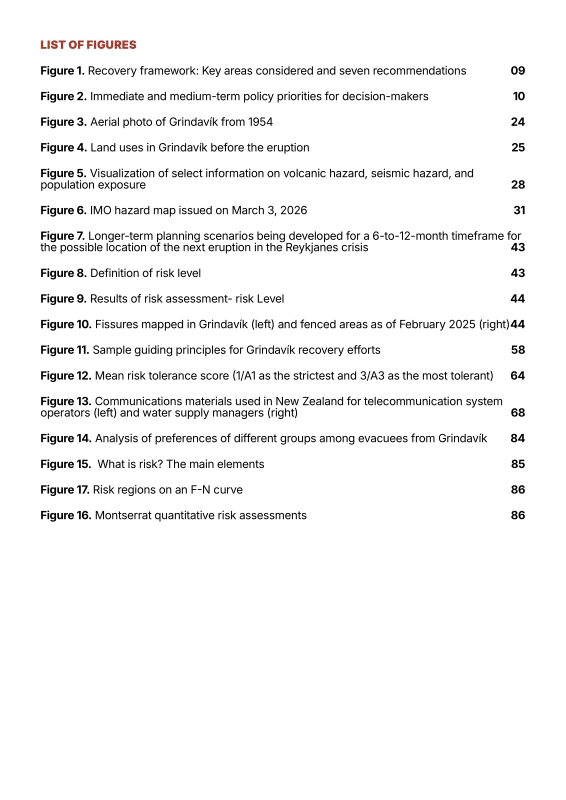
Figure 1. Recovery framework: Key areas considered and seven recommendations 11
Figure 2. Immediate and medium-term policy priorities for decision-makers 12
Figure 3. Aerial photo of Grindavík from 1954 26
Figure 4. Land uses in Grindavík before the eruption 27
Figure 5. Visualization of select information on volcanic hazard, seismic hazard, and population exposure 30
Figure 6. IMO hazard map issued on March 3, 2026 33
Figure 7. Longer-term planning scenarios being developed for a 6-to-12-month timeframe for the possible location of the next eruption... 45
Figure 8. Definition of risk level 45
Figure 9. Results of risk assessment- risk Level 46
Figure 10. Fissures mapped in Grindavík (left) and fenced areas as of February 2025 (right) 46
Figure 11. Sample guiding principles for Grindavík recovery efforts 60
Figure 12. Mean risk tolerance score (1/A1 as the strictest and 3/A3 as the most tolerant) 66
Figure 13. Communications materials used in New Zealand for telecommunication system operators (left) and water supply managers (right) 70
Figure 14. Analysis of preferences of different groups among evacuees from Grindavík 86
Figure 15. What is risk? The main elements 87
Figure 16. Montserrat quantitative risk assessments 88
Figure 17. Risk regions on an F-N curve 88
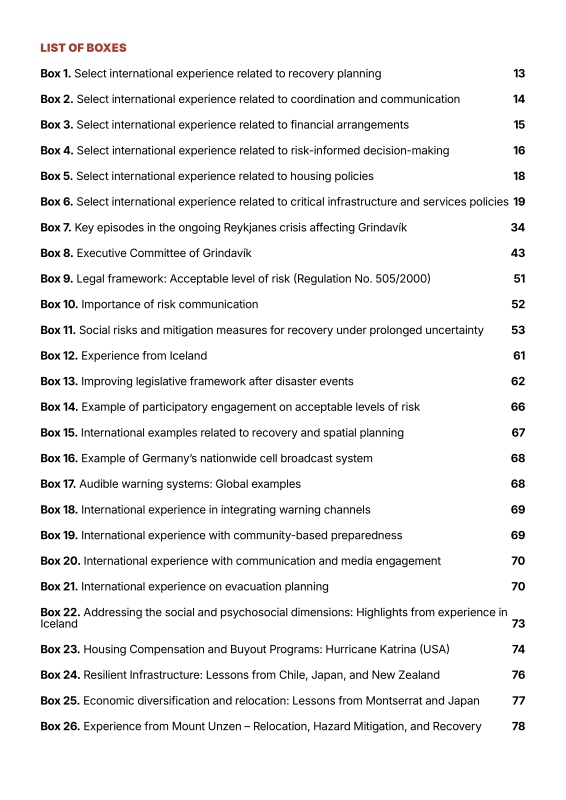
Boxes 5
Box 1. Select international experience related to recovery planning 13
Box 2. Select international experience related to coordination and communication 14
Box 3. Select international experience related to financial arrangements 15
Box 4. Select international experience related to risk-informed decision-making 16
Box 5. Select international experience related to housing policies 18
Box 6. Select international experience related to critical infrastructure and services policies 19
Box 7. Key episodes in the ongoing Reykjanes crisis affecting Grindavík 34
Box 8. Executive Committee of Grindavík 43
Box 9. Legal framework: Acceptable level of risk (Regulation No. 505/2000) 51
Box 10. Importance of risk communication 52
Box 11. Social risks and mitigation measures for recovery under prolonged uncertainty 53
Box 12. Experience from Iceland 61
Box 13. Improving legislative framework after disaster events 62
Box 14. Example of participatory engagement on acceptable levels of risk 66
Box 15. International examples related to recovery and spatial planning 67
Box 16. Example of Germany's nationwide cell broadcast system 68
Box 17. Audible warning systems: Global examples 68
Box 18. International experience in integrating warning channels 69
Box 19. International experience with community-based preparedness 69
Box 20. International experience with communication and media engagement 70
Box 21. International experience on evacuation planning 70
Box 22. Addressing the social and psychosocial dimensions: Highlights from experience in Iceland 73
Box 23. Housing Compensation and Buyout Programs: Hurricane Katrina (USA) 74
Box 24. Resilient Infrastructure: Lessons from Chile, Japan, and New Zealand 76
Box 25. Economic diversification and relocation: Lessons from Montserrat and Japan 77
Box 26. Experience from Mount Unzen - Relocation, Hazard Mitigation, and Recovery 78
*표시는 필수 입력사항입니다.
| 전화번호 |
|---|
| 기사명 | 저자명 | 페이지 | 원문 | 기사목차 |
|---|
| 번호 | 발행일자 | 권호명 | 제본정보 | 자료실 | 원문 | 신청 페이지 |
|---|
도서위치안내: / 서가번호:

우편복사 목록담기를 완료하였습니다.
*표시는 필수 입력사항입니다.
저장 되었습니다.
