
 대표어
대표어
 https://www.ifans.go.kr/knda/ifans/kor/pblct/PblctView.do?csrfPreventionSalt=null&pblctDtaSn=14760&menuCl=P18&clCode=P18&koreanEngSe=KOR&pclCode=&chcodeId=&searchCondition=searchAll&searchKeyword=&pageIndex=1
권호기사보기
| 기사명 | 저자명 | 페이지 | 원문 | 기사목차 |
|---|
결과 내 검색
동의어 포함
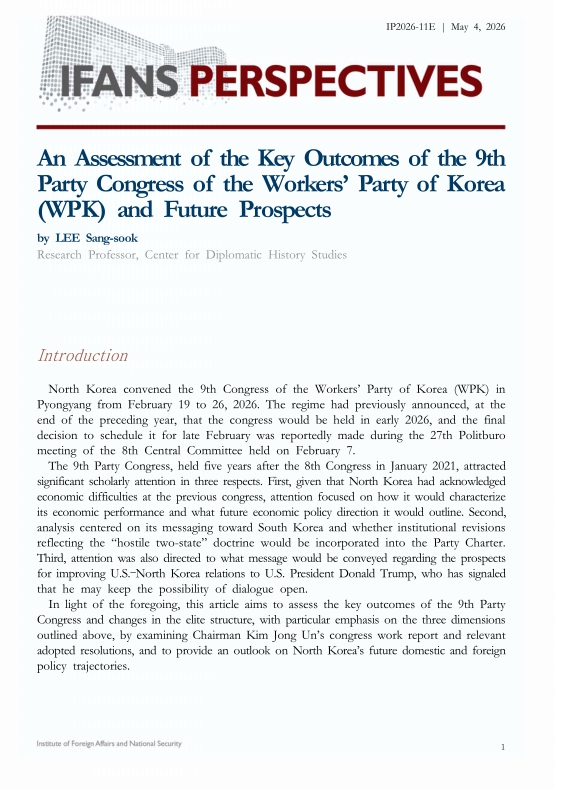
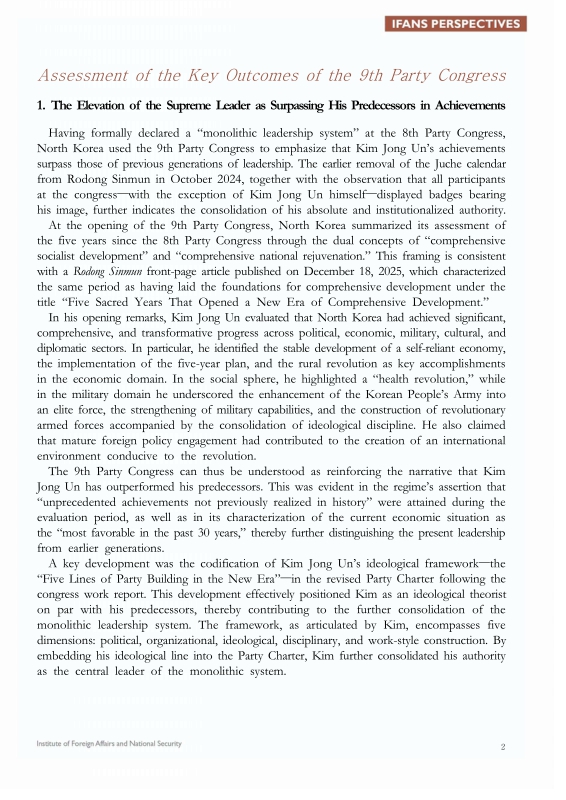
Contents 1
Introduction 1
Assessment of the Key Outcomes of the 9th Party Congress 2
1. The Elevation of the Supreme Leader as Surpassing His Predecessors in Achievements 2
2. Emphasis on the Irreversibility of Nuclear Status and the Simultaneous Strengthening of Nuclear and Conventional Forces 3
3. Completion of the Five-Year National Economic Development Plan and Intensification of Local Development Policies 3
4. Strategic Ambiguity in Foreign Relations and the Centrality of the Party Central Committee 4
Characteristics of Elite Change 5
1. Generational Change in the Central Committee and Alternate Members 5
2. The Rising Status of Diplomatic Elites 7
3. The Relative Declining Status of Military Elites 7
Outlook 8
1. De Facto Continuation of the Parallel Development of the Economy and Nuclear Forces 8
2. Concentration on Local Development and Expansion of the Defense Industry 8
3. Expanding Strategic Ambiguity in Relations with China and Russia 8
4. Continuation of the Hostile Two-State Doctrine and References to the Southern Border Line 9
5. Short-Term Strategic Distancing from the United States 9
6. Intensification of External Relations with the Global South 10
Policy Recommendations 10
1. Implementation of Proactive Peace-Building Measures 10
2. The Need for Alternative Conditions to Facilitate U.S.-North Korea Dialogue 10
3. Advancing South Korea-China Strategic Dialogue for the Stability of the Korean Peninsula 10
*표시는 필수 입력사항입니다.
| 전화번호 |
|---|
| 기사명 | 저자명 | 페이지 | 원문 | 기사목차 |
|---|
| 번호 | 발행일자 | 권호명 | 제본정보 | 자료실 | 원문 | 신청 페이지 |
|---|
도서위치안내: / 서가번호:

우편복사 목록담기를 완료하였습니다.
*표시는 필수 입력사항입니다.
저장 되었습니다.
