
 대표어
대표어
 https://documents.worldbank.org/en/publication/documents-reports/documentdetail/099082726110081614

권호기사보기
| 기사명 | 저자명 | 페이지 | 원문 | 기사목차 |
|---|
결과 내 검색
동의어 포함
Title page 1
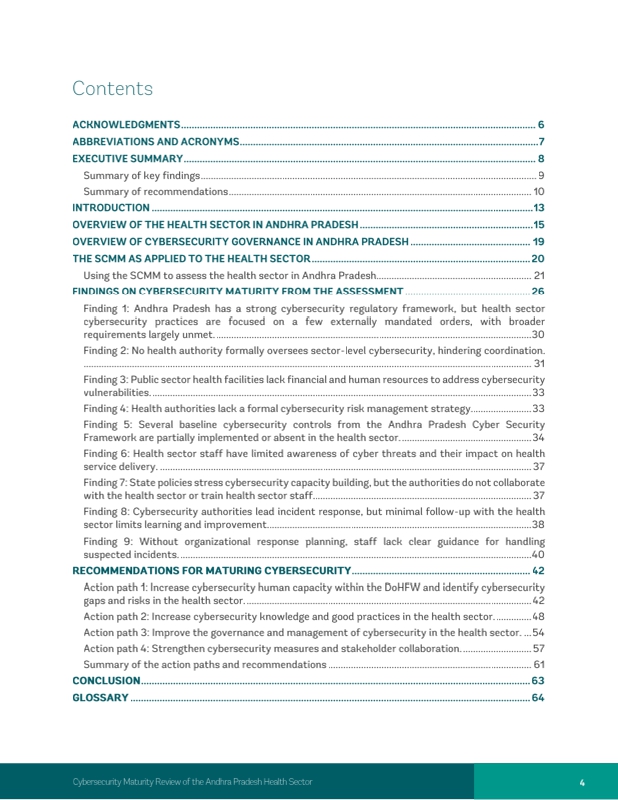
Contents 4
Acknowledgments 6
Abbreviations and Acronyms 7
Executive Summary 8
Summary of key findings 9
Summary of recommendations 10
Introduction 13
Overview of the Health Sector in Andhra Pradesh 15
Overview of Cybersecurity Governance in Andhra Pradesh 19
The SCMM as Applied to the Health Sector 20
Using the SCMM to assess the health sector in Andhra Pradesh 21
Findings on Cybersecurity Maturity from the Assessment 26
Finding 1: Andhra Pradesh has a strong cybersecurity regulatory framework, but health sector cybersecurity practices are focused on a few... 30
Finding 2: No health authority formally oversees sector-level cybersecurity, hindering coordination 31
Finding 3: Public sector health facilities lack financial and human resources to address cybersecurity vulnerabilities 33
Finding 4: Health authorities lack a formal cybersecurity risk management strategy 33
Finding 5: Several baseline cybersecurity controls from the Andhra Pradesh Cyber Security Framework are partially implemented or absent... 34
Finding 6: Health sector staff have limited awareness of cyber threats and their impact on health service delivery 37
Finding 7: State policies stress cybersecurity capacity building, but the authorities do not collaborate with the health sector or train health... 37
Finding 8: Cybersecurity authorities lead incident response, but minimal follow-up with the health sector limits learning and improvement 38
Finding 9: Without organizational response planning, staff lack clear guidance for handling suspected incidents 40
Recommendations for Maturing Cybersecurity 42
Action path 1: Increase cybersecurity human capacity within the DoHFW and identify cybersecurity gaps and risks in the health sector 42
Action path 2: Increase cybersecurity knowledge and good practices in the health sector 48
Action path 3: Improve the governance and management of cybersecurity in the health sector 54
Action path 4: Strengthen cybersecurity measures and stakeholder collaboration 57
Summary of the action paths and recommendations 61
Conclusion 63
Glossary 64
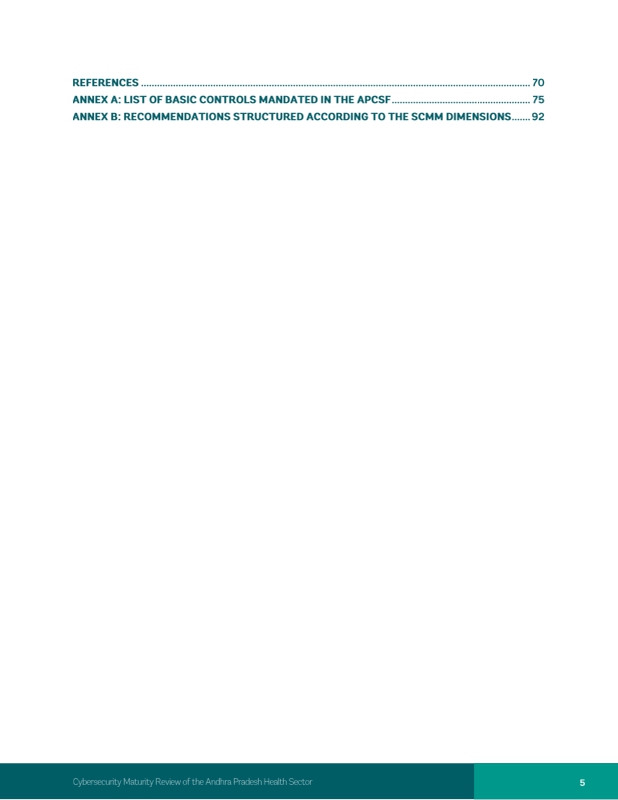
References 70
Annex A. List of Basic Controls Mandated in the APCSF 75
Annex B. Recommendations Structured According to the SCMM Dimensions 92
Figure 1. Structure of the Three-Tier Health Care Facilities in Andhra Pradesh 16
Figure 2. Mobile and Web Applications and Platforms at the Primary Care Level in Andhra Pradesh 17
Figure 3. Mapping of Stakeholders Assessed along Cybersecurity Lines of Responsibilities 22
Figure 4. Incident Response Life Cycle Model Based on the National Institute of Standards and Technology Cybersecurity Framework 2.0... 39
Figure 5. National Institute of Standards and Technology Incident Response Life Cycle 56
Boxes 23
Box 1. Levels of Assessment (LoAs) 23
Box 2. Overview of Activities That APTS Can Support 30
Box 3. Roles and Responsibilities of the Single Point of Contact 31
Box 4. Summary of the Incident Response Protocol Followed by the APCSOC 38
Box 5. Suggested Responsibilities of the Cybersecurity Specialists 43
Box 6. International Best Practice Example: Cybersecurity Information Platforms for the Health Sector in England 59
*표시는 필수 입력사항입니다.
| 전화번호 |
|---|
| 기사명 | 저자명 | 페이지 | 원문 | 기사목차 |
|---|
| 번호 | 발행일자 | 권호명 | 제본정보 | 자료실 | 원문 | 신청 페이지 |
|---|
도서위치안내: / 서가번호:

우편복사 목록담기를 완료하였습니다.
*표시는 필수 입력사항입니다.
저장 되었습니다.
