
 대표어
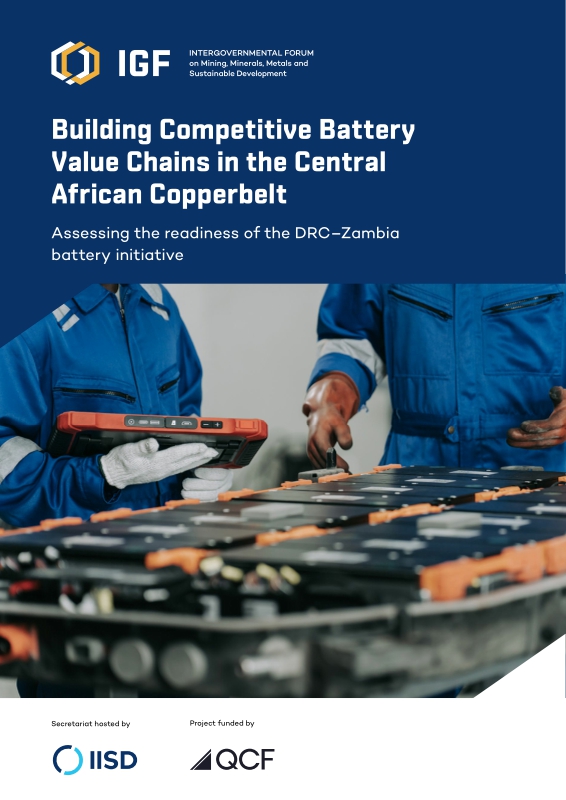
 https://www.iisd.org/publications/report/battery-value-chains-central-african-copperbelt
권호기사보기
| 기사명 | 저자명 | 페이지 | 원문 | 기사목차 |
|---|
결과 내 검색
동의어 포함
Title page 1
Contents 8
Acknowledgements 3
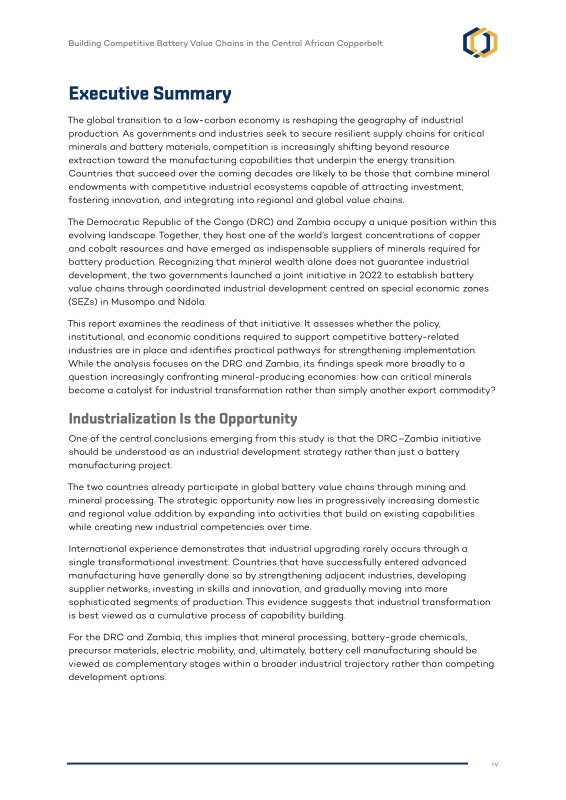
Executive Summary 4
1.0. Introduction 11
1.1. Why Battery Value Chains Matter for the Democratic Republic of the Congo and Zambia 11
1.2. Objectives of the Study 12
1.3. Research Methodology 13
2.0. Institutional Foundations of the DRC-Zambia Battery Initiative 14
2.1. Background to the Initiative 14
2.2. Key Agreements Underpinning the Initiative 15
2.2.1. The Cooperation Agreement for Manufacturing Batteries 15
2.2.2. The MoU Between the United States, DRC, and Zambia 15
2.2.3. The Framework Agreement for the Development of SEZs to Produce Electric Batteries in the DRC and Zambia 16
2.3. Strategic Vision and Industrial Development Model 16
2.3.1. Objectives of the Initiative 16
2.3.2. Targeted Value Chain Segments and Technologies 17
2.3.3. Implementation Strategies for the Development of the Battery Value Chain 19
2.4. Governance and Institutional Arrangements 19
2.4.1. The DRC-Zambia Battery Council 20
2.4.2. The African Centre of Excellence for Research and Innovation on Batteries 21
3.0. Progress Achieved and Current Status of Implementation 22
3.1. Development of CAEB 22
3.2. Pre-Feasibility Study 23
3.3. Development of the Musompo and Ndola Industrial Zones 23
3.3.1. Progress in the DRC 23
3.3.2. Progress in Zambia 24
3.3.3. Uneven Progress Across the Two Countries 25
3.3.4. Transparency and Stakeholder Engagement 25
3.3.5. Key Takeaways 25
3.4. Key Policy Frameworks Developing Mineral Value Chains in the DRC and Zambia 26
3.5. Coordination and Implementation Challenges Between the Two Countries 26
4.0. Lessons From International Experience 28
4.1. Industrial Ecosystems and the Role of SEZs 28
4.2. How Countries Built Competitive Industrial Ecosystems 29
4.2.1. Indonesia: Leveraging mineral endowment to build industrial capabilities 29
4.2.2. Morocco: Building competitive industrial platforms 29
4.2.3. Republic of Korea: Building skills and technological capabilities 30
4.2.4. Vietnam, Mauritius, and Dubai: Creating investor confidence 30
4.3. Key Lessons for the DRC-Zambia Initiative 32
4.4. Implications for the DRC-Zambia Battery Initiative 32
5.0. Assessing the Readiness of the DRC-Zambia Battery Initiative 33
5.1. Positioning the DRC and Zambia in Battery Value Chains 33
5.1.1. A Strong Position in Some Inputs, But Not in the Entire Value Chain 36
5.1.2. Regional Supply Chains Matter But Existing Refining Capacity Remains Weak 36
5.1.3. Existing Capabilities and Diversification Potential 37
5.2. The Strategic Positioning of Musompo and Ndola 37
5.2.1. Pathway 1: Midstream value addition - Building the industrial foundation 38
5.2.2. Pathway 2: Battery precursor and active material production - Moving into higher value addition 38
5.2.3. Pathway 3: Battery cell manufacturing 39
5.2.4. Pathway 4: Electric mobility and assembly industries - Creating regional markets 40
5.2.5. Assessment 41
5.3. Readiness of the Industrial Ecosystem 42
5.3.1. Governance and Institutional Readiness 42
5.3.2. Regulatory and Investment Readiness 43
5.3.3. Assessment 44
5.3.4. Infrastructure and Logistics Readiness 44
5.3.5. Assessment 46
5.3.6. Skills, Technology, and Innovation Readiness 47
5.3.7. Assessment 48
5.3.8. Access to Reliable and Affordable Energy 48
5.4. Sustainability, Finance, and Market Access Readiness 49
5.4.1. ESG and Social Licence 49
5.4.2. Access to Finance 50
5.4.3. Market Readiness 50
5.4.4. Strategic Partnerships 51
5.4.5. Assessment 52
5.5. Overall Readiness Assessment 52
6.0. Conclusions and Policy Recommendations 54
6.1. National Priorities for the DRC 55
6.1.1. Advance the Operationalization of the Musompo SEZ 55
6.1.2. Strengthen the Investment Environment 55
6.1.3. Expand Industrial Infrastructure and Energy 56
6.1.4. Strengthen Skills, Innovation, and Industrial Capabilities 56
6.1.5. Strengthen the Uptake of Standards and Community Engagement 56
6.2. National Priorities for Zambia 57
6.2.1. Strengthen the Positioning of the Ndola MFEZ 57
6.2.2. Continue Strengthening the Business and Investment Environment 58
6.2.3. Continue Investing in Infrastructure, Energy, and Skills 58
6.2.4. Strengthen Supplier Development and Industrial Linkages 58
6.3. Joint DRC-Zambia Priorities 59
6.3.1. Develop a Joint Industrialization Roadmap 59
6.3.2. Develop a Shared Market Strategy 60
6.3.3. Strengthen Joint Governance and Coordination 61
6.3.4. Strengthen Regional Trade and Investment Cooperation 61
6.4. Expanding the Initiative Into a Southern African Battery Ecosystem 63
6.4.1. Promote Complementary Industrial Capabilities Across Southern Africa 63
6.4.2. Develop Regional Public Goods for Industrial Development 64
6.4.3. Strengthen Regional Knowledge, Innovation, and Skills Networks 65
6.5. Strategic International Partnerships 66
6.5.1. Align Partnerships With Industrial Development Objectives 66
6.5.2. Diversify Partnerships to Strengthen Resilience 67
References 69
Appendix A. Gaps in Trade Facilitation Implementation in the Democratic Republic of the Congo and Zambia 79
FIGURE 1. The lithium-ion battery value chain 17
FIGURE 2. Lithium-ion battery value chain sales revenue forecast for 2030 18
FIGURE 3. Cathode battery chemistry demand, 2025-2040 18
FIGURE 4. The DRC-Zambia Battery Council governance structure 21
FIGURE 5. Location of SEZs at Musompo and Ndola, relative to key regional transport corridors 45
Boxes 9
BOX 1. INFRASTRUCTURE AS A COMPETITIVE ADVANTAGE-OR CONSTRAINT 46
BOX 2. POTENTIAL SPILLOVERS FOR LOCAL FIRMS AND WORKERS 47
BOX 3. STRATEGIC LESSONS FROM THE DRC-CHINA SICOMINES PARTNERSHIP 52
*표시는 필수 입력사항입니다.
| 전화번호 |
|---|
| 기사명 | 저자명 | 페이지 | 원문 | 기사목차 |
|---|
| 번호 | 발행일자 | 권호명 | 제본정보 | 자료실 | 원문 | 신청 페이지 |
|---|
도서위치안내: / 서가번호:

우편복사 목록담기를 완료하였습니다.
*표시는 필수 입력사항입니다.
저장 되었습니다.
