
 대표어
 https://documents.worldbank.org/en/publication/documents-reports/documentdetail/099101226054532238
권호기사보기
| 기사명 | 저자명 | 페이지 | 원문 | 기사목차 |
|---|
결과 내 검색
동의어 포함
Title page 1
Contents 6
Acknowledgements 4
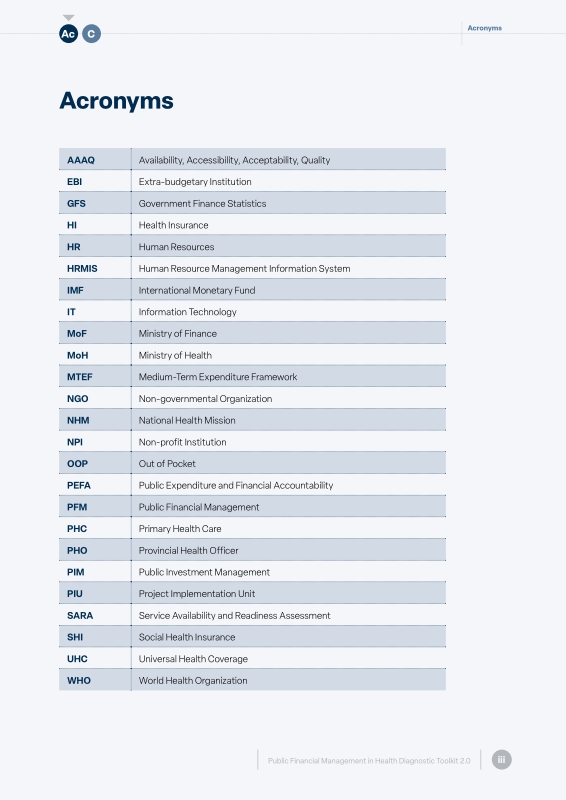
Acronyms 5
Executive Summary 8
1. Introduction 10
2. Conducting a FinHealth Assessment 12
2.1. Identification of Health Service Problem(s) 14
2.2. Mapping Organizations, Funding Flows, and PFM Rules Relevant to Selected Health Service Problem(s) 17
2.3. Causal Analysis: Identifying Bottlenecks and Their Root Causes 19
2.4. Formulating Recommendations 26
3. Guidance on Diagnosing PFM Bottleneck and Root Causes 31
3.1. Budget Preparation and Appropriation Bottlenecks 32
3.1.1. Integration of Planning and Budgeting is Inadequate 32
3.1.2. Inadequate Scrutiny of Baseline or New Spending 35
3.1.3. Budget Classification does Not Facilitate Allocation According to Government Priorities 36
3.1.4. Misalignment of Multi-year Budgets with Sectoral Needs 38
3.1.5. Lack of Budget Credibility 40
3.1.6. Rigidities in Budget Appropriations 43
3.1.7. Inadequate Planning and Budgeting for Public Sector Employment and Compensation 47
3.2. Budget Execution Bottlenecks 50
3.2.1. Flow of Funds Difficulties and Delays 50
3.2.2. Inadequate Budget Execution Controls 54
3.2.3. Deficiencies in Procurement Processes 55
3.2.4. Inadequate Inventory Management Practices 57
3.2.5. Weak Asset Management 58
3.2.6. Inadequate Capital Project Contract Management 60
3.2.7. Budget Supplementation is Too Difficult to Obtain 61
3.2.8. Challenges with payroll Implementation 63
3.3. Ex-post Reporting, Audit and Evaluation Bottlenecks 66
3.3.1. Inadequate Ex-post Financial Reporting 66
3.3.2. Absent or Weak Results Monitoring and Evaluation 67
3.4. Cross-Cutting PFM Bottlenecks 68
3.4.1. Multiple PFM Requirements are Associated with Different Funding Sources 68
3.4.2. PFM Mechanisms are Inconsistent with Strategic Purchasing Needs 69
3.4.3. Failure to Adequately Apply Formula-based Funding Models across Levels of Government 70
3.4.4. Dysfunctional Budgetary Transfers to Purchasers 72
References 74
Annex 1. Guidance on Mapping Organizations, Financing Flows and PFM Rules and Processes 77
Mapping Flows and Capturing Rule Environments 77
Mapping Funding Flows 77
Mapping PFM Rule Environment 78
Health System Mapping Definitions 80
Funding Source Definitions 83
Annex 2. Health Service Problems and Associated Bottlenecks Identified by FinHealth 1.0 Country Assessments 84
A2.1. There are demographic and/or regional inequalities in the provision of health services 84
A2.2. Patients remain untreated or experience long waiting times 85
A2.3. Adequate staffing is not available for health facilities and there is low staff productivity 87
A2.4. There is shortage and wastage of medical supplies 91
A2.5. Medical equipment is lacking and not fit for purpose 95
A2.6. Facility infrastructure is poorly maintained 98
Annex 3. Additional Reading regarding PFM Bottlenecks 101
Figure 2.1. Four Step FinHealth Assessment Process 12
Figure 2.2. Mapping Health Service Problems to PFM Bottlenecks and Root Causes in a Fishbone Diagram 13
Boxes 13
Box 2.1. Visualizing the Analysis of Health Service Problems, Bottlenecks, and Root Causes 13
Box 2.2. Is it a Health Service Problem, PFM Bottleneck, or Health Outcome? 14
Box 2.3. Available analytical frameworks from the literature to help identify service delivery problems 16
Box 2.4/Box 2.5. Illustrative Example: Translating a Bottleneck into a Recommendation 29
Figure A1.1. Sample flow of funds to service providers 79
Annex Boxes 80
Box A1.1. Illustrative example for capturing PFM rule environment 80
*표시는 필수 입력사항입니다.
| 전화번호 |
|---|
| 기사명 | 저자명 | 페이지 | 원문 | 기사목차 |
|---|
| 번호 | 발행일자 | 권호명 | 제본정보 | 자료실 | 원문 | 신청 페이지 |
|---|
도서위치안내: / 서가번호:

우편복사 목록담기를 완료하였습니다.
*표시는 필수 입력사항입니다.
저장 되었습니다.
