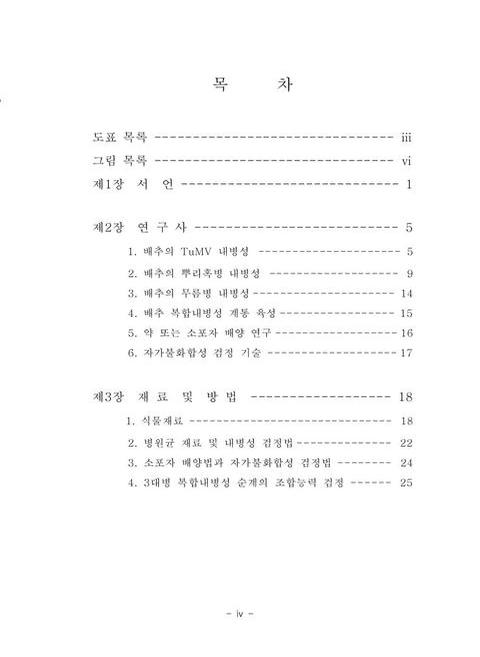
1. 배추의 TuMV 내병성 15
2. 배추의 뿌리혹병 내병성 19
3. 배추의 무름병 내병성 24
4. 배추 복합내병성 계통 육성 25
5. 약 또는 소포자 배양 연구 26
6. 자가불화합성 검정 기술 27
1. 식물재료 28
2. 병원균 재료 및 내병성 검정법 32
3. 소포자 배양법과 자가불화합성 검정법 34
4. 3대병 복합내병성 순계의 조합능력 검정 35
1 . 바이러스병과 뿌리혹병의 2대병해 복합내병성 계통 육성 36
2. 소포자 유래 개체의 자가불화합성 검정 42
3. TuMV , 뿌리혹병 및 무름병의 복합 내병성 계통 육성 46
4. TuMV와 뿌리혹병의 내병성의 유전분석 56
5. 무름병 내병성의 유전양식 분석 66
6. 복합내병성 순계를 이용한 F1조합 성능 검정 72
표목차1. Description of the code for plant material used in experiments 31
2. Screening for resistance to turnip mosasic virus and club root on 6 pedigree populations in Chinese cabbage 37
3. The x2-test for segregation ratio of clubroot and TuMV 39
4. Test of susceptability of soft rot resistant lines to clubroot and TuMV in Chinese cabbage 40
5. Effects of genotypes on embryo induction in microspore culture in Chinese cabbage 41
6. Selection of microspore-derived lines resistant to clubroot and TuMV in Chinese cabbage 44
7. Variations in some character of microspore-derived lines resistant to clubroot and TuMV in Chinese cabbage 45
8. Number of seeds from crossing between dual-resistant lines (TuMV and clubroot(CR)) and soft rot tolerant inbreds, 'SR-2' and 'SR-5' in Chinese cabbage 47
9. Microspore culture of 2 F1 hybrids holding tolerant genes to TuMV, clubroot and soft rot in Chinese cabbage 48
10. Classification of microspore-derived plants by the number of seeds produced in 2 F1 hybrids in Chinese cabbage 49
11. Screening microspore-derived inbreds from 2 mother parents for TuMV and clubroot in Chinese cabbage 51
12. Segregation in resistance and susceptability to TuMV-C4 of inbreds derived from microspore culture of 2 F1 crosses in Chinese cabbage 52
13. Frequency distribution of resistant and susceptible plants to TuMV and clubroot in parents, F1 , F2 , and backcross populations in Chinese cabbage 57
14. Frequency distribution of resistant and susceptible plants to clubroot in parents, F1, F2, and backcross populations in Chinese cabbage 58
15. Frequency distribution of resistant and susceptible plants to TuMV in parents, F1, F2, and backcross populations in Chinese cabbage 61
16. Frequency distribution of resistant and susceptible plants to TuMV in parents, F1, F2, and backcross populations in Chinese cabbage(retrial) 62
17. Frequency distribution of resistant and susceptible plants to TuMV in parents, F1, F2, and backcross populations in Chinese cabbage(3rd trial) 65
18. Frequency distribution of resistant and susceptible plants to TuMV in soft rot tolerant and susceptible inbreds in Chinese cabbage 65
19. Symptom length on mid-rib(A) and number of individuals that symptom were grown to the margianl end of tested ones(B) at each investigated time after inoculation of soft rot in parents, F1, F2, and backcross population in Chinese cabbage 68
20. Genetic analysis of soft rot resistance in Chinese cabbage 72
21. Combining ability test of selected multi resistant inbreds to TuMV, clubroot and soft rot diseases in Chinese cabbage 74
22. Heterosis in several characters of inbreds selected for resistance to TuMV, clubroot and soft rot disease in Chinese cabbage 75
1. Frequency of self-imcompatibility alleles of microspore-derived plants 42
2. Various doubled haploid lines resistant to TuMV and club root in Chinese cabbage 46
3. Distribution of inbreds by symptom length of soft rot in Chinese cabbage 54
4. Morphology of doubled haploid lines selected for multi-resistant to TuMV, clubroot and soft rot in Chinese cabbage 55
5. Frequency of plants by the symptom length grown after inoculation with soft rot pathogene to basal part of cut leaf in Chinese cabbage 71
6. Frequency of plants by the symptom length grown after inoculation with soft rot pathogene to basal part of cut leaf in Chinese cabbage 71

 대표어
대표어