
 대표어
대표어


권호기사보기
| 기사명 | 저자명 | 페이지 | 원문 | 기사목차 |
|---|
결과 내 검색
동의어 포함
국문목차
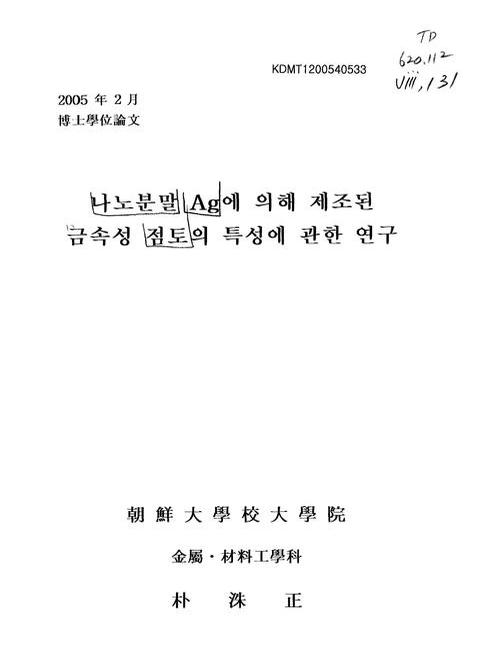
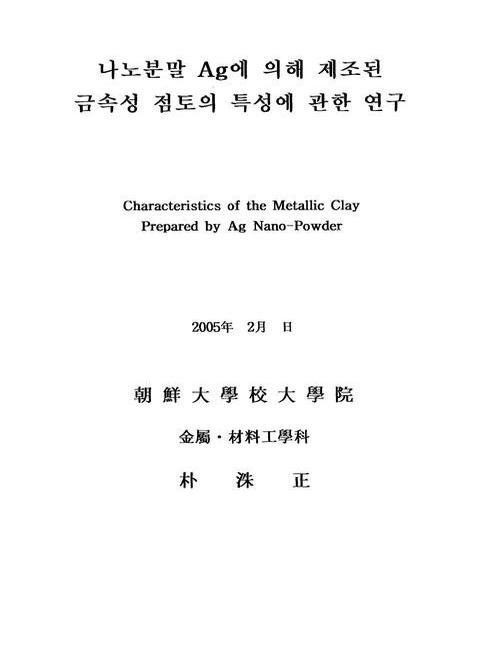
표제지=0,1,5
목차=0,6,3
LIST OF TABLES=I,9,1
LIST OF FIGURES=II,10,4
ABSTRACT=VI,14,3
제1장 서론=1,17,3
제2장 이론적 배경=4,20,1
제1절 나노 재료의 특성=4,20,5
제2절 나노 분말 합성 방법=9,25,1
1. 물리적 방법에 의한 나노 분말 합성=9,25,4
2. 화학적 방법에 의한 나노 분말 형성=12,28,4
3. 기타 나노 분말 합성방법=15,31,3
제3절 소결 단계=18,34,1
1. 소결의 초기 단계=18,34,2
2. 소결의 중기 단계=19,35,2
3. 소결의 말기 단계=20,36,2
제4절 나노 분말의 소결 거동=22,38,1
1. 나노 분말의 소결 거동=22,38,3
2. 응집체의 소결 거동=25,41,3
제3장 Ag 나노 분말 합성=28,44,1
제1절 서론=28,44,2
제2절 실험 방법=30,46,1
1. 환원제 첨가에 따른 나노 Ag 분말의 제조=30,46,2
2. 나노 Ag 분말의 특성 분석=32,48,1
제3절 결과 및 고찰=33,49,1
1. 환원제를 이용하여 생성된 Ag 분말의 특성=33,49,13
제4절 결론=46,62,1
제4장 분말의 크기에 따른 금속성 은점토의 소결특성=47,63,1
제1절 서론=47,63,1
제2절 실험 방법=48,64,1
1. 시료분말의 준비=48,64,6
2. 바인더 제조 및 점토 합성=53,69,4
3. 소결=56,72,3
4. 흡수율, 기공률 및 밀도 측정=59,75,3
5. 수축률 측정=62,78,1
6. 소결체의 회절 실험 및 결정구조=63,79,1
7. 조직 관찰=63,79,1
8. 경도 시험 및 인장시험=63,79,2
9. 충격 시험=64,80,3
제3절 결과 및 고찰=67,83,1
1. 바인더 양이 점토 특성에 미치는 영향=67,83,6
2. 흡수율, 기공률 및 밀도 측정=73,89,5
3. 소결시 시편장입온도에 따른 수축률=78,94,4
4. 소결시 수축률=82,98,3
5. 소결체의 회절 실험 및 결정구조=84,100,3
6. 조직 관찰=87,103,9
7. 경도시험 및 인장시험=95,111,8
8. 충격 시험=103,119,3
제4절 결론=106,122,2
제5장 금속 장신구 제작 공정의 분석=108,124,1
제1절 서론=108,124,2
제2절 제작 방법의 분석=110,126,1
1. 주조에 의한 제작=110,126,4
2. 수작업에 의한 제작=114,130,3
3. 금속성 은점토에 의한 제작=117,133,2
제3절 결론=119,135,1
제6장 총괄=120,136,4
참고문헌=124,140,5
감사의 글=129,145,2
저작물 이용 허락서=131,147,1
Fig1. Schematic representation of an equiaxed nano-crystalline metal distinguishing between the atoms associated with the individual crystal grains(filled circles) and those constituting the boundary network(open circles)6)(이미지 참조)=5,21,1
Fig2. Stress-strain curves for nanocrystalline (25 ㎚) (●) and coarse grained (50 ㎛)(□) copper sample=8,24,1
Fig3. The Layout of the Nano powder synthesis by an inert gas condensation=11,27,1
Fig4. The Cox Ni1-x Fe₂O₄ Nano powder synthesized by Glycothermal(이미지참조)=14,30,1
Fig5. The examples of Nano Powder synthesis device by gas reaction (The insertion of vaporable liquid with O₂ and addition of O₂ or air to the exterior angle)=16,32,1
Fig6. Dilatometric curves of the ultra-fine Fe powders; first cycle=23,39,1
Fig7. Dilatometric curves obtained with the classical Fe powder; second cycle=24,40,1
Fig8. Agglomeration efffect on developing a bimodal pore size, leading to shrinkage of the smaller pores and growth of the larger, intercluster pore=26,42,1
Fig9. Green density and sintered density of compacts pressed at 34MPa as a function of aggregate content=27,43,1
Fig10. Flow diagram for synthesis of Ag powders in the absence of surfactant=31,47,1
Fig11. Change in pH of the 0.01 M AgNO₃ solution with volume of NaBH₄ solution=34,50,1
Fig12. Change in pH of the 0.05 M AgNO₃ solution with volume of NaBH₄ solution=35,51,1
Fig13. XRD patterns of silver powders: (a) 0.01M AgNO₃ solution + 20㎖ NaBH₄ solution, (b) 0.01M AgNO₃ solution + 60㎖ NaBH₄ solution, (c) 0.01M AgNO₃ solution + 200㎖ NaBH₄ solution=37,53,1
Fig14. XRD patterns of silver powders: (a) 0.05M AgNO₃ solution + 20㎖ NaBH₄ solution, (b) 0.05M AgNO₃ solution + 50㎖ NaBH₄ solution, (c) 0.05M AgNO₃ solution + 200㎖ NaBH₄ solution=38,54,1
Fig15. TEM image of the 0.01 M AgNO₃ solution with volume of NaBH₄ solution=40,56,1
Fig16. TEM image of the 0.05 M AgNO₃ solution with volume of NaBH₄ solution=41,57,1
Fig17. Schematic diagram of size control and stabilization of Ag particels by adsorption of surfactant on the surface of particles=43,59,1
Fig18. TEM micrographs of nano-sized Ag particles=44,60,1
Fig19. Flow chart of Experimental Procedure=49,65,1
Fig20. TEM morphology of 50㎚ Ag powder=50,66,1
Fig21. TEM morphology of Nano aggregation Ag powder=51,67,1
Fig22. SEM morphology of 4.84㎛ Ag powder=52,68,1
Fig23. SEM morphology of 50㎛ Ag powder=54,70,1
Fig24. The surface of normal casting(SEM)=55,71,1
Fig25. The thermal history and atmosphere of sintering process=57,73,1
Fig26. The schematic description of sintering furnace and motordriven pusher=58,74,1
Fig27. The density measurement of the bulk=60,76,1
Fig28. Tensile test specimen=65,81,1
Fig29. Charpy V-notch impact test specimen=66,82,1
Fig30. The clay less added 0.6wt% to the amount of polymer binder=69,85,1
Fig31. The clay more added 0.8wt% to the amount of polymer binder=70,86,1
Fig32. The surface microstructure by H₂O influence in Sintering=71,87,1
Fig33. The surface microstructure by the added amount of polymer binder (after sintering)=72,88,1
Fig34. The absorption rate of specimen in sintered body and normal casting(%)=74,90,1
Fig35. The apparent porosity rate of specimen in sintered body and normal casting(%)=75,91,1
Fig36. The density of specimen in sintered body and normal casting(g/㎥)=76,92,1
Fig37. The relative density of specimen in sintered body and normal casting(g/㎥)=77,93,1
Fig38. The relation of the sintering speed and sinterability=81,97,1
Fig39. The dry shrinkage rate by sizes(%)=83,99,1
Fig40. The sintering shrinkage of specimen in sintered body and normal casting(%)=85,101,1
Fig41. X-ray diffraction after sintering of normal casting Ag and metallic Ag clay=86,102,1
Fig42. The surface microstructure of metallic Ag clay and normal casting Ag mixed with a binder(SEM)=88,104,1
Fig43. The microstructure of normal casting Ag(SEM)=89,105,1
Fig44. The internal microstructure after sintering(800℃~10min) of metallic Ag clay(50㎛) (SEM)=90,106,1
Fig45. The microstructure of metallic Ag clay(50㎛)(after sintering-SEM)=91,107,1
Fig46. The microstructure of metallic Ag clay according to the sintering temperature(SEM)=92,108,1
Fig47. The examination of metallic Ag clay(50㎛) after sintering(870℃~5min)=94,110,1
Fig48. The surface microstructure of metallic Ag clay(50㎛) according to sintering temperature(SEM)=96,112,1
Fig49. The surface microstructure of metallic Ag clay(4.84㎛) according to sintering temperature(SEM)=97,113,1
Fig50. The hardness data according to the sintering temperature=98,114,1
Fig51. Variation in tensile strength of the specimens after sintering(870℃)=100,116,1
Fig52. The fracture surface of specimen after tensile test of sintering body and normal casting(SEM)=101,117,1
Fig53. The fracture surface of specimen after tensile test of 50㎛ sintering body(870℃~10min) and normal casting(SEM)=102,118,1
Fig54. Charpy Impact Value=104,120,1
Fig55. SEM micrographs showing the Fracture surface microstructures of Charpy impact test=105,121,1
Fig56. The omaments-making process by lost wax casting=113,129,1
Fig57. The omaments-making process by hand=116,132,1
Fig58. The omaments-making process using metallic Ag clay=118,134,1
jpg
Fig18. TEM micrographs of nano-sized Ag particles=44,60,1
Fig24. The surface of normal casting(SEM)=55,71,1
Fig27. The density measurement of the bulk=60,76,1
Fig32. The surface microstructure by H₂O influence in Sintering=71,87,1
Fig33. The surface microstructure by the added amount of polymer binder (after sintering)=72,88,1
Fig42. The surface microstructure of metallic Ag clay and normal casting Ag mixed with a binder(SEM)=88,104,1
Fig43. The microstructure of normal casting Ag(SEM)=89,105,1
Fig44. The internal microstructure after sintering(800℃~10min) of metallic Ag clay(50㎛) (SEM)=90,106,1
Fig45. The microstructure of metallic Ag clay(50㎛)(after sintering-SEM)=91,107,1
Fig46. The microstructure of metallic Ag clay according to the sintering temperature(SEM)=92,108,1
Fig47. The examination of metallic Ag clay(50㎛) after sintering(870℃~5min)=94,110,1
Fig48. The surface microstructure of metallic Ag clay(50㎛) according to sintering temperature(SEM)=96,112,1
Fig49. The surface microstructure of metallic Ag clay(4.84㎛) according to sintering temperature(SEM)=97,113,1
Fig52. The fracture surface of specimen after tensile test of sintering body and normal casting(SEM)=101,117,1
Fig53. The fracture surface of specimen after tensile test of 50㎛ sintering body(870℃~10min) and normal casting(SEM)=102,118,1
Fig55. SEM micrographs showing the Fracture surface microstructures of Charpy impact test=105,121,1
*표시는 필수 입력사항입니다.
| 전화번호 |
|---|
| 기사명 | 저자명 | 페이지 | 원문 | 기사목차 |
|---|
| 번호 | 발행일자 | 권호명 | 제본정보 | 자료실 | 원문 | 신청 페이지 |
|---|
도서위치안내: / 서가번호:

우편복사 목록담기를 완료하였습니다.
*표시는 필수 입력사항입니다.
저장 되었습니다.
