
 대표어
대표어
권호기사보기
| 기사명 | 저자명 | 페이지 | 원문 | 기사목차 |
|---|
결과 내 검색
동의어 포함
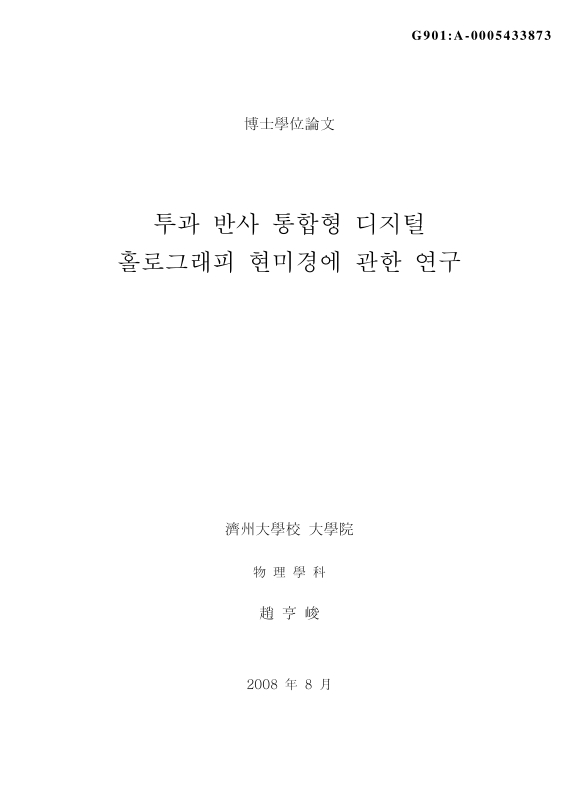
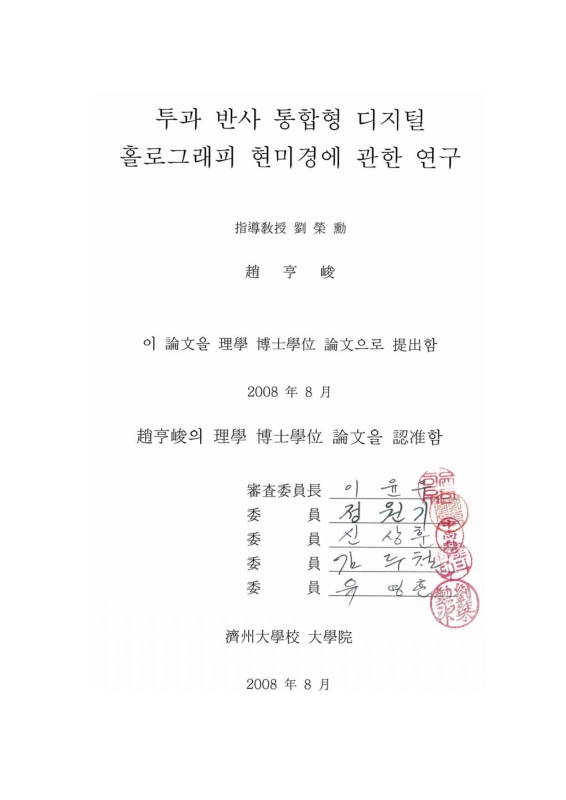
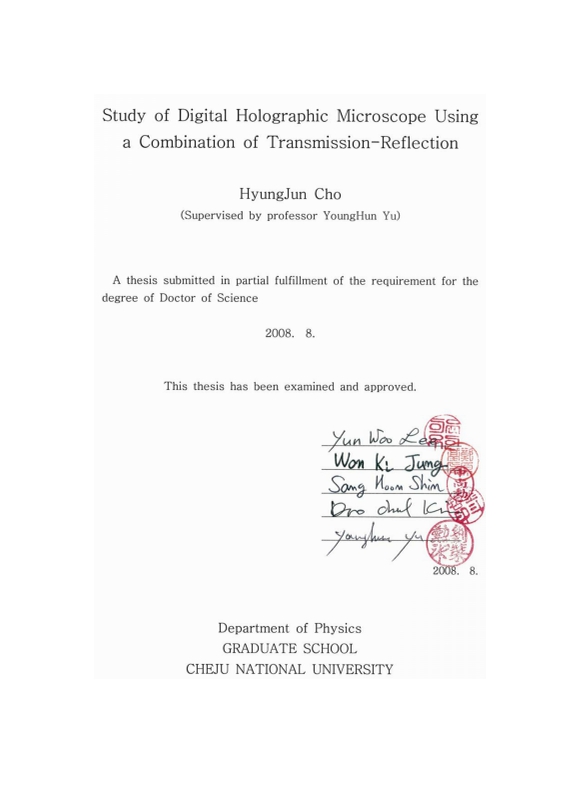
표제지
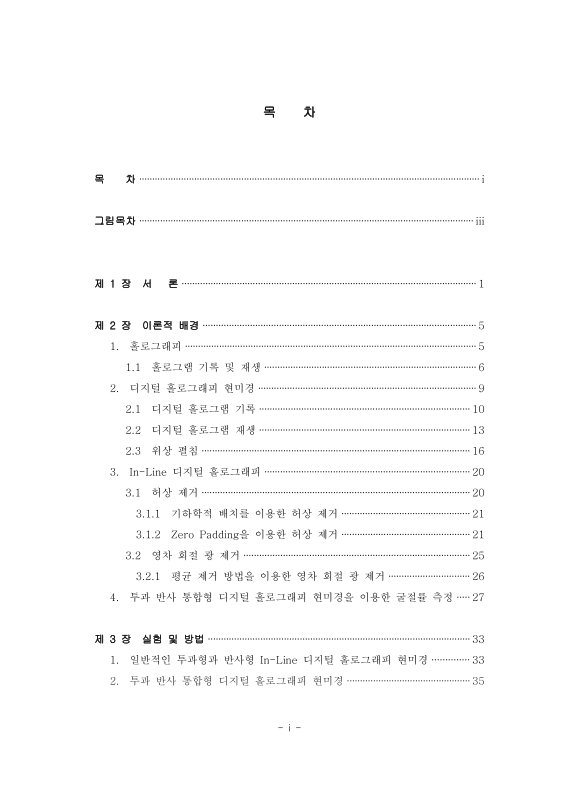
목차
제1장 서론 11
제2장 이론적 배경 15
1. 홀로그래피 15
1.1. 홀로그램 기록 및 재생 16
2. 디지털 홀로그래피 현미경 19
2.1. 디지털 홀로그램 기록 20
2.2. 디지털 홀로그램 재생 23
2.3. 위상펼침 26
3. In-Line 디지털 홀로그래피 30
3.1. 허상 제거 30
3.2. 영차 회절 광 제거 35
4. 투과 반사 통합형 디지털 홀로그래피 현미경을 이용한 굴절률 측정 37
제3장 실험 및 방법 43
1. 일반적인 투과형과 반사형 In-Line 디지털 홀로그래피 현미경 43
2. 투과 반사 통합형 디지털 홀로그래피 현미경 45
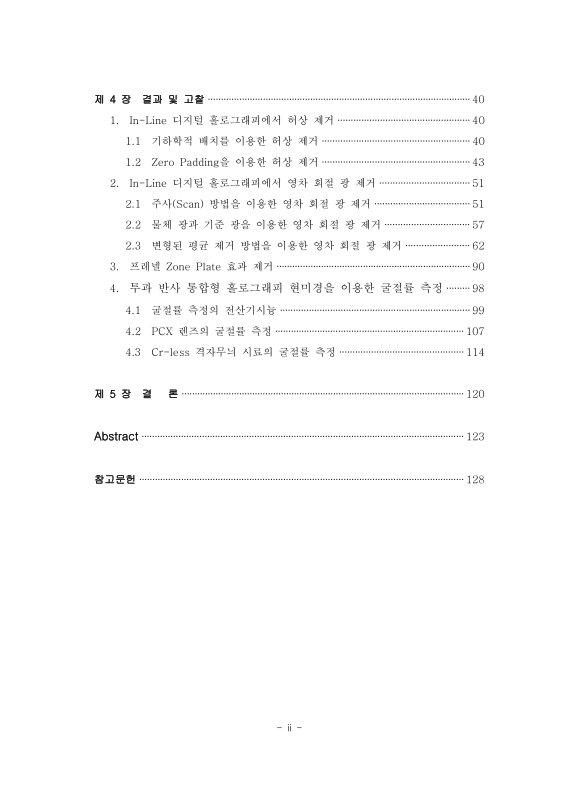
제4장 결과 및 고찰 50
1. In-Line 디지털 홀로그래피에서 허상 제거 50
1.1. 기하학적 배치를 이용한 허상 제거 50
1.2. Zero Padding을 이용한 허상 제거 53
2. In-Line 디지털 홀로그래피에서 영차 회절 광 제거 61
2.1. 주사(Scan) 방법을 이용한 영차 회절 광 제거 61
2.2. 물체 광과 기준 광을 이용한 영차 회절 광 제거 67
2.3. 변형된 평균 제거 방법을 이용한 영차 회절 광 제거 72
3. 프레넬 Zone Plate 효과 제거 100
4. 투과 반사 통합형 홀로그래피 현미경을 이용한 굴절률 측정 108
4.1. 굴절률 측정의 전산기시늉 109
4.2. PCX 렌즈의 굴절률 측정 117
4.3. Cr-less 격자무늬 시료의 굴절률 측정 124
제5장 결론 130
Abstract 133
참고문헌 138
감사의 글 144
Fig. 2.1. Hologram Recording. 17
Fig. 2.2. Hologram Reconstruction. 18
Fig. 2.3. Configuration of Digital Hologram Microscope and Image Reconstruction. MO : magnification lens, R : reference wave, O : object wave, b : distance between object and lens, c : distance between CCD and lens, d : distance between CCD and image... 21
Fig. 2.4. Two-Dimensional Sampling by CCD. 22
Fig. 2.5. Geometry for Hologram Reconstruction. x-y: hologram plane, ξ-n: reconstruction plane, d: reconstruction distance, ■(ξ,n): reconstructed wave front.(이미지참조) 24
Fig. 2.6. Hologram Recording and Reconstruction. 28
Fig. 2.7. Phase Unwrapping. 29
Fig. 2.8. Problem of Digital Encoding. Phase-Contrast Image(a), and Error(b) by 8-Bit-Encoded Numbers. 29
Fig. 2.9. Wave Path of real image and virtual image. solid line : wave path of real image, dotted line : wave path of virtual image, MO : magnification lens, c : distance between CCD and lens, d : distance between CCD and image plane. 32
Fig. 2.10. Reconstructed Virtual Image Size. 33
Fig. 2.11. Hologram Recording and Reading Mechanism in the In-Line Holographic Microscopy. 34
Fig. 2.12. Phase of Digital Holographic Microscopy. 38
Fig. 2.13. Thickness of 3D Reconstruction Image. 40
Fig. 3.1. Schematic of Digital Holographic Microscopy. VN : variable density filter, BS : beam spliter, M : mirror, O : object wave, R : reference wave, BE : beam expander with spatial filter, ML : microscope objective lens. 44
Fig. 3.2. Digital Holographic Microscopy Using a Combination of Transmission-Reflection. VN : variable density filter, BS : beam spliter, M : mirror, BEL1 and BEL2 : lens for beam expander P : pin hole, ML : microscope objective lens, MTS : transmission and reflection selection... 46
Fig. 3.3. Transmission and Reflection Selection Component. 47
Fig. 3.4. Beam Pass of Transmission and Reflection. 48
Fig. 4.1. Reconstructed Image in case c+d=57cm. (unit : cm ) 51
Fig. 4.2. Hologram and Reconstructed Image when c=d. (a) hologram, (b) reconstructed image with 0th remove, (c) reconstructed image without 0th remove.(이미지참조) 52
Fig. 4.3. (a) Hologram and (b) Reconstructed image. 54
Fig. 4.4. Hologram images constructed by the combination of a reference beam and an objective beam that is passed through the objective lens without objects. 55
Fig. 4.5. Hologram images constructed by the combination of a reference beam and an objective beam that is passed through the objective lens with objects. 56
Fig. 4.6. Zero Padding of Hologram. 57
Fig. 4.7. Reconstructed of each area in A, B, C, D. 58
Fig. 4.8. Reconstructed image obtained by a Zero Padding method. 59
Fig. 4.9. Reconstructed Image after Suppression of DC term. (a) Hologram, (b) Reconstruction Image, (c) area (b). 62
Fig. 4.10. Scanning Method. 62
Fig. 4.11. Hologram Information by Scanning Method. 63
Fig. 4.12. Hologram by Scanning Method. 64
Fig. 4.13. Hologram Reconstruction by Scanning Method. 65
Fig. 4.14. Reconstructed Image with Hologram Eliminated Object Wave and Zero-Order Diffraction. (a) hologram, (b) object image at CCD, (c) reconstructed image with hologram eliminated object wave, (d) reconstructed image with hologram eliminated object wave and zero-order... 68
Fig. 4.15. Reconstructed Image by Using Numerical Zero Order Diffraction Elimination Filter and Object Wave Elimination from Hologram. Cut-off frequencies of filter are 0 (a) and 50 (b). 69
Fig. 4.16. Reconstructed Image with Hologram, which is Eliminated Object and Reference Wave. (a) hologram, (b) intensity of object wave, (c) intensity of reference wave, (d) reconstructed image with hologram, which is eliminated object and reference wave, (e)... 71
Fig. 4.17. DC term Suppression Hologram by Subtracting Average Intensity. 73
Fig. 4.18. Reconstruction of Fig. 4.17. 74
Fig. 4.19. Enlarge of Fig. 4.18 in Dotted Line. 75
Fig. 4.20. Number of Pixel for Average. 77
Fig. 4.21. DC term Suppression Hologram by Subtracting variable Pixels Average Intensity. 78
Fig. 4.22. Reconstruction of Fig. 4.17. 79
Fig. 4.23. Suppression Rate of Total Pixels Intensity. 80
Fig. 4.24. Fourier Transform of Fig. 4.5. 81
Fig. 4.25. Fourier Transform of Fig. 4.21. 82
Fig. 4.26. Low Frequency Rate. 83
Fig. 4.27. Hologram images by 50× Objective Lens. 86
Fig. 4.28. DC term Suppression Hologram by Subtracting variable Pixels Average Intensity. 87
Fig. 4.29. Suppression of Total Pixels Intensity. 88
Fig. 4.30. Fourier Transform of Fig. 4.27. 89
Fig. 4.31. Fourier Transform of Fig. 4.28. 90
Fig. 4.32. Low Frequency Rate. 91
Fig. 4.33. Reconstruction with DC Term Suppressed Hologram by average Intensity Subtracted of Constant Pixels Number. 93
Fig. 4.34. Reconstruction with DC Term Suppressed Hologram by average Intensity Subtracted of Constant Pixels Number. 94
Fig. 4.35. A of Fig. 4.33(a) and Fig. 4.34(a). 95
Fig. 4.36. B of Fig. 4.33(a) and Fig. 4.34(a). 96
Fig. 4.37. MTF of Fig. 4.35. 97
Fig. 4.38. MTF of Fig. 4.36. 98
Fig. 4.39. Hologram images constructed by the combination of a reference beam and an objective beam that is passed through the objective lens without objects. 101
Fig. 4.40. Phase Reconstruction images constructed by Fig. 4.20. 102
Fig. 4.41. Phase Unwrapping images constructed by Fig. 4.39. 103
Fig. 4.42. Fresnel Zone Plate Elimination. 104
Fig. 4.43. Fresnel Zone Plate Elimination after 10 Minute. 106
Fig. 4.44. Fresnel Zone Plate Elimination after 1 Day. 107
Fig. 4.45. Plano-Convex Lens. 110
Fig. 4.46. Hologram of Plano-Convex Lens. 112
Fig. 4.47. Phase Reconstruction of Fig. 4.46. 114
Fig. 4.48. Phase Unwrapping of Fig. 4.47. 115
Fig. 4.49. Refractive Index Restoration. 116
Fig. 4.50. Hologram of Plano-Convex Lens. 118
Fig. 4.51. Phase Reconstruction of Plano-Convex Lens. 119
Fig. 4.52. Phase Unwrapping of Fig. 4.51. 120
Fig. 4.53. Distribution of Refractive Index. 122
Fig. 4.54. Refractive Index of Dotted Line in Fig. 4.53. 123
Fig. 4.55. Cr-less Pattern Spider Mask. 125
Fig. 4.56. Hologram of Cr-less Pattern Spider Mask. 126
Fig. 4.57. Phase Unwrapping of Fig. 4.40. 127
Fig. 4.58. Refractive Index Restoration. 128
Since nano technology was introduced recently, it has been used in studies on material characteristics of non-organism such as carbon nanotube, single electron transistor and semi-conductor. However lately nano technology has been applied to biology for understanding physical and chemical phenomenon of a molecular. It is expected to raise the revolutionary change throughout bio technology such as biology and medicine. But, the past nano technology has been restricted for applying to biology and medicine which must observe a living body in real time.
Digital holographic technology has been developed for the last three decades to apply to In-Vivo inspection, encrypting technology, 3D vision, and holographic microscope. We call it 'digital holographic technology' that reconstructs 3D image of hologram recorded in CCD(Charged Coupled Device) with using numerical diffraction calculation. This technology was proposed by Goodman and Laurence, and realized by Kronrod et al. The biggest difference in classic holography and digital holography is the hologram recorder and 3D image reconstruction method. A recorder can abbreviate chemical hologram process, and record the hologram data in real time with using digital image recorder such as CCD instead of holography photo-plate. Also digital holography can get spatial benefit, and moreover, save, copy and edit the measured results. And unlike classic holography that reconstructs 3D image by optical method, digital holography reconstructs 3D image by computer. Digital holographic technology has more interest in large number of applications for a high resolution real-time 3D observation when the technology of computer & digitial recorder has developed remarkably.
However, we have some difficulty in embodying the image with good signal to noise ratio because DC term including zero-order suppression and twin image work as noise when the image is reconstructed numerically with using hologram from CCD. Holography is classified with an in-line hologram and an off-axis hologram by the incidence angle of reference beam. Gabor developed in-line hologram for the first time. Its incidence angle of reference beam to objective beam is 0°.
In the in-line hologram, it is difficult to provide a clear image because real image, virtual image, and DC term can be superposed. These problems were solved by off-axis hologram designed by Leith and Upatnieks. We call it when reference beam enters with angle, and real image, virtual image, and DC term are separated spatially. However, a real image in off-axis is reconstructed within only 1/4 of reconstruction zone. For that reason, it has a bad effect on FOV(Field Of View) of digital holography because resolution of digital holography recorder is less than 50 lines/mm . Virtual image and DC term must be removed with using in-line hologram to get a high resolution image.
Also, in case of measurement using the light, refractive index is an important factor. The 3D depth information is distorted as much as the difference in refractive index because each organizer in a living body provides the various refractive index. Furthermore, refractive index can give the information to convert the density of materials reversely. This is useful information in test of sorts, densities of a living body, and defect of materials. Only the Ellipsometry can measure object's structure and refractive index simultaneously. However, Ellipsometry can provide a fragmentary information of film thickness, but composes a 3D image. Also its measuring time is very long because it is a scan type. Until now, there is no report about any study on measuring a real 3D structure and a refractive index simultaneously.
This study was performed to construct an in-line digital holographic microscope to embody the highest resolution of CCD, and to research the method of removing integrated virtual image and DC term effectively. And, in this study I measured 3D structure and refractive index simultaneously by constructing digital holographic microscope using a combination of transmission-reflection.
At first, for the case of removing virtual image, I researched the virtual image removal method using geometric arrangement and the virtual image removal method using a zero padding method. The virtual image removal method using geometric arrangement is to use the phenomenon that virtual image size is minimized with considering the distance from lens to CCD, and the distance from CCD to a reconstructed plane. This method uses specific property in holography using a lens. However, in case of removing real image with a geometric method, there is some constraint in the measurement and reconstruction process. We studied the virtual image removal method using a zero padding method that was studied to complement this problem. The virtual image removal method using a zero padding method uses also specific property in holography using a lens. In an in-line digital holographic microscope, because the interference information is recorded in a hologram with some local limitation, the reconstructed image also is locally limited. That is to say, if we reconstruct each of hologram after dividing hologram into 4 domains, then we can get each of reconstruction image whose virtual image and real image are separated. Futhermore, if we combine 4 domains after selecting only the real images, then we can get a 3D image without virtual image. The virtual image removal method using a zero padding method has no dependence on hardware, and also exerts immaterial influence on reconstruction speed.
In case of removing DC term, because its intensity is very strong, much more than that of virtual image, DC term must be removed to embody the image with higher signal to noise ratio. In this study, it researched zero-order suppression method using scanning, zero-order suppression method using object beam & reference beam, and zero-order suppression method using the average removal method to remove DC term. Zero-order suppression method using scanning is to construct a hologram selectively by moving a subject of zero-order suppression, and remove zero-order beam.
When using this method, it is inconvenient more than other methods because it needs experimentally repetitive hologram saving and repetitive calculation, but it can remove DC term effectively. Zero-order suppression method using object beam and Reference Beam is to eliminate the intensity of reference beam and object beam from the hologram intensity. This method can provide a hologram without the DC term removed by eliminating zero-order beam and object beam. Because this method doesn't use a scanning method, it gives repetitive work inconveniency. But an object beam and a reference beam must be measured whenever we measure a subject. And refractive index of zero-order beam is significant as compared to scanning. Zero-order suppression using the average removal method is used widely because it can remove DC term with measuring a hologram once the reconstruction speed is fast, and the removal efficiency of DC term is relatively higher. The average removal method is to calculate the average of hologram intensity and then to extract the average for removing DC term. However, if we lower the average range(number of pixel to calculate the average), then DC term elimination rate will be improved. But at the same time, the high frequency region will be removed too. I researched the variable average removal method. This method is applied with the average range within a low frequency region and a high frequency region of hologram by grade. In consequence, we have minimized the loss of real image with maintenance DC term elimination rate.
Furthermore, I developed a digital holographic microscope using a combination of transmission-reflection by combining transmission holographic microscope that is influenced by refractive index and reflection holographic microscope that is not influenced by refractive index, and then measured the 3D images and refractive index simultaneously.*표시는 필수 입력사항입니다.
| 전화번호 |
|---|
| 기사명 | 저자명 | 페이지 | 원문 | 기사목차 |
|---|
| 번호 | 발행일자 | 권호명 | 제본정보 | 자료실 | 원문 | 신청 페이지 |
|---|
도서위치안내: / 서가번호:

우편복사 목록담기를 완료하였습니다.
*표시는 필수 입력사항입니다.
저장 되었습니다.
